

Hydromechanics 7.3 Hydrodynamics 171
Part A | 7.3
@w
@t
C u
@w
@x
C v
@w
@y
C w
@w
@z
D
@W e
@t
C U e
@W e
@x
C W e
@W e
@z
C
@
2
w
@y 2 ;
(7.75)
@u
@x
C
@v
@y
C
@w
@z
D 0 :
(7.76)
For steady two-dimensional flow over a flat plate
with its upstream edge at x D 0 and U e D .U e ; 0; 0/,
where U e is a constant, a well-known Blasius similarity solution [7.16] for the flow in the boundary layer is obtained upon introducing the similarity
variable Á D y
p
U=.2x/ as u D U e F
0
.Á/, and v D
p
U=.2x/.ÁF
0
F/, where F.Á/ satisfies
F
000
C FF
00
D 0; F.0/ D F
0
.0/ D 0 ;
F
0
.1/ D 1 :
(7.77)
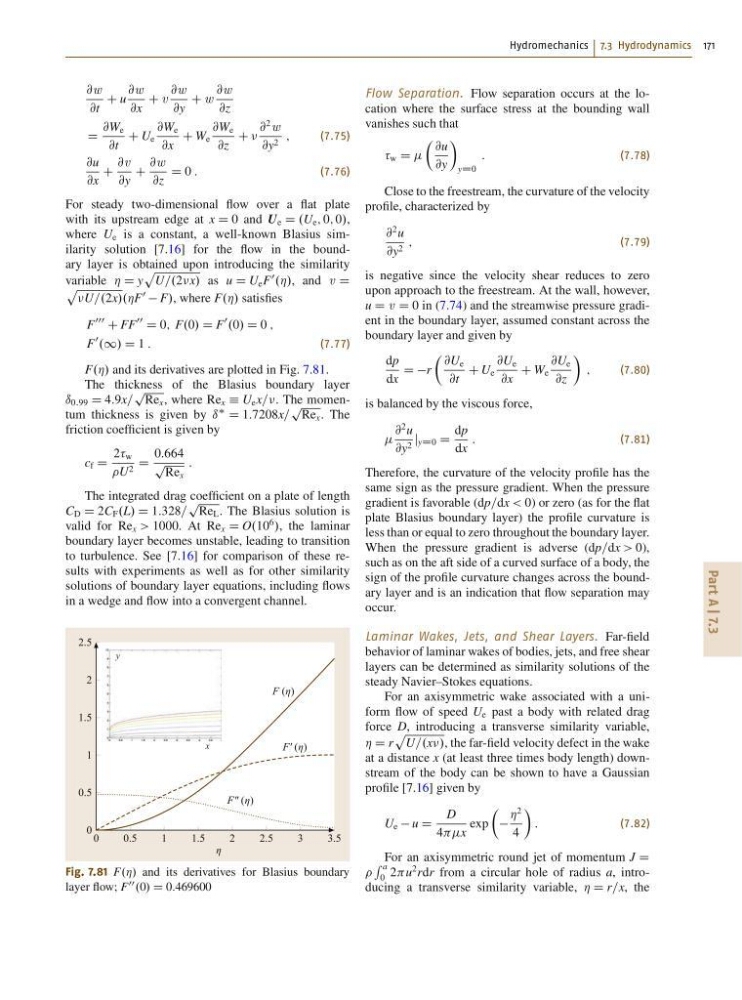
F.Á/ and its derivatives are plotted in Fig. 7.81.
The thickness of the Blasius boundary layer
ı 0:99 D 4:9x=
p
Re x , where Re x Á U e x==. The momentum thickness is given by ı
D 1:7208x=
p
Re x . The
friction coefficient is given by
c f D
2 w
U 2 D
0:664
p
Re x
:
The integrated drag coefficient on a plate of length
C D D 2C F .L/ D 1:328=
p
Re L . The Blasius solution is
valid for Re x > 1000. At Re x D O.10
6
/, the laminar
boundary layer becomes unstable, leading to transition
to turbulence. See [7.16] for comparison of these results with experiments as well as for other similarity
solutions of boundary layer equations, including flows
in a wedge and flow into a convergent channel.
0
0.5
1
1.5
2
2.5
F (η)
F′ (η)
F″ (η)
3
3.5
η
y
x
2.5
2
1.5
1
0.5
0
Fig. 7.81 F.Á/ and its derivatives for Blasius boundary
layer flow; F
00
.0/ D 0:469600
Flow Separation. Flow separation occurs at the location where the surface stress at the bounding wall
vanishes such that
w D
 @u
@y
Ã
yD0
:
(7.78)
Close to the freestream, the curvature of the velocity
profile, characterized by
@
2 u
@y 2 ;
(7.79)
is negative since the velocity shear reduces to zero
upon approach to the freestream. At the wall, however,
u D v D 0 in (7.74) and the streamwise pressure gradient in the boundary layer, assumed constant across the
boundary layer and given by
dp
dx
D Dr
 @U e
@t
C U e
@U e
@x
C W e
@U e
@z
Ã
;
(7.80)
is balanced by the viscous force,
@
2 u
@y 2 j yD0 D
dp
dx
:
(7.81)
Therefore, the curvature of the velocity profile has the
same sign as the pressure gradient. When the pressure
gradient is favorable (dp=dx < 0) or zero (as for the flat
plate Blasius boundary layer) the profile curvature is
less than or equal to zero throughout the boundary layer.
When the pressure gradient is adverse (dp=dx > 0),
such as on the aft side of a curved surface of a body, the
sign of the profile curvature changes across the boundary layer and is an indication that flow separation may
occur.
Laminar Wakes, Jets, and Shear Layers. Far-field
behavior of laminar wakes of bodies, jets, and free shear
layers can be determined as similarity solutions of the
steady Navier–Stokes equations.
For an axisymmetric wake associated with a uniform flow of speed U e past a body with related drag
force D, introducing a transverse similarity variable,
Á D r
p
U=.x/, the far-field velocity defect in the wake
at a distance x (at least three times body length) downstream of the body can be shown to have a Gaussian
profile [7.16] given by
U e u D
D
4x
exp
Â
Á
2
4
Ã
:
(7.82)
For an axisymmetric round jet of momentum J D
R a
0 2u
2 rdr from a circular hole of radius a, introducing a transverse similarity variable, Á D r=x, the
Part A | 7.3
@w
@t
C u
@w
@x
C v
@w
@y
C w
@w
@z
D
@W e
@t
C U e
@W e
@x
C W e
@W e
@z
C
@
2
w
@y 2 ;
(7.75)
@u
@x
C
@v
@y
C
@w
@z
D 0 :
(7.76)
For steady two-dimensional flow over a flat plate
with its upstream edge at x D 0 and U e D .U e ; 0; 0/,
where U e is a constant, a well-known Blasius similarity solution [7.16] for the flow in the boundary layer is obtained upon introducing the similarity
variable Á D y
p
U=.2x/ as u D U e F
0
.Á/, and v D
p
U=.2x/.ÁF
0
F/, where F.Á/ satisfies
F
000
C FF
00
D 0; F.0/ D F
0
.0/ D 0 ;
F
0
.1/ D 1 :
(7.77)
F.Á/ and its derivatives are plotted in Fig. 7.81.
The thickness of the Blasius boundary layer
ı 0:99 D 4:9x=
p
Re x , where Re x Á U e x==. The momentum thickness is given by ı
D 1:7208x=
p
Re x . The
friction coefficient is given by
c f D
2 w
U 2 D
0:664
p
Re x
:
The integrated drag coefficient on a plate of length
C D D 2C F .L/ D 1:328=
p
Re L . The Blasius solution is
valid for Re x > 1000. At Re x D O.10
6
/, the laminar
boundary layer becomes unstable, leading to transition
to turbulence. See [7.16] for comparison of these results with experiments as well as for other similarity
solutions of boundary layer equations, including flows
in a wedge and flow into a convergent channel.
0
0.5
1
1.5
2
2.5
F (η)
F′ (η)
F″ (η)
3
3.5
η
y
x
2.5
2
1.5
1
0.5
0
Fig. 7.81 F.Á/ and its derivatives for Blasius boundary
layer flow; F
00
.0/ D 0:469600
Flow Separation. Flow separation occurs at the location where the surface stress at the bounding wall
vanishes such that
w D
 @u
@y
Ã
yD0
:
(7.78)
Close to the freestream, the curvature of the velocity
profile, characterized by
@
2 u
@y 2 ;
(7.79)
is negative since the velocity shear reduces to zero
upon approach to the freestream. At the wall, however,
u D v D 0 in (7.74) and the streamwise pressure gradient in the boundary layer, assumed constant across the
boundary layer and given by
dp
dx
D Dr
 @U e
@t
C U e
@U e
@x
C W e
@U e
@z
Ã
;
(7.80)
is balanced by the viscous force,
@
2 u
@y 2 j yD0 D
dp
dx
:
(7.81)
Therefore, the curvature of the velocity profile has the
same sign as the pressure gradient. When the pressure
gradient is favorable (dp=dx < 0) or zero (as for the flat
plate Blasius boundary layer) the profile curvature is
less than or equal to zero throughout the boundary layer.
When the pressure gradient is adverse (dp=dx > 0),
such as on the aft side of a curved surface of a body, the
sign of the profile curvature changes across the boundary layer and is an indication that flow separation may
occur.
Laminar Wakes, Jets, and Shear Layers. Far-field
behavior of laminar wakes of bodies, jets, and free shear
layers can be determined as similarity solutions of the
steady Navier–Stokes equations.
For an axisymmetric wake associated with a uniform flow of speed U e past a body with related drag
force D, introducing a transverse similarity variable,
Á D r
p
U=.x/, the far-field velocity defect in the wake
at a distance x (at least three times body length) downstream of the body can be shown to have a Gaussian
profile [7.16] given by
U e u D
D
4x
exp
Â
Á
2
4
Ã
:
(7.82)
For an axisymmetric round jet of momentum J D
R a
0 2u
2 rdr from a circular hole of radius a, introducing a transverse similarity variable, Á D r=x, the