

Part A | 7.3
170 Part A Fundamentals
diameter D D 2r 0 is given by
u.r/ D D
1
4
d.p C gz/
ds
r
2
0 r
2
D u max
Â
1
r
2
r
2
0
Ã
;
(7.70)
where s is the distance along the pipe. The mean speed
is N
u D u max =2 and the volume flow rate is Q D r
2
0 N
u.
The shear stress at the pipe wall is
w D D
du
dr
j rDr0 D
4N u
r 0
:
This implies a skin-friction coefficient of
C F D
2 w
N u 2 D
16
Re D
;
where the diameter-based Reynolds number is Re D D
N uD==. The friction represents a head loss of h f D
32N u=..gD
2
/ in the pipe. The laminar flow undergoes
transition to turbulence when Re D 2000 and is fully
turbulent when Re D > 3000. See [7.32] for other internal flow solutions.
Similarity Solutions. A class of solutions of the
Navier–Stokes equations obtained through introduction
of a similarity variable and reduction of the set of partial
differential equations to ordinary differential equations
that can be solved analytically or numerically is referred
to as a self-similar solution. Such solutions include:
Flow at an Axisymmetric Stagnation Point. At
an axisymmetric stagnation point, with free stream flow
0
0.5
1
1.5
2
2.5
F (η)
F′ (η)
F″ (η)
3
3.5
η
η
r
2.5
2
1.5
1
0.5
0
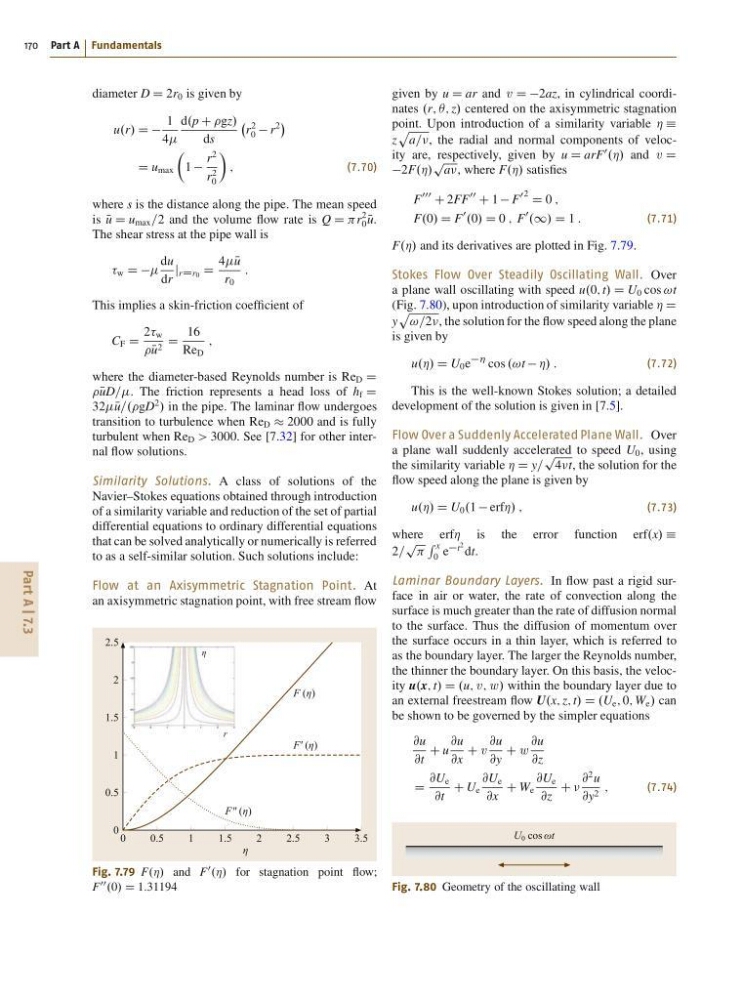
Fig. 7.79 F.Á/ and F
0
.Á/ for stagnation point flow;
F
00
.0/ D 1:31194
given by u D ar and v D D2az, in cylindrical coordinates .r; Â; z/ centered on the axisymmetric stagnation
point. Upon introduction of a similarity variable Á Á
z
p
a==, the radial and normal components of velocity are, respectively, given by u D arF
0
.Á/ and v D
2F.Á/
p
a, where F.Á/ satisfies
F
000
C 2FF
00
C 1 F
0 2 D 0 ;
F.0/ D F
0
.0/ D 0 ; F
0
.1/ D 1 :
(7.71)
F.Á/ and its derivatives are plotted in Fig. 7.79.
Stokes Flow Over Steadily Oscillating Wall. Over
a plane wall oscillating with speed u.0; t/ D U 0 cos !t
(Fig. 7.80), upon introduction of similarity variable Á D
y
p !=2, the solution for the flow speed along the plane
is given by
u.Á/ D U 0 e
Á cos .!t Á/ :
(7.72)
This is the well-known Stokes solution; a detailed
development of the solution is given in [7.5].
Flow Over a Suddenly Accelerated Plane Wall. Over
a plane wall suddenly accelerated to speed U 0 , using
the similarity variable Á D y=
p
4t, the solution for the
flow speed along the plane is given by
u.Á/ D U 0 .1 erfÁ/ ;
(7.73)
where erfÁ is the error function erf.x/ Á
2=
p
R x
0 e
t 2 dt.
Laminar Boundary Layers. In flow past a rigid surface in air or water, the rate of convection along the
surface is much greater than the rate of diffusion normal
to the surface. Thus the diffusion of momentum over
the surface occurs in a thin layer, which is referred to
as the boundary layer. The larger the Reynolds number,
the thinner the boundary layer. On this basis, the velocity u.x; t/ D .u; v ; w / within the boundary layer due to
an external freestream flow U.x; z; t/ D .U e ; 0; W e / can
be shown to be governed by the simpler equations
@u
@t
C u
@u
@x
C v
@u
@y
C w
@u
@z
D
@U e
@t
C U e
@U e
@x
C W e
@U e
@z
C
@
2 u
@y 2 ;
(7.74)
U 0 cos ωt
Fig. 7.80 Geometry of the oscillating wall
170 Part A Fundamentals
diameter D D 2r 0 is given by
u.r/ D D
1
4
d.p C gz/
ds
r
2
0 r
2
D u max
Â
1
r
2
r
2
0
Ã
;
(7.70)
where s is the distance along the pipe. The mean speed
is N
u D u max =2 and the volume flow rate is Q D r
2
0 N
u.
The shear stress at the pipe wall is
w D D
du
dr
j rDr0 D
4N u
r 0
:
This implies a skin-friction coefficient of
C F D
2 w
N u 2 D
16
Re D
;
where the diameter-based Reynolds number is Re D D
N uD==. The friction represents a head loss of h f D
32N u=..gD
2
/ in the pipe. The laminar flow undergoes
transition to turbulence when Re D 2000 and is fully
turbulent when Re D > 3000. See [7.32] for other internal flow solutions.
Similarity Solutions. A class of solutions of the
Navier–Stokes equations obtained through introduction
of a similarity variable and reduction of the set of partial
differential equations to ordinary differential equations
that can be solved analytically or numerically is referred
to as a self-similar solution. Such solutions include:
Flow at an Axisymmetric Stagnation Point. At
an axisymmetric stagnation point, with free stream flow
0
0.5
1
1.5
2
2.5
F (η)
F′ (η)
F″ (η)
3
3.5
η
η
r
2.5
2
1.5
1
0.5
0
Fig. 7.79 F.Á/ and F
0
.Á/ for stagnation point flow;
F
00
.0/ D 1:31194
given by u D ar and v D D2az, in cylindrical coordinates .r; Â; z/ centered on the axisymmetric stagnation
point. Upon introduction of a similarity variable Á Á
z
p
a==, the radial and normal components of velocity are, respectively, given by u D arF
0
.Á/ and v D
2F.Á/
p
a, where F.Á/ satisfies
F
000
C 2FF
00
C 1 F
0 2 D 0 ;
F.0/ D F
0
.0/ D 0 ; F
0
.1/ D 1 :
(7.71)
F.Á/ and its derivatives are plotted in Fig. 7.79.
Stokes Flow Over Steadily Oscillating Wall. Over
a plane wall oscillating with speed u.0; t/ D U 0 cos !t
(Fig. 7.80), upon introduction of similarity variable Á D
y
p !=2, the solution for the flow speed along the plane
is given by
u.Á/ D U 0 e
Á cos .!t Á/ :
(7.72)
This is the well-known Stokes solution; a detailed
development of the solution is given in [7.5].
Flow Over a Suddenly Accelerated Plane Wall. Over
a plane wall suddenly accelerated to speed U 0 , using
the similarity variable Á D y=
p
4t, the solution for the
flow speed along the plane is given by
u.Á/ D U 0 .1 erfÁ/ ;
(7.73)
where erfÁ is the error function erf.x/ Á
2=
p
R x
0 e
t 2 dt.
Laminar Boundary Layers. In flow past a rigid surface in air or water, the rate of convection along the
surface is much greater than the rate of diffusion normal
to the surface. Thus the diffusion of momentum over
the surface occurs in a thin layer, which is referred to
as the boundary layer. The larger the Reynolds number,
the thinner the boundary layer. On this basis, the velocity u.x; t/ D .u; v ; w / within the boundary layer due to
an external freestream flow U.x; z; t/ D .U e ; 0; W e / can
be shown to be governed by the simpler equations
@u
@t
C u
@u
@x
C v
@u
@y
C w
@u
@z
D
@U e
@t
C U e
@U e
@x
C W e
@U e
@z
C
@
2 u
@y 2 ;
(7.74)
U 0 cos ωt
Fig. 7.80 Geometry of the oscillating wall