

Hydromechanics 7.3 Hydrodynamics 167
Part A | 7.3
coefficient
C p Á
p p 1
1
2
U 2
D 1
u
2
Â
U 2
!
;
about the cylinder without circulation is shown in
Fig. 7.73a. As can be seen from Figs. 7.66 and 7.73a
the symmetrical velocity distribution produces a correspondingly symmetrical pressure coefficient distribution about both the vertical and horizontal axes of the
flow. Because of this, both the lift and drag, as determined by integrating the pressure about the cylinder
with no circulation, are zero. As one can imagine, the
asymmetrical velocity distribution about the cylinder
with circulation in a uniform flow (Fig. 7.72) will produce an asymmetrical pressure distribution about the
horizontal axis. The integration of the pressure about
the cylinder then gives rise to the lift force, which is
acting in the cross-stream (vertical) direction.
The Blasius Integral
The Blasius integral is a convenient means of determining the lift and drag per unit span on an object in a flow
when the complex velocity potential is known.
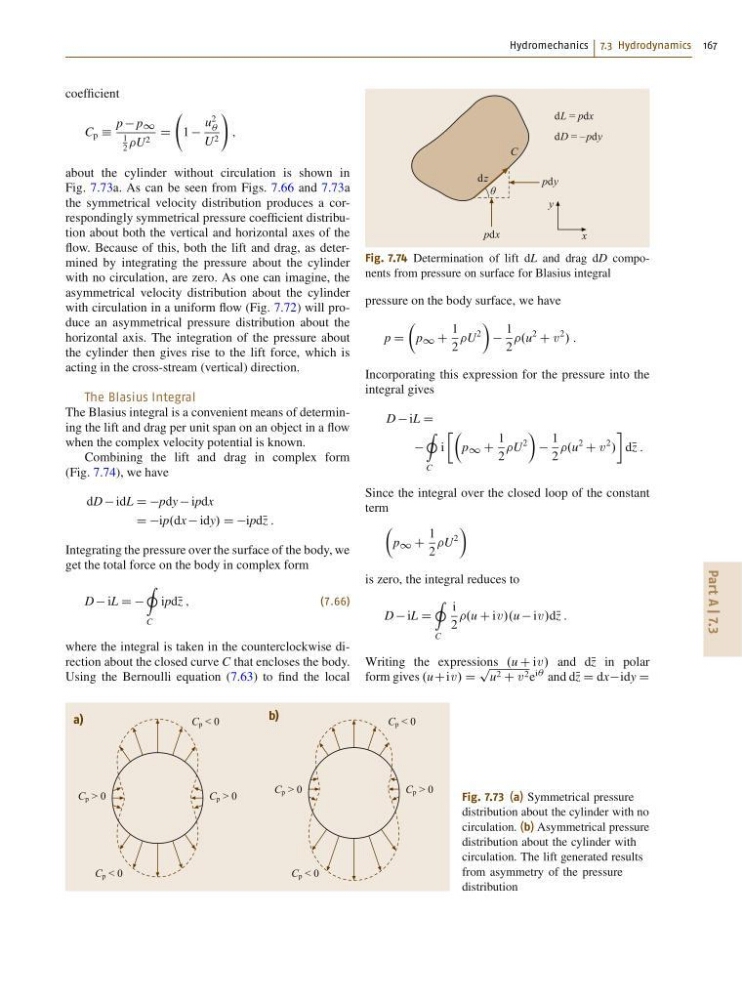
Combining the lift and drag in complex form
(Fig. 7.74), we have
dD idL D Dpdy ipdx
D Dip.dx idy/ D DipdN z :
Integrating the pressure over the surface of the body, we
get the total force on the body in complex form
D iL D D
I
C
ipdN z ;
(7.66)
where the integral is taken in the counterclockwise direction about the closed curve C that encloses the body.
Using the Bernoulli equation (7.63) to find the local
C p > 0
C p > 0
C p < 0
C p < 0
a)
C p > 0
C p > 0
C p < 0
C p < 0
b)
Fig. 7.73 (a) Symmetrical pressure
distribution about the cylinder with no
circulation. (b) Asymmetrical pressure
distribution about the cylinder with
circulation. The lift generated results
from asymmetry of the pressure
distribution
y
C
θ
x
dL = pdx
dD = –pdy
pdy
pdx
d z
Fig. 7.74 Determination of lift dL and drag dD components from pressure on surface for Blasius integral
pressure on the body surface, we have
p D
Â
p 1 C
1
2
U
2
Ã
1
2
.u
2
C v
2
/ :
Incorporating this expression for the pressure into the
integral gives
D iL D
I
C
i
ÄÂ
p 1 C
1
2
U
2
Ã
1
2
.u
2
C v
2
/
dN z :
Since the integral over the closed loop of the constant
term
Â
p 1 C
1
2
U
2
Ã
is zero, the integral reduces to
D iL D
I
C
i
2
.u C iv /.u iv /dN z :
Writing the expressions .u C iv / and dN z in polar
form gives .uCiv / D
p
u 2 C v 2 e
i and dN z D dxidy D
Part A | 7.3
coefficient
C p Á
p p 1
1
2
U 2
D 1
u
2
Â
U 2
!
;
about the cylinder without circulation is shown in
Fig. 7.73a. As can be seen from Figs. 7.66 and 7.73a
the symmetrical velocity distribution produces a correspondingly symmetrical pressure coefficient distribution about both the vertical and horizontal axes of the
flow. Because of this, both the lift and drag, as determined by integrating the pressure about the cylinder
with no circulation, are zero. As one can imagine, the
asymmetrical velocity distribution about the cylinder
with circulation in a uniform flow (Fig. 7.72) will produce an asymmetrical pressure distribution about the
horizontal axis. The integration of the pressure about
the cylinder then gives rise to the lift force, which is
acting in the cross-stream (vertical) direction.
The Blasius Integral
The Blasius integral is a convenient means of determining the lift and drag per unit span on an object in a flow
when the complex velocity potential is known.
Combining the lift and drag in complex form
(Fig. 7.74), we have
dD idL D Dpdy ipdx
D Dip.dx idy/ D DipdN z :
Integrating the pressure over the surface of the body, we
get the total force on the body in complex form
D iL D D
I
C
ipdN z ;
(7.66)
where the integral is taken in the counterclockwise direction about the closed curve C that encloses the body.
Using the Bernoulli equation (7.63) to find the local
C p > 0
C p > 0
C p < 0
C p < 0
a)
C p > 0
C p > 0
C p < 0
C p < 0
b)
Fig. 7.73 (a) Symmetrical pressure
distribution about the cylinder with no
circulation. (b) Asymmetrical pressure
distribution about the cylinder with
circulation. The lift generated results
from asymmetry of the pressure
distribution
y
C
θ
x
dL = pdx
dD = –pdy
pdy
pdx
d z
Fig. 7.74 Determination of lift dL and drag dD components from pressure on surface for Blasius integral
pressure on the body surface, we have
p D
Â
p 1 C
1
2
U
2
Ã
1
2
.u
2
C v
2
/ :
Incorporating this expression for the pressure into the
integral gives
D iL D
I
C
i
ÄÂ
p 1 C
1
2
U
2
Ã
1
2
.u
2
C v
2
/
dN z :
Since the integral over the closed loop of the constant
term
Â
p 1 C
1
2
U
2
Ã
is zero, the integral reduces to
D iL D
I
C
i
2
.u C iv /.u iv /dN z :
Writing the expressions .u C iv / and dN z in polar
form gives .uCiv / D
p
u 2 C v 2 e
i and dN z D dxidy D