

Part A | 7.3
166 Part A Fundamentals
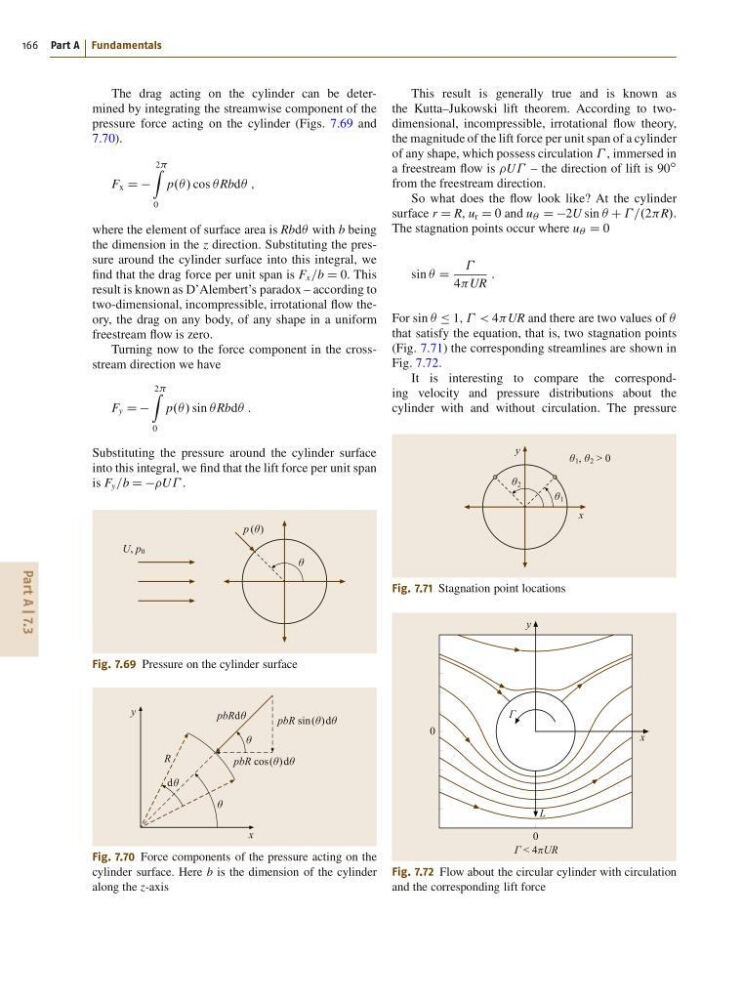
The drag acting on the cylinder can be determined by integrating the streamwise component of the
pressure force acting on the cylinder (Figs. 7.69 and
7.70).
F x D D
2
Z
0
p. / cos  Rbd ;
where the element of surface area is Rbd with b being
the dimension in the z direction. Substituting the pressure around the cylinder surface into this integral, we
find that the drag force per unit span is F x =b D 0. This
result is known as D’Alembert’s paradox – according to
two-dimensional, incompressible, irrotational flow theory, the drag on any body, of any shape in a uniform
freestream flow is zero.
Turning now to the force component in the crossstream direction we have
F y D D
2
Z
0
p. / sin  Rbd :
Substituting the pressure around the cylinder surface
into this integral, we find that the lift force per unit span
is F y =b D DU .
U, p 0
p (θ)
θ
Fig. 7.69 Pressure on the cylinder surface
θ
θ
R
pbR cos (θ)dθ
pbR sin (θ)dθ
pbRdθ
dθ
y
x
Fig. 7.70 Force components of the pressure acting on the
cylinder surface. Here b is the dimension of the cylinder
along the z-axis
This result is generally true and is known as
the Kutta–Jukowski lift theorem. According to twodimensional, incompressible, irrotational flow theory,
the magnitude of the lift force per unit span of a cylinder
of any shape, which possess circulation , immersed in
a freestream flow is U – the direction of lift is 90
ı
from the freestream direction.
So what does the flow look like? At the cylinder
surface r D R, u r D 0 and u  D D2U sin  C =.2R/.
The stagnation points occur where u  D 0
sin  D
4UR
:
For sin Â Ä 1, < 4UR and there are two values of Â
that satisfy the equation, that is, two stagnation points
(Fig. 7.71) the corresponding streamlines are shown in
Fig. 7.72.
It is interesting to compare the corresponding velocity and pressure distributions about the
cylinder with and without circulation. The pressure
y
x
θ 1 , θ 2 > 0
θ 2
θ 1
Fig. 7.71 Stagnation point locations
Г
L
x
y
0
0
Г < 4UR
Fig. 7.72 Flow about the circular cylinder with circulation
and the corresponding lift force
166 Part A Fundamentals
The drag acting on the cylinder can be determined by integrating the streamwise component of the
pressure force acting on the cylinder (Figs. 7.69 and
7.70).
F x D D
2
Z
0
p. / cos  Rbd ;
where the element of surface area is Rbd with b being
the dimension in the z direction. Substituting the pressure around the cylinder surface into this integral, we
find that the drag force per unit span is F x =b D 0. This
result is known as D’Alembert’s paradox – according to
two-dimensional, incompressible, irrotational flow theory, the drag on any body, of any shape in a uniform
freestream flow is zero.
Turning now to the force component in the crossstream direction we have
F y D D
2
Z
0
p. / sin  Rbd :
Substituting the pressure around the cylinder surface
into this integral, we find that the lift force per unit span
is F y =b D DU .
U, p 0
p (θ)
θ
Fig. 7.69 Pressure on the cylinder surface
θ
θ
R
pbR cos (θ)dθ
pbR sin (θ)dθ
pbRdθ
dθ
y
x
Fig. 7.70 Force components of the pressure acting on the
cylinder surface. Here b is the dimension of the cylinder
along the z-axis
This result is generally true and is known as
the Kutta–Jukowski lift theorem. According to twodimensional, incompressible, irrotational flow theory,
the magnitude of the lift force per unit span of a cylinder
of any shape, which possess circulation , immersed in
a freestream flow is U – the direction of lift is 90
ı
from the freestream direction.
So what does the flow look like? At the cylinder
surface r D R, u r D 0 and u  D D2U sin  C =.2R/.
The stagnation points occur where u  D 0
sin  D
4UR
:
For sin Â Ä 1, < 4UR and there are two values of Â
that satisfy the equation, that is, two stagnation points
(Fig. 7.71) the corresponding streamlines are shown in
Fig. 7.72.
It is interesting to compare the corresponding velocity and pressure distributions about the
cylinder with and without circulation. The pressure
y
x
θ 1 , θ 2 > 0
θ 2
θ 1
Fig. 7.71 Stagnation point locations
Г
L
x
y
0
0
Г < 4UR
Fig. 7.72 Flow about the circular cylinder with circulation
and the corresponding lift force