

Hydromechanics 7.3 Hydrodynamics 165
Part A | 7.3
so that u r D 0. We can define the stagnation
streamline such that D stag D 0, which gives
stag
ˇ
ˇ
rDR
D
1
R
.UR
2
/ sin  D 0 ;
for all  . Thus, the body defined by stag is a circle of radius R. We can re-write as
D Ur sin Â
Â
1
R
2
r 2
Ã
; for r R :
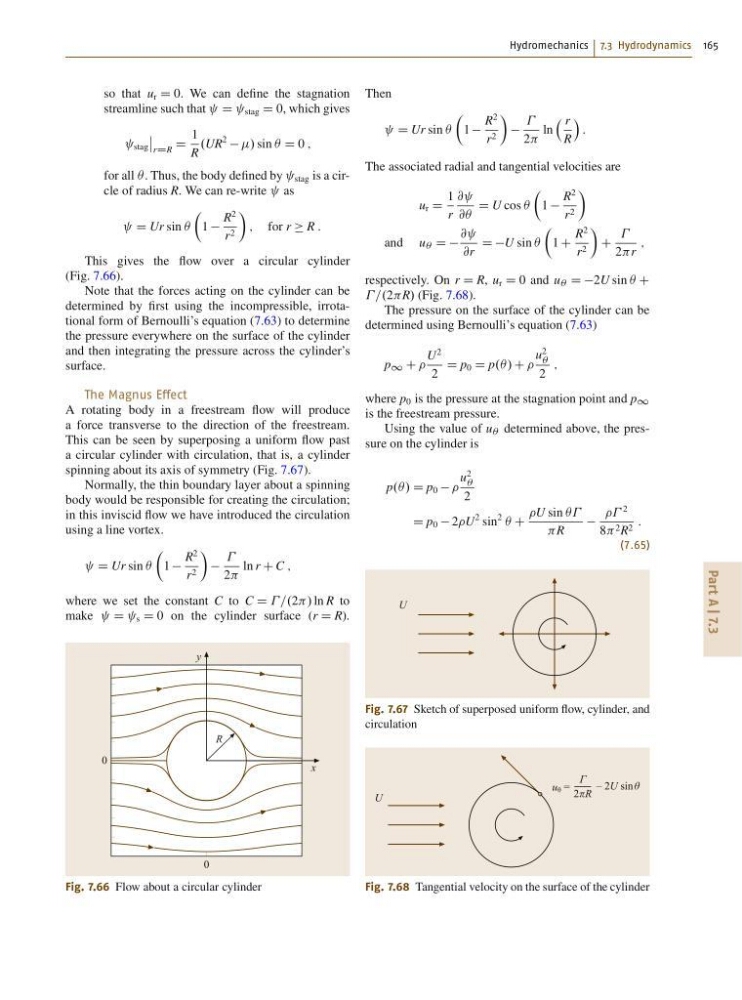
This gives the flow over a circular cylinder
(Fig. 7.66).
Note that the forces acting on the cylinder can be
determined by first using the incompressible, irrotational form of Bernoulli’s equation (7.63) to determine
the pressure everywhere on the surface of the cylinder
and then integrating the pressure across the cylinder’s
surface.
The Magnus Effect
A rotating body in a freestream flow will produce
a force transverse to the direction of the freestream.
This can be seen by superposing a uniform flow past
a circular cylinder with circulation, that is, a cylinder
spinning about its axis of symmetry (Fig. 7.67).
Normally, the thin boundary layer about a spinning
body would be responsible for creating the circulation;
in this inviscid flow we have introduced the circulation
using a line vortex.
D Ur sin Â
Â
1
R
2
r 2
Ã
2
ln r C C ;
where we set the constant C to C D =.2/ ln R to
make
D s D 0 on the cylinder surface (r D R).
R
x
y
0
0
Fig. 7.66 Flow about a circular cylinder
Then
D Ur sin Â
Â
1
R
2
r 2
Ã
2
ln
r
R
Á
:
The associated radial and tangential velocities are
u r D
1
r
@
@Â
D U cos Â
Â
1
R
2
r 2
Ã
and u  D D
@
@r
D DU sin Â
Â
1 C
R
2
r 2
Ã
C
2r
;
respectively. On r D R, u r D 0 and u  D D2U sin  C
=.2R/ (Fig. 7.68).
The pressure on the surface of the cylinder can be
determined using Bernoulli’s equation (7.63)
p 1 C
U
2
2
D p 0 D p. / C
u
2
Â
2
;
where p 0 is the pressure at the stagnation point and p 1
is the freestream pressure.
Using the value of u  determined above, the pressure on the cylinder is
p. / D p 0
u
2
Â
2
D p 0 2U
2 sin
2
 C
U sin ÂÂ
R
2
8 2 R 2 :
(7.65)
U
Fig. 7.67 Sketch of superposed uniform flow, cylinder, and
circulation
U
Г
2R
u θ =
– 2U sin θ
Fig. 7.68 Tangential velocity on the surface of the cylinder
Part A | 7.3
so that u r D 0. We can define the stagnation
streamline such that D stag D 0, which gives
stag
ˇ
ˇ
rDR
D
1
R
.UR
2
/ sin  D 0 ;
for all  . Thus, the body defined by stag is a circle of radius R. We can re-write as
D Ur sin Â
Â
1
R
2
r 2
Ã
; for r R :
This gives the flow over a circular cylinder
(Fig. 7.66).
Note that the forces acting on the cylinder can be
determined by first using the incompressible, irrotational form of Bernoulli’s equation (7.63) to determine
the pressure everywhere on the surface of the cylinder
and then integrating the pressure across the cylinder’s
surface.
The Magnus Effect
A rotating body in a freestream flow will produce
a force transverse to the direction of the freestream.
This can be seen by superposing a uniform flow past
a circular cylinder with circulation, that is, a cylinder
spinning about its axis of symmetry (Fig. 7.67).
Normally, the thin boundary layer about a spinning
body would be responsible for creating the circulation;
in this inviscid flow we have introduced the circulation
using a line vortex.
D Ur sin Â
Â
1
R
2
r 2
Ã
2
ln r C C ;
where we set the constant C to C D =.2/ ln R to
make
D s D 0 on the cylinder surface (r D R).
R
x
y
0
0
Fig. 7.66 Flow about a circular cylinder
Then
D Ur sin Â
Â
1
R
2
r 2
Ã
2
ln
r
R
Á
:
The associated radial and tangential velocities are
u r D
1
r
@
@Â
D U cos Â
Â
1
R
2
r 2
Ã
and u  D D
@
@r
D DU sin Â
Â
1 C
R
2
r 2
Ã
C
2r
;
respectively. On r D R, u r D 0 and u  D D2U sin  C
=.2R/ (Fig. 7.68).
The pressure on the surface of the cylinder can be
determined using Bernoulli’s equation (7.63)
p 1 C
U
2
2
D p 0 D p. / C
u
2
Â
2
;
where p 0 is the pressure at the stagnation point and p 1
is the freestream pressure.
Using the value of u  determined above, the pressure on the cylinder is
p. / D p 0
u
2
Â
2
D p 0 2U
2 sin
2
 C
U sin ÂÂ
R
2
8 2 R 2 :
(7.65)
U
Fig. 7.67 Sketch of superposed uniform flow, cylinder, and
circulation
U
Г
2R
u θ =
– 2U sin θ
Fig. 7.68 Tangential velocity on the surface of the cylinder