

Part A | 7.3
162 Part A Fundamentals
m
θ 6
θ 5
θ 1
r 1
r 2
r 3
θ 4
θ 2
θ 3
θ 7
θ 8
2
φ =
ln r, r = {r 1 , r 2 , r 3 }
mθ
2
ψ =
, θ = {θ 1 , θ 2 , θ 3 , θ 4 , θ 5 , θ 6 , θ 7 , θ 8 }
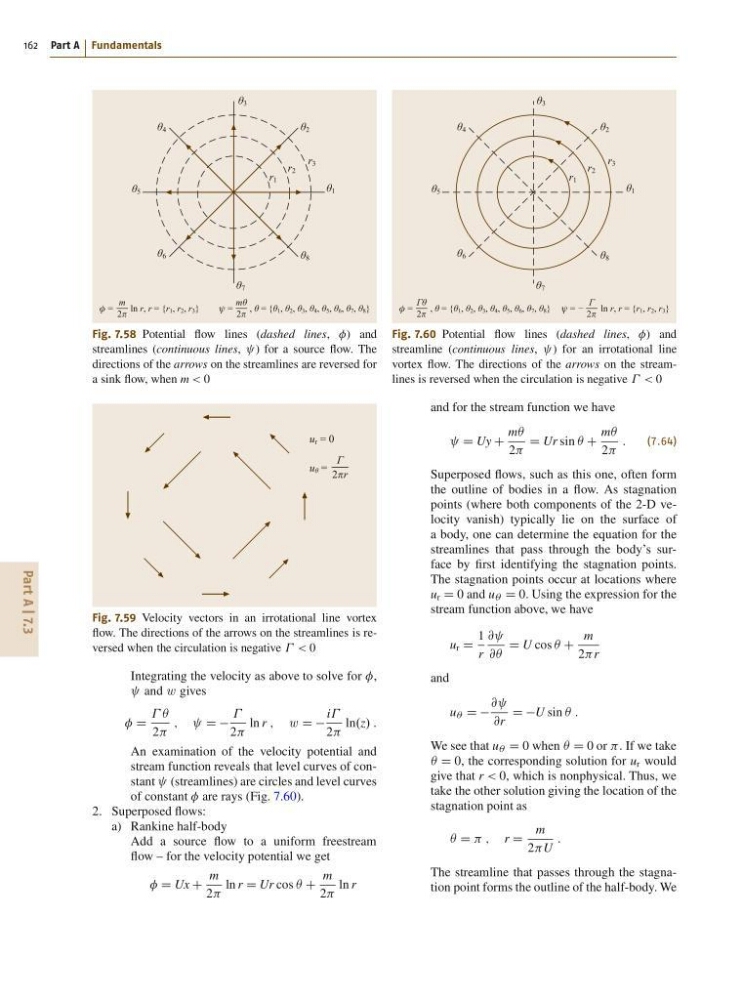
Fig. 7.58 Potential flow lines (dashed lines, ) and
streamlines (continuous lines, ) for a source flow. The
directions of the arrows on the streamlines are reversed for
a sink flow, when m < 0
Г
2r
u r = 0
u θ =
Fig. 7.59 Velocity vectors in an irrotational line vortex
flow. The directions of the arrows on the streamlines is reversed when the circulation is negative < 0
Integrating the velocity as above to solve for ,
and w gives
D
Â
2
;
D D
2
ln r ; w D D
i
2
ln.z/ :
An examination of the velocity potential and
stream function reveals that level curves of constant (streamlines) are circles and level curves
of constant are rays (Fig. 7.60).
2. Superposed flows:
a) Rankine half-body
Add a source flow to a uniform freestream
flow – for the velocity potential we get
D Ux C
m
2
ln r D Ur cos  C
m
2
ln r
Гθ
θ 6
θ 5
θ 1
r 1
r 2
r 3
θ 4
θ 2
θ 3
θ 7
θ 8
2
φ =
ln r, r = {r 1 , r 2 , r 3 }
Г
2
ψ = –
, θ = {θ 1 , θ 2 , θ 3 , θ 4 , θ 5 , θ 6 , θ 7 , θ 8 }
Fig. 7.60 Potential flow lines (dashed lines, ) and
streamline (continuous lines, ) for an irrotational line
vortex flow. The directions of the arrows on the streamlines is reversed when the circulation is negative < 0
and for the stream function we have
D Uy C
mÂ
2
D Ur sin  C
mÂ
2
:
(7.64)
Superposed flows, such as this one, often form
the outline of bodies in a flow. As stagnation
points (where both components of the 2-D velocity vanish) typically lie on the surface of
a body, one can determine the equation for the
streamlines that pass through the body’s surface by first identifying the stagnation points.
The stagnation points occur at locations where
u r D 0 and u  D 0. Using the expression for the
stream function above, we have
u r D
1
r
@
@Â
D U cos  C
m
2r
and
u  D D
@
@r
D DU sin  :
We see that u  D 0 when  D 0 or . If we take
 D 0, the corresponding solution for u r would
give that r < 0, which is nonphysical. Thus, we
take the other solution giving the location of the
stagnation point as
 D ; r D
m
2U
:
The streamline that passes through the stagnation point forms the outline of the half-body. We
162 Part A Fundamentals
m
θ 6
θ 5
θ 1
r 1
r 2
r 3
θ 4
θ 2
θ 3
θ 7
θ 8
2
φ =
ln r, r = {r 1 , r 2 , r 3 }
mθ
2
ψ =
, θ = {θ 1 , θ 2 , θ 3 , θ 4 , θ 5 , θ 6 , θ 7 , θ 8 }
Fig. 7.58 Potential flow lines (dashed lines, ) and
streamlines (continuous lines, ) for a source flow. The
directions of the arrows on the streamlines are reversed for
a sink flow, when m < 0
Г
2r
u r = 0
u θ =
Fig. 7.59 Velocity vectors in an irrotational line vortex
flow. The directions of the arrows on the streamlines is reversed when the circulation is negative < 0
Integrating the velocity as above to solve for ,
and w gives
D
Â
2
;
D D
2
ln r ; w D D
i
2
ln.z/ :
An examination of the velocity potential and
stream function reveals that level curves of constant (streamlines) are circles and level curves
of constant are rays (Fig. 7.60).
2. Superposed flows:
a) Rankine half-body
Add a source flow to a uniform freestream
flow – for the velocity potential we get
D Ux C
m
2
ln r D Ur cos  C
m
2
ln r
Гθ
θ 6
θ 5
θ 1
r 1
r 2
r 3
θ 4
θ 2
θ 3
θ 7
θ 8
2
φ =
ln r, r = {r 1 , r 2 , r 3 }
Г
2
ψ = –
, θ = {θ 1 , θ 2 , θ 3 , θ 4 , θ 5 , θ 6 , θ 7 , θ 8 }
Fig. 7.60 Potential flow lines (dashed lines, ) and
streamline (continuous lines, ) for an irrotational line
vortex flow. The directions of the arrows on the streamlines is reversed when the circulation is negative < 0
and for the stream function we have
D Uy C
mÂ
2
D Ur sin  C
mÂ
2
:
(7.64)
Superposed flows, such as this one, often form
the outline of bodies in a flow. As stagnation
points (where both components of the 2-D velocity vanish) typically lie on the surface of
a body, one can determine the equation for the
streamlines that pass through the body’s surface by first identifying the stagnation points.
The stagnation points occur at locations where
u r D 0 and u  D 0. Using the expression for the
stream function above, we have
u r D
1
r
@
@Â
D U cos  C
m
2r
and
u  D D
@
@r
D DU sin  :
We see that u  D 0 when  D 0 or . If we take
 D 0, the corresponding solution for u r would
give that r < 0, which is nonphysical. Thus, we
take the other solution giving the location of the
stagnation point as
 D ; r D
m
2U
:
The streamline that passes through the stagnation point forms the outline of the half-body. We