

Hydromechanics 7.3 Hydrodynamics 161
Part A | 7.3
x
u = U
υ = 0
y
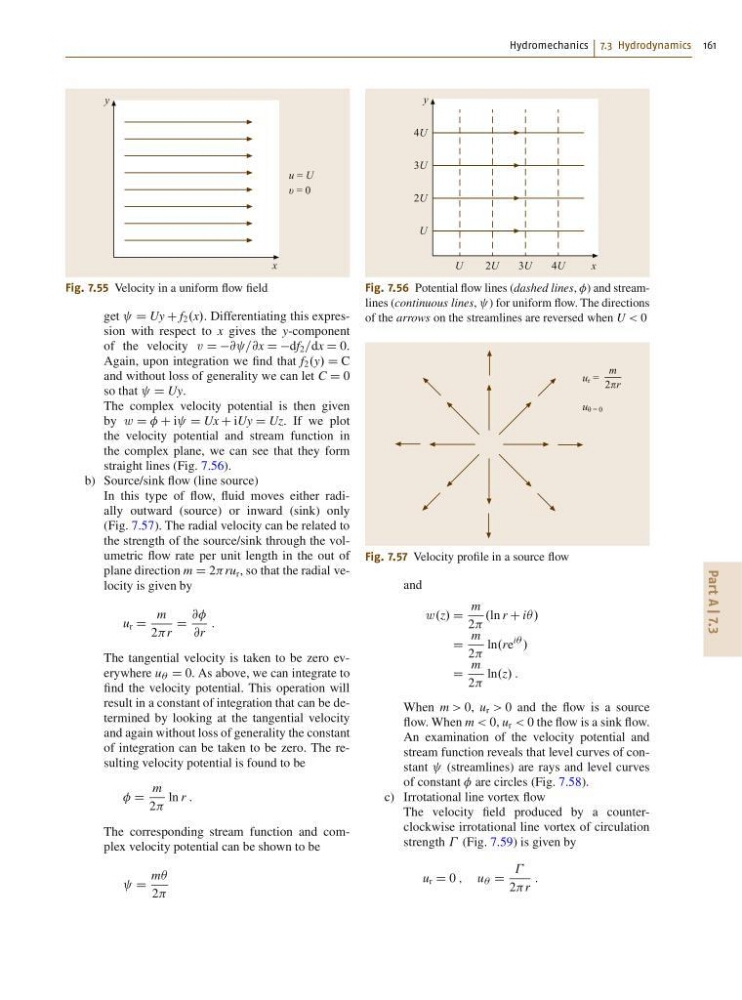
Fig. 7.55 Velocity in a uniform flow field
get D Uy C f 2 .x/. Differentiating this expression with respect to x gives the y-component
of the velocity v D D@ =@x D Ddf 2 =dx D 0.
Again, upon integration we find that f 2 .y/ D C
and without loss of generality we can let C D 0
so that D Uy.
The complex velocity potential is then given
by w D C i D Ux C iUy D Uz. If we plot
the velocity potential and stream function in
the complex plane, we can see that they form
straight lines (Fig. 7.56).
b) Source/sink flow (line source)
In this type of flow, fluid moves either radially outward (source) or inward (sink) only
(Fig. 7.57). The radial velocity can be related to
the strength of the source/sink through the volumetric flow rate per unit length in the out of
plane direction m D 2ru r , so that the radial velocity is given by
u r D
m
2r
D
@@
@r
:
The tangential velocity is taken to be zero everywhere u  D 0. As above, we can integrate to
find the velocity potential. This operation will
result in a constant of integration that can be determined by looking at the tangential velocity
and again without loss of generality the constant
of integration can be taken to be zero. The resulting velocity potential is found to be
D
m
2
ln r :
The corresponding stream function and complex velocity potential can be shown to be
D
mÂ
2
x
U
2U
4U
3U
2U
U
3U
4U
y
Fig. 7.56 Potential flow lines (dashed lines, ) and streamlines (continuous lines, ) for uniform flow. The directions
of the arrows on the streamlines are reversed when U < 0
m
2r
u r =
u θ = 0
Fig. 7.57 Velocity profile in a source flow
and
w .z/ D
m
2
.ln r C iÂ/
D
m
2
ln.re
iÂ
/
D
m
2
ln.z/ :
When m > 0, u r > 0 and the flow is a source
flow. When m < 0, u r < 0 the flow is a sink flow.
An examination of the velocity potential and
stream function reveals that level curves of constant (streamlines) are rays and level curves
of constant are circles (Fig. 7.58).
c) Irrotational line vortex flow
The velocity field produced by a counterclockwise irrotational line vortex of circulation
strength (Fig. 7.59) is given by
u r D 0 ; u  D
2r
:
Part A | 7.3
x
u = U
υ = 0
y
Fig. 7.55 Velocity in a uniform flow field
get D Uy C f 2 .x/. Differentiating this expression with respect to x gives the y-component
of the velocity v D D@ =@x D Ddf 2 =dx D 0.
Again, upon integration we find that f 2 .y/ D C
and without loss of generality we can let C D 0
so that D Uy.
The complex velocity potential is then given
by w D C i D Ux C iUy D Uz. If we plot
the velocity potential and stream function in
the complex plane, we can see that they form
straight lines (Fig. 7.56).
b) Source/sink flow (line source)
In this type of flow, fluid moves either radially outward (source) or inward (sink) only
(Fig. 7.57). The radial velocity can be related to
the strength of the source/sink through the volumetric flow rate per unit length in the out of
plane direction m D 2ru r , so that the radial velocity is given by
u r D
m
2r
D
@@
@r
:
The tangential velocity is taken to be zero everywhere u  D 0. As above, we can integrate to
find the velocity potential. This operation will
result in a constant of integration that can be determined by looking at the tangential velocity
and again without loss of generality the constant
of integration can be taken to be zero. The resulting velocity potential is found to be
D
m
2
ln r :
The corresponding stream function and complex velocity potential can be shown to be
D
mÂ
2
x
U
2U
4U
3U
2U
U
3U
4U
y
Fig. 7.56 Potential flow lines (dashed lines, ) and streamlines (continuous lines, ) for uniform flow. The directions
of the arrows on the streamlines are reversed when U < 0
m
2r
u r =
u θ = 0
Fig. 7.57 Velocity profile in a source flow
and
w .z/ D
m
2
.ln r C iÂ/
D
m
2
ln.re
iÂ
/
D
m
2
ln.z/ :
When m > 0, u r > 0 and the flow is a source
flow. When m < 0, u r < 0 the flow is a sink flow.
An examination of the velocity potential and
stream function reveals that level curves of constant (streamlines) are rays and level curves
of constant are circles (Fig. 7.58).
c) Irrotational line vortex flow
The velocity field produced by a counterclockwise irrotational line vortex of circulation
strength (Fig. 7.59) is given by
u r D 0 ; u  D
2r
: