

Part A | 7.3
158 Part A Fundamentals
Exit velocity
u e
Inlet velocity u i
Exit area
A e
Inlet area A i
Rigid hull top
Inflated hull
Payload tray
Motor pod
Waterjet exit nozzle
θ
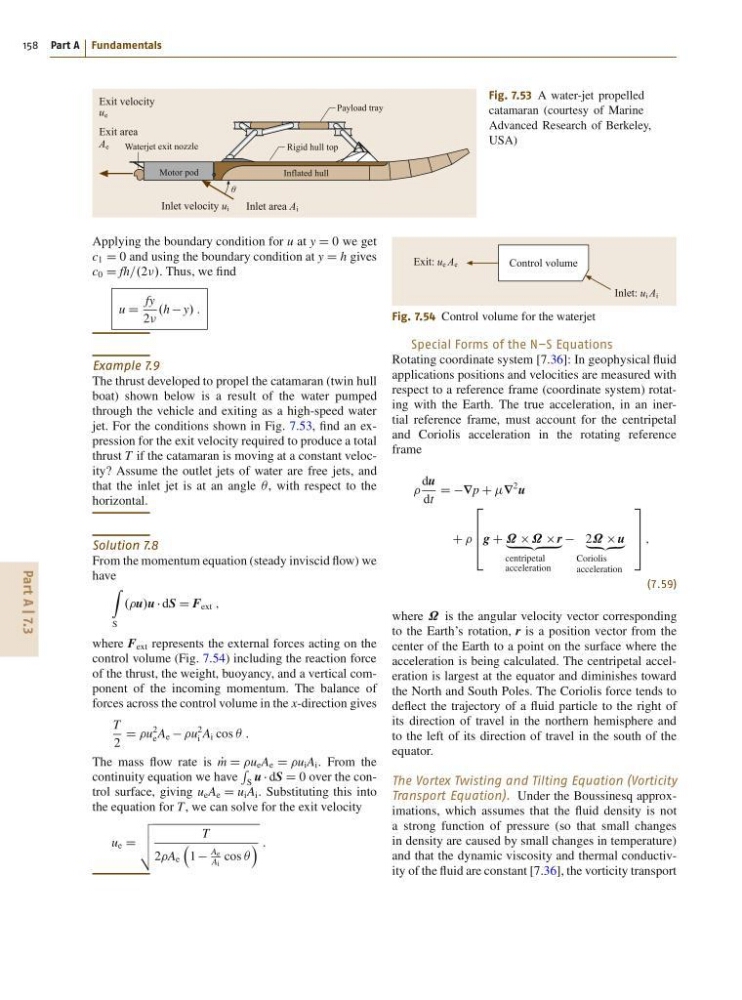
Fig. 7.53 A water-jet propelled
catamaran (courtesy of Marine
Advanced Research of Berkeley,
USA)
Applying the boundary condition for u at y D 0 we get
c 1 D 0 and using the boundary condition at y D h gives
c 0 D fh=.2/. Thus, we find
u D
fy
2
.h y/ :
Example 7.9
The thrust developed to propel the catamaran (twin hull
boat) shown below is a result of the water pumped
through the vehicle and exiting as a high-speed water
jet. For the conditions shown in Fig. 7.53, find an expression for the exit velocity required to produce a total
thrust T if the catamaran is moving at a constant velocity? Assume the outlet jets of water are free jets, and
that the inlet jet is at an angle  , with respect to the
horizontal.
Solution 7.8
From the momentum equation (steady inviscid flow) we
have
Z
S
..u/u dS D F ext ;
where F ext represents the external forces acting on the
control volume (Fig. 7.54) including the reaction force
of the thrust, the weight, buoyancy, and a vertical component of the incoming momentum. The balance of
forces across the control volume in the x-direction gives
T
2
D u
2
e A e u
2
i A i cos  :
The mass flow rate is P
m D u e A e D u i A i . From the
continuity equation we have
R
S u dS D 0 over the control surface, giving u e A e D u i A i . Substituting this into
the equation for T, we can solve for the exit velocity
u e D
v
u
u
t
T
2A e
1
Ae
Ai
cos Â
Á :
Exit: u e A e
Inlet: u i A i
Control volume
Fig. 7.54 Control volume for the waterjet
Special Forms of the N–S Equations
Rotating coordinate system [7.36]: In geophysical fluid
applications positions and velocities are measured with
respect to a reference frame (coordinate system) rotating with the Earth. The true acceleration, in an inertial reference frame, must account for the centripetal
and Coriolis acceleration in the rotating reference
frame
du
dt
D Dr p C r
2 u
C
2
6
6
4 g C ˝ ˝ r
„ ƒ‚ …
centripetal
acceleration
2˝ u
„ ƒ‚ …
Coriolis
acceleration
3
7
7
5 ;
(7.59)
where ˝ is the angular velocity vector corresponding
to the Earth’s rotation, r is a position vector from the
center of the Earth to a point on the surface where the
acceleration is being calculated. The centripetal acceleration is largest at the equator and diminishes toward
the North and South Poles. The Coriolis force tends to
deflect the trajectory of a fluid particle to the right of
its direction of travel in the northern hemisphere and
to the left of its direction of travel in the south of the
equator.
The Vortex Twisting and Tilting Equation (Vorticity
Transport Equation). Under the Boussinesq approximations, which assumes that the fluid density is not
a strong function of pressure (so that small changes
in density are caused by small changes in temperature)
and that the dynamic viscosity and thermal conductivity of the fluid are constant [7.36], the vorticity transport
158 Part A Fundamentals
Exit velocity
u e
Inlet velocity u i
Exit area
A e
Inlet area A i
Rigid hull top
Inflated hull
Payload tray
Motor pod
Waterjet exit nozzle
θ
Fig. 7.53 A water-jet propelled
catamaran (courtesy of Marine
Advanced Research of Berkeley,
USA)
Applying the boundary condition for u at y D 0 we get
c 1 D 0 and using the boundary condition at y D h gives
c 0 D fh=.2/. Thus, we find
u D
fy
2
.h y/ :
Example 7.9
The thrust developed to propel the catamaran (twin hull
boat) shown below is a result of the water pumped
through the vehicle and exiting as a high-speed water
jet. For the conditions shown in Fig. 7.53, find an expression for the exit velocity required to produce a total
thrust T if the catamaran is moving at a constant velocity? Assume the outlet jets of water are free jets, and
that the inlet jet is at an angle  , with respect to the
horizontal.
Solution 7.8
From the momentum equation (steady inviscid flow) we
have
Z
S
..u/u dS D F ext ;
where F ext represents the external forces acting on the
control volume (Fig. 7.54) including the reaction force
of the thrust, the weight, buoyancy, and a vertical component of the incoming momentum. The balance of
forces across the control volume in the x-direction gives
T
2
D u
2
e A e u
2
i A i cos  :
The mass flow rate is P
m D u e A e D u i A i . From the
continuity equation we have
R
S u dS D 0 over the control surface, giving u e A e D u i A i . Substituting this into
the equation for T, we can solve for the exit velocity
u e D
v
u
u
t
T
2A e
1
Ae
Ai
cos Â
Á :
Exit: u e A e
Inlet: u i A i
Control volume
Fig. 7.54 Control volume for the waterjet
Special Forms of the N–S Equations
Rotating coordinate system [7.36]: In geophysical fluid
applications positions and velocities are measured with
respect to a reference frame (coordinate system) rotating with the Earth. The true acceleration, in an inertial reference frame, must account for the centripetal
and Coriolis acceleration in the rotating reference
frame
du
dt
D Dr p C r
2 u
C
2
6
6
4 g C ˝ ˝ r
„ ƒ‚ …
centripetal
acceleration
2˝ u
„ ƒ‚ …
Coriolis
acceleration
3
7
7
5 ;
(7.59)
where ˝ is the angular velocity vector corresponding
to the Earth’s rotation, r is a position vector from the
center of the Earth to a point on the surface where the
acceleration is being calculated. The centripetal acceleration is largest at the equator and diminishes toward
the North and South Poles. The Coriolis force tends to
deflect the trajectory of a fluid particle to the right of
its direction of travel in the northern hemisphere and
to the left of its direction of travel in the south of the
equator.
The Vortex Twisting and Tilting Equation (Vorticity
Transport Equation). Under the Boussinesq approximations, which assumes that the fluid density is not
a strong function of pressure (so that small changes
in density are caused by small changes in temperature)
and that the dynamic viscosity and thermal conductivity of the fluid are constant [7.36], the vorticity transport