

Part A | 7.3
156 Part A Fundamentals
locity potential. It can be shown that r Œr . O
k/ D 0
and so r . O
k/ gives the part of u with no contraction/expansion. Since r .r / D 0, r is the part of
u with no rotation. For an incompressible flow, r u D
r
2
D 0 and for an irrotational flow r u D r Œr
. O
k/ D r
2
D 0. Thus, for a two-dimensional incompressible, irrotational flow, both the velocity potential
and stream function satisfy Laplace’s equation.
7.3.2 The Navier–Stokes Equations
Material Derivative
The material derivative, sometimes also referred to as
the either total derivative or the substantial derivative,
is a differential operator that gives the total time rate
of change of a quantity as that quantity moves through
a flow field. There are essentially two contributions
to the time rate of change. The first is the unsteady,
time-dependent change in the quantity over time, which
would happen even if the quantity were not moving
with the flow. The second contribution is the change in
the quantity as it moves through the flow. This second
part is sometimes referred to as either the convective
rate of change or the advective rate of change. For threedimensional Cartesian coordinates, the total derivative
can effectively be written as
df D
@f
@t
dt C
@f
@x
dx C
@f
@y
dy C
@f
@z
dz :
Taking the total derivative with respect to time gives
df
dt
D
@f
@t
C
@f
@x
dx
dt
C
@f
@y
dy
dt
C
@f
@z
dz
dt
;
which can be written compactly as
df
dt
D
@f
@t
„ƒ‚…
unsteady, local
rate of change
C
u r f
„ƒ‚…
rate of change
due to convection
;
(7.52)
where the gradient operator in three-dimensional Cartesian coordinates is
r . / D
@. /
@x
O i C
@. /
@y
O j C
@. /
@z
O
k ;
and the velocity is
u D
dx
dt
O i C
dy
dt
O j C
dz
dt
O
k :
Example 7.7
In a river with a velocity field v .x; t/ with respect to the
ground, the temperature is given by the function f .x; t/.
A small boat is in the river and has a velocity U.t/ with
respect to the ground:
1. Give the time rate of change of f experienced by the
boat when forced to move at the velocity U
df
dt
D
@f
@t
C U r f :
2. If the engine is turned off and the vessel freely drifts
with the surrounding current, give the time rate of
change of f experienced by the boat
df
dt
D
@f
@t
C v r f :
3. The boat is anchored. Give the time rate of change
of f experienced by the vessel
df
dt
D
@f
@t
:
Conservation of Mass
The integral form of conservation of mass for a fluid
volume V enclosed by surface S is
@
@t
Z
V
dV
„ ƒ‚ …
rate of change
of mass in V
D D
Z
S
u dS
„ ƒ‚ …
flux of mass
across surface of V
:
(7.53)
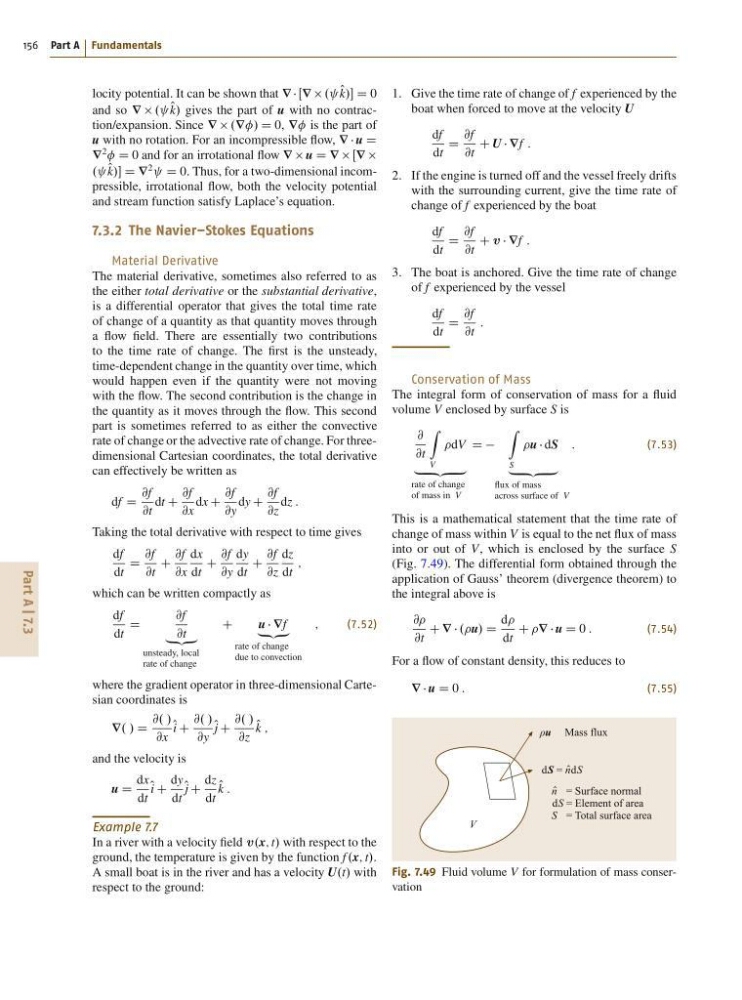
This is a mathematical statement that the time rate of
change of mass within V is equal to the net flux of mass
into or out of V, which is enclosed by the surface S
(Fig. 7.49). The differential form obtained through the
application of Gauss’ theorem (divergence theorem) to
the integral above is
@@
@t
C r ..u/ D
d
dt
C r u D 0 :
(7.54)
For a flow of constant density, this reduces to
r u D 0 :
(7.55)
ρu
dS = n ˆdS
n ˆ = Surface normal
dS = Element of area
S = Total surface area
Mass flux
V
Fig. 7.49 Fluid volume V for formulation of mass conservation
156 Part A Fundamentals
locity potential. It can be shown that r Œr . O
k/ D 0
and so r . O
k/ gives the part of u with no contraction/expansion. Since r .r / D 0, r is the part of
u with no rotation. For an incompressible flow, r u D
r
2
D 0 and for an irrotational flow r u D r Œr
. O
k/ D r
2
D 0. Thus, for a two-dimensional incompressible, irrotational flow, both the velocity potential
and stream function satisfy Laplace’s equation.
7.3.2 The Navier–Stokes Equations
Material Derivative
The material derivative, sometimes also referred to as
the either total derivative or the substantial derivative,
is a differential operator that gives the total time rate
of change of a quantity as that quantity moves through
a flow field. There are essentially two contributions
to the time rate of change. The first is the unsteady,
time-dependent change in the quantity over time, which
would happen even if the quantity were not moving
with the flow. The second contribution is the change in
the quantity as it moves through the flow. This second
part is sometimes referred to as either the convective
rate of change or the advective rate of change. For threedimensional Cartesian coordinates, the total derivative
can effectively be written as
df D
@f
@t
dt C
@f
@x
dx C
@f
@y
dy C
@f
@z
dz :
Taking the total derivative with respect to time gives
df
dt
D
@f
@t
C
@f
@x
dx
dt
C
@f
@y
dy
dt
C
@f
@z
dz
dt
;
which can be written compactly as
df
dt
D
@f
@t
„ƒ‚…
unsteady, local
rate of change
C
u r f
„ƒ‚…
rate of change
due to convection
;
(7.52)
where the gradient operator in three-dimensional Cartesian coordinates is
r . / D
@. /
@x
O i C
@. /
@y
O j C
@. /
@z
O
k ;
and the velocity is
u D
dx
dt
O i C
dy
dt
O j C
dz
dt
O
k :
Example 7.7
In a river with a velocity field v .x; t/ with respect to the
ground, the temperature is given by the function f .x; t/.
A small boat is in the river and has a velocity U.t/ with
respect to the ground:
1. Give the time rate of change of f experienced by the
boat when forced to move at the velocity U
df
dt
D
@f
@t
C U r f :
2. If the engine is turned off and the vessel freely drifts
with the surrounding current, give the time rate of
change of f experienced by the boat
df
dt
D
@f
@t
C v r f :
3. The boat is anchored. Give the time rate of change
of f experienced by the vessel
df
dt
D
@f
@t
:
Conservation of Mass
The integral form of conservation of mass for a fluid
volume V enclosed by surface S is
@
@t
Z
V
dV
„ ƒ‚ …
rate of change
of mass in V
D D
Z
S
u dS
„ ƒ‚ …
flux of mass
across surface of V
:
(7.53)
This is a mathematical statement that the time rate of
change of mass within V is equal to the net flux of mass
into or out of V, which is enclosed by the surface S
(Fig. 7.49). The differential form obtained through the
application of Gauss’ theorem (divergence theorem) to
the integral above is
@@
@t
C r ..u/ D
d
dt
C r u D 0 :
(7.54)
For a flow of constant density, this reduces to
r u D 0 :
(7.55)
ρu
dS = n ˆdS
n ˆ = Surface normal
dS = Element of area
S = Total surface area
Mass flux
V
Fig. 7.49 Fluid volume V for formulation of mass conservation