

Hydromechanics 7.3 Hydrodynamics 155
Part A | 7.3
y
x
L
dx
r
Z
G
r
M
W
φ
W 1
B
0
Δ Δ
B 1
L 1
L
0
a)
b)
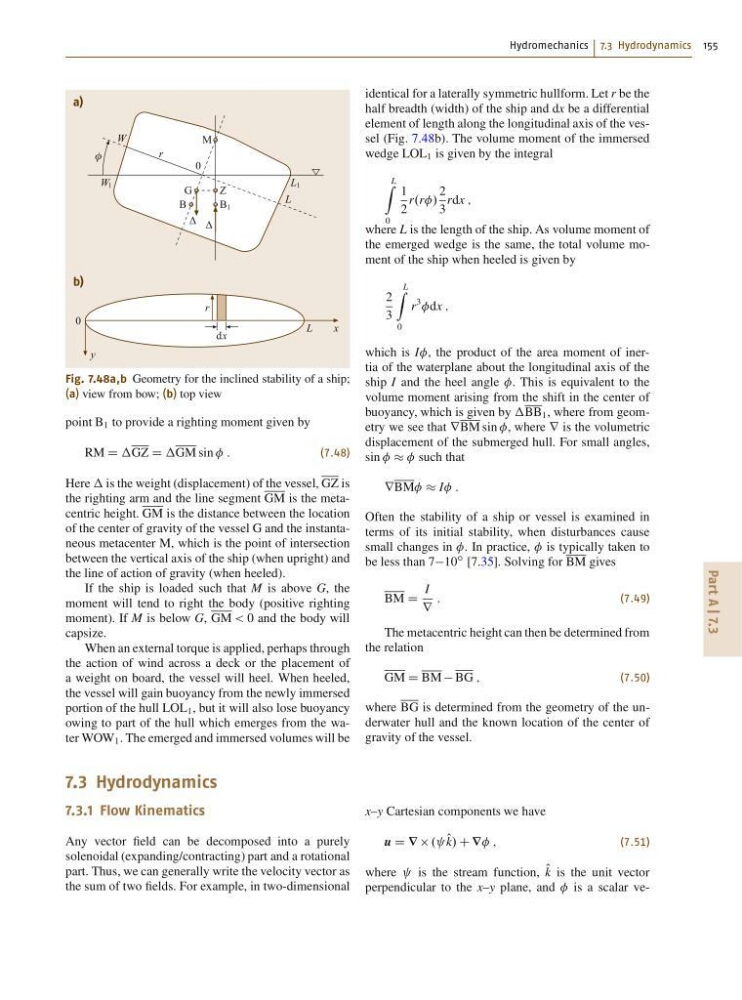
Fig. 7.48a,b Geometry for the inclined stability of a ship;
(a) view from bow; (b) top view
point B 1 to provide a righting moment given by
RM D GZ D GM sin :
(7.48)
Here is the weight (displacement) of the vessel, GZ is
the righting arm and the line segment GM is the metacentric height. GM is the distance between the location
of the center of gravity of the vessel G and the instantaneous metacenter M, which is the point of intersection
between the vertical axis of the ship (when upright) and
the line of action of gravity (when heeled).
If the ship is loaded such that M is above G, the
moment will tend to right the body (positive righting
moment). If M is below G, GM < 0 and the body will
capsize.
When an external torque is applied, perhaps through
the action of wind across a deck or the placement of
a weight on board, the vessel will heel. When heeled,
the vessel will gain buoyancy from the newly immersed
portion of the hull LOL 1 , but it will also lose buoyancy
owing to part of the hull which emerges from the water WOW 1 . The emerged and immersed volumes will be
identical for a laterally symmetric hullform. Let r be the
half breadth (width) of the ship and dx be a differential
element of length along the longitudinal axis of the vessel (Fig. 7.48b). The volume moment of the immersed
wedge LOL 1 is given by the integral
L
Z
0
1
2
r.r/
2
3
rdx ;
where L is the length of the ship. As volume moment of
the emerged wedge is the same, the total volume moment of the ship when heeled is given by
2
3
L
Z
0
r
3
dx ;
which is I, the product of the area moment of inertia of the waterplane about the longitudinal axis of the
ship I and the heel angle . This is equivalent to the
volume moment arising from the shift in the center of
buoyancy, which is given by BB 1 , where from geometry we see that rBM sin , where r is the volumetric
displacement of the submerged hull. For small angles,
sin such that
rBM I :
Often the stability of a ship or vessel is examined in
terms of its initial stability, when disturbances cause
small changes in . In practice, is typically taken to
be less than 710
ı [7.35]. Solving for BM gives
BM D
I
r
:
(7.49)
The metacentric height can then be determined from
the relation
GM D BM BG ;
(7.50)
where BG is determined from the geometry of the underwater hull and the known location of the center of
gravity of the vessel.
7.3 Hydrodynamics
7.3.1 Flow Kinematics
Any vector field can be decomposed into a purely
solenoidal (expanding/contracting) part and a rotational
part. Thus, we can generally write the velocity vector as
the sum of two fields. For example, in two-dimensional
x–y Cartesian components we have
u D r . O
k/ C r ;
(7.51)
where
is the stream function, O
k is the unit vector
perpendicular to the x–y plane, and is a scalar ve-
Part A | 7.3
y
x
L
dx
r
Z
G
r
M
W
φ
W 1
B
0
Δ Δ
B 1
L 1
L
0
a)
b)
Fig. 7.48a,b Geometry for the inclined stability of a ship;
(a) view from bow; (b) top view
point B 1 to provide a righting moment given by
RM D GZ D GM sin :
(7.48)
Here is the weight (displacement) of the vessel, GZ is
the righting arm and the line segment GM is the metacentric height. GM is the distance between the location
of the center of gravity of the vessel G and the instantaneous metacenter M, which is the point of intersection
between the vertical axis of the ship (when upright) and
the line of action of gravity (when heeled).
If the ship is loaded such that M is above G, the
moment will tend to right the body (positive righting
moment). If M is below G, GM < 0 and the body will
capsize.
When an external torque is applied, perhaps through
the action of wind across a deck or the placement of
a weight on board, the vessel will heel. When heeled,
the vessel will gain buoyancy from the newly immersed
portion of the hull LOL 1 , but it will also lose buoyancy
owing to part of the hull which emerges from the water WOW 1 . The emerged and immersed volumes will be
identical for a laterally symmetric hullform. Let r be the
half breadth (width) of the ship and dx be a differential
element of length along the longitudinal axis of the vessel (Fig. 7.48b). The volume moment of the immersed
wedge LOL 1 is given by the integral
L
Z
0
1
2
r.r/
2
3
rdx ;
where L is the length of the ship. As volume moment of
the emerged wedge is the same, the total volume moment of the ship when heeled is given by
2
3
L
Z
0
r
3
dx ;
which is I, the product of the area moment of inertia of the waterplane about the longitudinal axis of the
ship I and the heel angle . This is equivalent to the
volume moment arising from the shift in the center of
buoyancy, which is given by BB 1 , where from geometry we see that rBM sin , where r is the volumetric
displacement of the submerged hull. For small angles,
sin such that
rBM I :
Often the stability of a ship or vessel is examined in
terms of its initial stability, when disturbances cause
small changes in . In practice, is typically taken to
be less than 710
ı [7.35]. Solving for BM gives
BM D
I
r
:
(7.49)
The metacentric height can then be determined from
the relation
GM D BM BG ;
(7.50)
where BG is determined from the geometry of the underwater hull and the known location of the center of
gravity of the vessel.
7.3 Hydrodynamics
7.3.1 Flow Kinematics
Any vector field can be decomposed into a purely
solenoidal (expanding/contracting) part and a rotational
part. Thus, we can generally write the velocity vector as
the sum of two fields. For example, in two-dimensional
x–y Cartesian components we have
u D r . O
k/ C r ;
(7.51)
where
is the stream function, O
k is the unit vector
perpendicular to the x–y plane, and is a scalar ve-