

Part A | 7.2
154 Part A Fundamentals
Forces on an Inclined Planar Surface
Force Magnitude. Examine a submerged object with
a planar surface oriented at an angle to the horizontal
(Fig. 7.46).
Determine the force acting normal to a portion of
the submerged surface spanning two points A and B, as
shown
F R D
B
Z
A
pdA D g
B
Z
A
hdA ;
where h D z sin  . Then
F R D g sin Â
B
Z
A
zdA
D g sin Â
R B
A zdA
R B
A dA
A D gN z sin  A :
Here N
z is the position of the area centroid, which is related to the depth of the area centroid as N
h D N
z sin  so
that
F R D g N
hA D N
pA ;
where N
p is the pressure at the area centroid. The point
of the resultant force application is
z F F R D
B
Z
A
pzdA D
B
Z
A
ghzdA D
B
Z
A
ghz
2 sin  dA
D g sin Â
B
Z
A
z
2 dA D g sin  I 0 ;
where I 0 is the area moment of inertia about the intersection between the submerged body and the water
surface. Using the parallel axis theorem, I 0 can be rewritten in terms of the area moment of inertia of the
submerged area about its own centroid I 0 D I C C N
z
2 A.
Then
z F F R D g sin Â.I C C N
z
2 A/ ;
and using the solution for the resultant force above, we
get
z F D
I C C N
z
2 A
N
zA
D N
z C
I C
N
zA
:
Thus, the resultant force acts below the centroid for
an inclined plate.
C
Vertical planar
projection
Curved surface
F H
F V = Δ
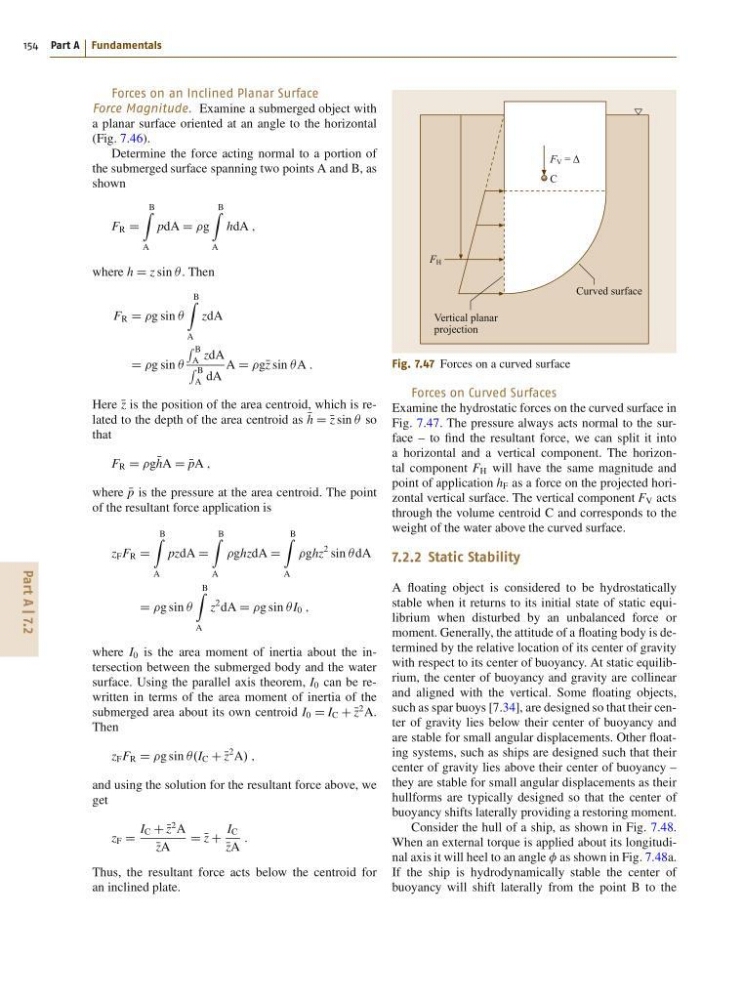
Fig. 7.47 Forces on a curved surface
Forces on Curved Surfaces
Examine the hydrostatic forces on the curved surface in
Fig. 7.47. The pressure always acts normal to the surface – to find the resultant force, we can split it into
a horizontal and a vertical component. The horizontal component F H will have the same magnitude and
point of application h F as a force on the projected horizontal vertical surface. The vertical component F V acts
through the volume centroid C and corresponds to the
weight of the water above the curved surface.
7.2.2 Static Stability
A floating object is considered to be hydrostatically
stable when it returns to its initial state of static equilibrium when disturbed by an unbalanced force or
moment. Generally, the attitude of a floating body is determined by the relative location of its center of gravity
with respect to its center of buoyancy. At static equilibrium, the center of buoyancy and gravity are collinear
and aligned with the vertical. Some floating objects,
such as spar buoys [7.34], are designed so that their center of gravity lies below their center of buoyancy and
are stable for small angular displacements. Other floating systems, such as ships are designed such that their
center of gravity lies above their center of buoyancy –
they are stable for small angular displacements as their
hullforms are typically designed so that the center of
buoyancy shifts laterally providing a restoring moment.
Consider the hull of a ship, as shown in Fig. 7.48.
When an external torque is applied about its longitudinal axis it will heel to an angle as shown in Fig. 7.48a.
If the ship is hydrodynamically stable the center of
buoyancy will shift laterally from the point B to the
154 Part A Fundamentals
Forces on an Inclined Planar Surface
Force Magnitude. Examine a submerged object with
a planar surface oriented at an angle to the horizontal
(Fig. 7.46).
Determine the force acting normal to a portion of
the submerged surface spanning two points A and B, as
shown
F R D
B
Z
A
pdA D g
B
Z
A
hdA ;
where h D z sin  . Then
F R D g sin Â
B
Z
A
zdA
D g sin Â
R B
A zdA
R B
A dA
A D gN z sin  A :
Here N
z is the position of the area centroid, which is related to the depth of the area centroid as N
h D N
z sin  so
that
F R D g N
hA D N
pA ;
where N
p is the pressure at the area centroid. The point
of the resultant force application is
z F F R D
B
Z
A
pzdA D
B
Z
A
ghzdA D
B
Z
A
ghz
2 sin  dA
D g sin Â
B
Z
A
z
2 dA D g sin  I 0 ;
where I 0 is the area moment of inertia about the intersection between the submerged body and the water
surface. Using the parallel axis theorem, I 0 can be rewritten in terms of the area moment of inertia of the
submerged area about its own centroid I 0 D I C C N
z
2 A.
Then
z F F R D g sin Â.I C C N
z
2 A/ ;
and using the solution for the resultant force above, we
get
z F D
I C C N
z
2 A
N
zA
D N
z C
I C
N
zA
:
Thus, the resultant force acts below the centroid for
an inclined plate.
C
Vertical planar
projection
Curved surface
F H
F V = Δ
Fig. 7.47 Forces on a curved surface
Forces on Curved Surfaces
Examine the hydrostatic forces on the curved surface in
Fig. 7.47. The pressure always acts normal to the surface – to find the resultant force, we can split it into
a horizontal and a vertical component. The horizontal component F H will have the same magnitude and
point of application h F as a force on the projected horizontal vertical surface. The vertical component F V acts
through the volume centroid C and corresponds to the
weight of the water above the curved surface.
7.2.2 Static Stability
A floating object is considered to be hydrostatically
stable when it returns to its initial state of static equilibrium when disturbed by an unbalanced force or
moment. Generally, the attitude of a floating body is determined by the relative location of its center of gravity
with respect to its center of buoyancy. At static equilibrium, the center of buoyancy and gravity are collinear
and aligned with the vertical. Some floating objects,
such as spar buoys [7.34], are designed so that their center of gravity lies below their center of buoyancy and
are stable for small angular displacements. Other floating systems, such as ships are designed such that their
center of gravity lies above their center of buoyancy –
they are stable for small angular displacements as their
hullforms are typically designed so that the center of
buoyancy shifts laterally providing a restoring moment.
Consider the hull of a ship, as shown in Fig. 7.48.
When an external torque is applied about its longitudinal axis it will heel to an angle as shown in Fig. 7.48a.
If the ship is hydrodynamically stable the center of
buoyancy will shift laterally from the point B to the