

Hydromechanics 7.2 Fluid Statics 153
Part A | 7.2
7.2 Fluid Statics
In a solid, shear stress is directly proportional to shear
strain. In a fluid flow viscous shear (tangential) stresses
are directly proportional to the rate of change of shear
strain with time. When a fluid is at rest, there are no
tangential stresses and the only force between adjacent
fluid surfaces is normal to the surface. In static equilibrium, the surface force per unit area (pressure) at a point
is equal in all directions. However, owing to the density
of a fluid, a pressure gradient exists. If we assume that
gravity is acting in the z direction, the magnitude of
the pressure gradient is
dp
dz
D Dg :
Here, is the fluid density. A typical value of for seawater is D 1025:9 kg m
3 . The pressure gradient can
be integrated to give
p D p 0 gz ;
where p 0 is the pressure at z D 0. Thus, when density
and gravity can be taken as constant, we see that the
pressure varies linearly with depth. When z D 0 is taken
as the vertical location of a free surface of a body of
water, such as the sea, the local pressure can be taken
as atmospheric p atm . A typical value of atmospheric
pressure is p atm D 101 325 Pa D 1:013 bar. Sometimes
pressure is reported as gauge pressure p gauge , which is
the absolute pressure p, measured with respect to atmospheric pressure
p gauge D p p atm :
7.2.1 Pressure Forces on Surfaces
Forces on a Horizontal Planar Surface
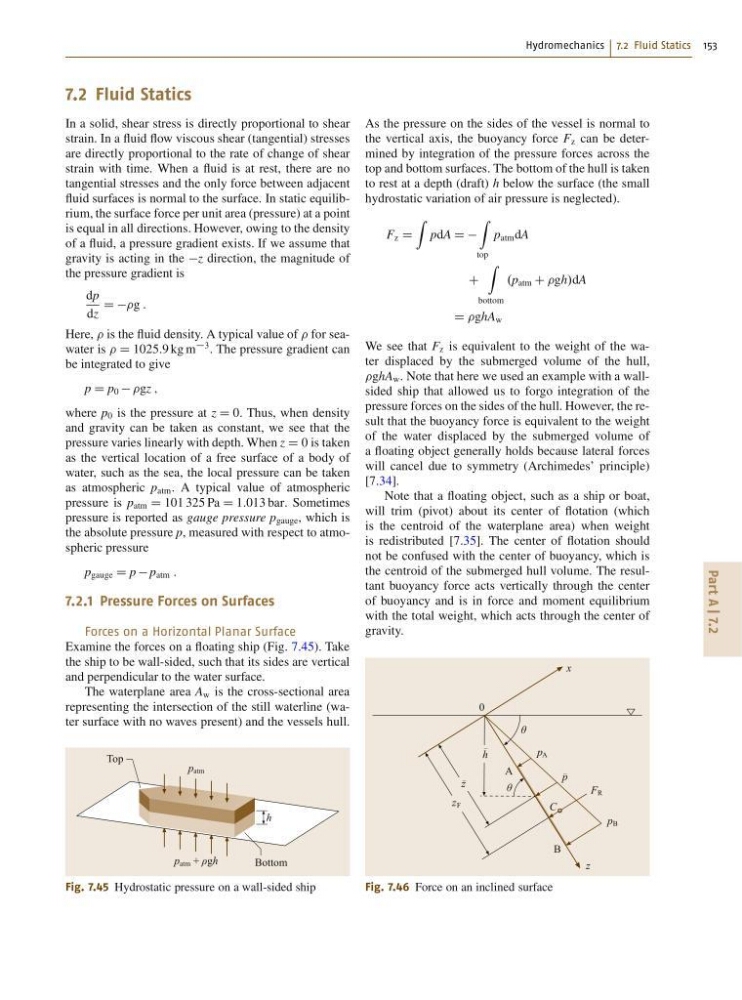
Examine the forces on a floating ship (Fig. 7.45). Take
the ship to be wall-sided, such that its sides are vertical
and perpendicular to the water surface.
The waterplane area A w is the cross-sectional area
representing the intersection of the still waterline (water surface with no waves present) and the vessels hull.
Top
Bottom
h
p atm
p atm + ρgh
Fig. 7.45 Hydrostatic pressure on a wall-sided ship
As the pressure on the sides of the vessel is normal to
the vertical axis, the buoyancy force F z can be determined by integration of the pressure forces across the
top and bottom surfaces. The bottom of the hull is taken
to rest at a depth (draft) h below the surface (the small
hydrostatic variation of air pressure is neglected).
F z D
Z
pdA D D
Z
top
p atm dA
C
Z
bottom
.p atm C gh/dA
D ghA w
We see that F z is equivalent to the weight of the water displaced by the submerged volume of the hull,
ghA w . Note that here we used an example with a wallsided ship that allowed us to forgo integration of the
pressure forces on the sides of the hull. However, the result that the buoyancy force is equivalent to the weight
of the water displaced by the submerged volume of
a floating object generally holds because lateral forces
will cancel due to symmetry (Archimedes’ principle)
[7.34].
Note that a floating object, such as a ship or boat,
will trim (pivot) about its center of flotation (which
is the centroid of the waterplane area) when weight
is redistributed [7.35]. The center of flotation should
not be confused with the center of buoyancy, which is
the centroid of the submerged hull volume. The resultant buoyancy force acts vertically through the center
of buoyancy and is in force and moment equilibrium
with the total weight, which acts through the center of
gravity.
A
0
B
C
θ
x
θ
p A
p B
z F
F R
z
p
–
z
–
h
–
Fig. 7.46 Force on an inclined surface
Part A | 7.2
7.2 Fluid Statics
In a solid, shear stress is directly proportional to shear
strain. In a fluid flow viscous shear (tangential) stresses
are directly proportional to the rate of change of shear
strain with time. When a fluid is at rest, there are no
tangential stresses and the only force between adjacent
fluid surfaces is normal to the surface. In static equilibrium, the surface force per unit area (pressure) at a point
is equal in all directions. However, owing to the density
of a fluid, a pressure gradient exists. If we assume that
gravity is acting in the z direction, the magnitude of
the pressure gradient is
dp
dz
D Dg :
Here, is the fluid density. A typical value of for seawater is D 1025:9 kg m
3 . The pressure gradient can
be integrated to give
p D p 0 gz ;
where p 0 is the pressure at z D 0. Thus, when density
and gravity can be taken as constant, we see that the
pressure varies linearly with depth. When z D 0 is taken
as the vertical location of a free surface of a body of
water, such as the sea, the local pressure can be taken
as atmospheric p atm . A typical value of atmospheric
pressure is p atm D 101 325 Pa D 1:013 bar. Sometimes
pressure is reported as gauge pressure p gauge , which is
the absolute pressure p, measured with respect to atmospheric pressure
p gauge D p p atm :
7.2.1 Pressure Forces on Surfaces
Forces on a Horizontal Planar Surface
Examine the forces on a floating ship (Fig. 7.45). Take
the ship to be wall-sided, such that its sides are vertical
and perpendicular to the water surface.
The waterplane area A w is the cross-sectional area
representing the intersection of the still waterline (water surface with no waves present) and the vessels hull.
Top
Bottom
h
p atm
p atm + ρgh
Fig. 7.45 Hydrostatic pressure on a wall-sided ship
As the pressure on the sides of the vessel is normal to
the vertical axis, the buoyancy force F z can be determined by integration of the pressure forces across the
top and bottom surfaces. The bottom of the hull is taken
to rest at a depth (draft) h below the surface (the small
hydrostatic variation of air pressure is neglected).
F z D
Z
pdA D D
Z
top
p atm dA
C
Z
bottom
.p atm C gh/dA
D ghA w
We see that F z is equivalent to the weight of the water displaced by the submerged volume of the hull,
ghA w . Note that here we used an example with a wallsided ship that allowed us to forgo integration of the
pressure forces on the sides of the hull. However, the result that the buoyancy force is equivalent to the weight
of the water displaced by the submerged volume of
a floating object generally holds because lateral forces
will cancel due to symmetry (Archimedes’ principle)
[7.34].
Note that a floating object, such as a ship or boat,
will trim (pivot) about its center of flotation (which
is the centroid of the waterplane area) when weight
is redistributed [7.35]. The center of flotation should
not be confused with the center of buoyancy, which is
the centroid of the submerged hull volume. The resultant buoyancy force acts vertically through the center
of buoyancy and is in force and moment equilibrium
with the total weight, which acts through the center of
gravity.
A
0
B
C
θ
x
θ
p A
p B
z F
F R
z
p
–
z
–
h
–
Fig. 7.46 Force on an inclined surface