

Hydromechanics 7.1 Dimensional Analysis, Basic Estimation, and Model Testing 149
Part A | 7.1
Fig. 7.29 An ultra large crude carrier (ULCC)
ing at speed, and the effects of the wave wash
created [7.3].
Basic Hull Forms. The Froude number determines the
hull type (adapted from [7.29]):
1. Displacement hulls:
Fr Ä 0:4 Hydrostatic buoyancy completely dominates. Examples of this type of ship include cruise
ships, common carriers (bulk transports, cargo
ships, reefers), roll on roll off (RORO) ships, fishing trawlers, tankers, and submarines (Figs. 7.28
and 7.29).
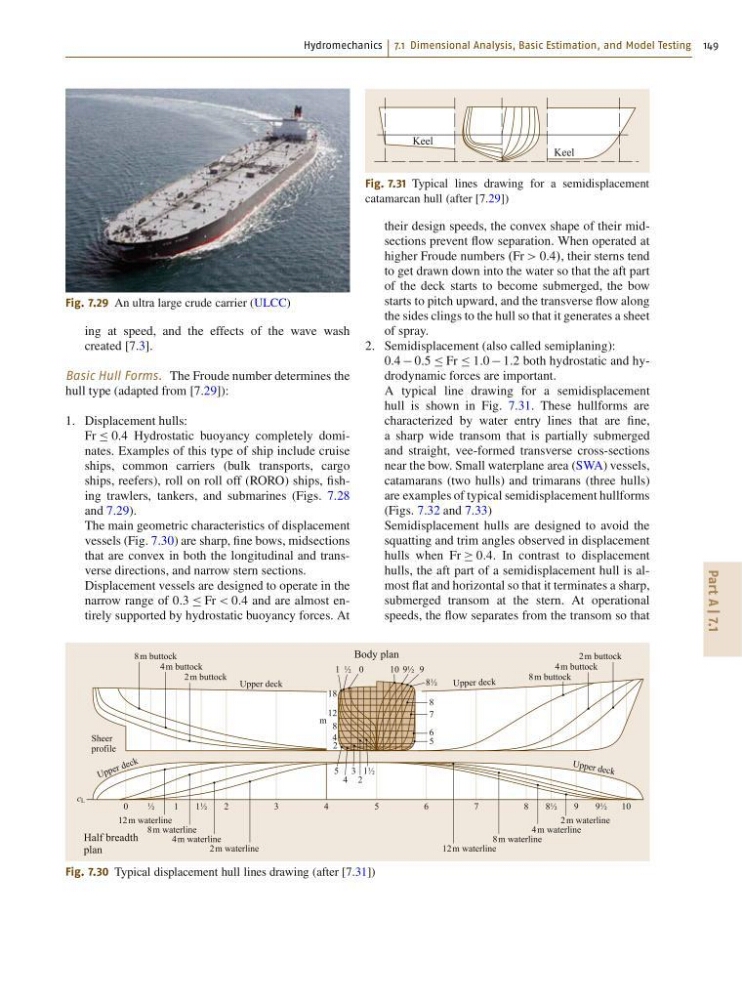
The main geometric characteristics of displacement
vessels (Fig. 7.30) are sharp, fine bows, midsections
that are convex in both the longitudinal and transverse directions, and narrow stern sections.
Displacement vessels are designed to operate in the
narrow range of 0:3 Ä Fr < 0:4 and are almost entirely supported by hydrostatic buoyancy forces. At
c L
½
1
0
1 ½
2
3
4
5
5
1
0
10
9
2
4
8
m
12
18
3
4 2
1½
½
9 ½
8½
8
7
6
5
6
7
8
8 ½
9
9 ½
1 0
Body plan
Sheer
profile
Half breadth
plan
8m buttock
2 m buttock
4m buttock
4 m buttock
2m buttock
8 m buttock
12m waterline
2 m waterline
8m waterline
4 m waterline
4m waterline
8 m waterline
2m waterline
12 m waterline
Upper deck
Upper deck
U p p e r d e c k
Up pe r de ck
Fig. 7.30 Typical displacement hull lines drawing (after [7.31])
Keel
Keel
Fig. 7.31 Typical lines drawing for a semidisplacement
catamarcan hull (after [7.29])
their design speeds, the convex shape of their midsections prevent flow separation. When operated at
higher Froude numbers .Fr > 0:4/, their sterns tend
to get drawn down into the water so that the aft part
of the deck starts to become submerged, the bow
starts to pitch upward, and the transverse flow along
the sides clings to the hull so that it generates a sheet
of spray.
2. Semidisplacement (also called semiplaning):
0:4 0:5 Ä Fr Ä 1:0 1:2 both hydrostatic and hydrodynamic forces are important.
A typical line drawing for a semidisplacement
hull is shown in Fig. 7.31. These hullforms are
characterized by water entry lines that are fine,
a sharp wide transom that is partially submerged
and straight, vee-formed transverse cross-sections
near the bow. Small waterplane area (SWA) vessels,
catamarans (two hulls) and trimarans (three hulls)
are examples of typical semidisplacement hullforms
(Figs. 7.32 and 7.33)
Semidisplacement hulls are designed to avoid the
squatting and trim angles observed in displacement
hulls when Fr 0:4. In contrast to displacement
hulls, the aft part of a semidisplacement hull is almost flat and horizontal so that it terminates a sharp,
submerged transom at the stern. At operational
speeds, the flow separates from the transom so that
Part A | 7.1
Fig. 7.29 An ultra large crude carrier (ULCC)
ing at speed, and the effects of the wave wash
created [7.3].
Basic Hull Forms. The Froude number determines the
hull type (adapted from [7.29]):
1. Displacement hulls:
Fr Ä 0:4 Hydrostatic buoyancy completely dominates. Examples of this type of ship include cruise
ships, common carriers (bulk transports, cargo
ships, reefers), roll on roll off (RORO) ships, fishing trawlers, tankers, and submarines (Figs. 7.28
and 7.29).
The main geometric characteristics of displacement
vessels (Fig. 7.30) are sharp, fine bows, midsections
that are convex in both the longitudinal and transverse directions, and narrow stern sections.
Displacement vessels are designed to operate in the
narrow range of 0:3 Ä Fr < 0:4 and are almost entirely supported by hydrostatic buoyancy forces. At
c L
½
1
0
1 ½
2
3
4
5
5
1
0
10
9
2
4
8
m
12
18
3
4 2
1½
½
9 ½
8½
8
7
6
5
6
7
8
8 ½
9
9 ½
1 0
Body plan
Sheer
profile
Half breadth
plan
8m buttock
2 m buttock
4m buttock
4 m buttock
2m buttock
8 m buttock
12m waterline
2 m waterline
8m waterline
4 m waterline
4m waterline
8 m waterline
2m waterline
12 m waterline
Upper deck
Upper deck
U p p e r d e c k
Up pe r de ck
Fig. 7.30 Typical displacement hull lines drawing (after [7.31])
Keel
Keel
Fig. 7.31 Typical lines drawing for a semidisplacement
catamarcan hull (after [7.29])
their design speeds, the convex shape of their midsections prevent flow separation. When operated at
higher Froude numbers .Fr > 0:4/, their sterns tend
to get drawn down into the water so that the aft part
of the deck starts to become submerged, the bow
starts to pitch upward, and the transverse flow along
the sides clings to the hull so that it generates a sheet
of spray.
2. Semidisplacement (also called semiplaning):
0:4 0:5 Ä Fr Ä 1:0 1:2 both hydrostatic and hydrodynamic forces are important.
A typical line drawing for a semidisplacement
hull is shown in Fig. 7.31. These hullforms are
characterized by water entry lines that are fine,
a sharp wide transom that is partially submerged
and straight, vee-formed transverse cross-sections
near the bow. Small waterplane area (SWA) vessels,
catamarans (two hulls) and trimarans (three hulls)
are examples of typical semidisplacement hullforms
(Figs. 7.32 and 7.33)
Semidisplacement hulls are designed to avoid the
squatting and trim angles observed in displacement
hulls when Fr 0:4. In contrast to displacement
hulls, the aft part of a semidisplacement hull is almost flat and horizontal so that it terminates a sharp,
submerged transom at the stern. At operational
speeds, the flow separates from the transom so that