

Part A | 7.1
144 Part A Fundamentals
0
J
0.6 ≤ η p max ≤ 0.8, generally
K T , K Q decreases as
J increases
K Q = 0, no drag
propeller
windmills
K T < 0
K T vanishes
as α → 0
K Q > 0 due to
frictional drag
J → 0: K T , K Q max
η p = 0
Bollard pull condition
no forward speed
10 K Q
K T
η p
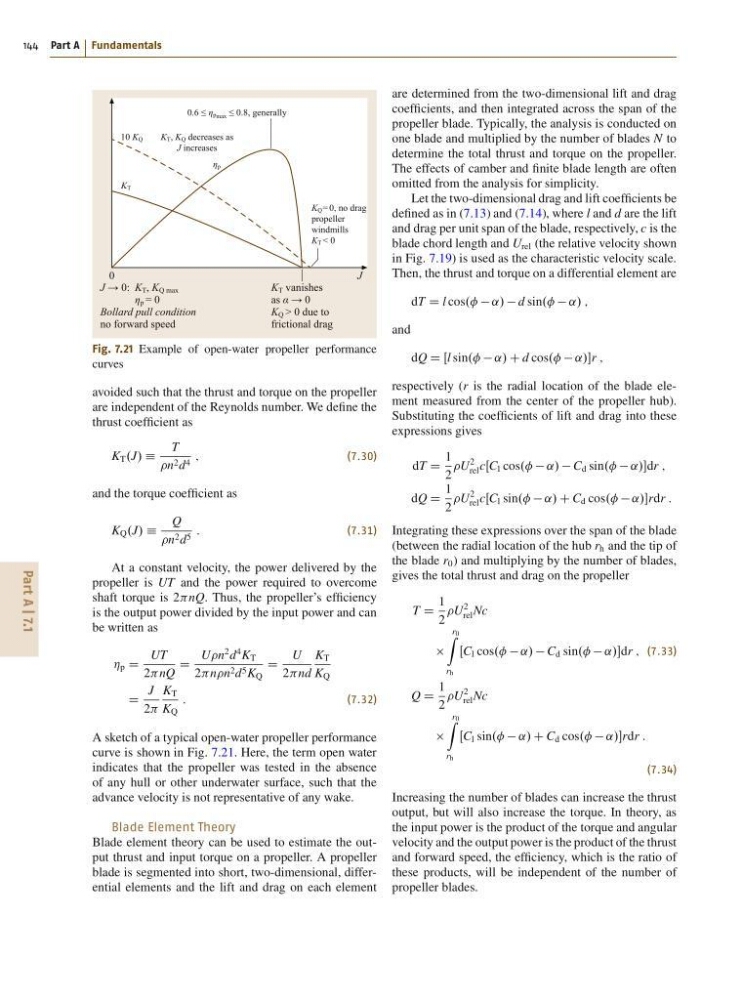
Fig. 7.21 Example of open-water propeller performance
curves
avoided such that the thrust and torque on the propeller
are independent of the Reynolds number. We define the
thrust coefficient as
K T .J/ Á
T
n 2 d 4 ;
(7.30)
and the torque coefficient as
K Q .J/ Á
Q
n 2 d 5 :
(7.31)
At a constant velocity, the power delivered by the
propeller is UT and the power required to overcome
shaft torque is 2nQ. Thus, the propeller’s efficiency
is the output power divided by the input power and can
be written as
Á p D
UT
2nQ
D
Un
2 d
4 K T
2nn 2 d 5 K Q
D
U
2nd
K T
K Q
D
J
2
K T
K Q
:
(7.32)
A sketch of a typical open-water propeller performance
curve is shown in Fig. 7.21. Here, the term open water
indicates that the propeller was tested in the absence
of any hull or other underwater surface, such that the
advance velocity is not representative of any wake.
Blade Element Theory
Blade element theory can be used to estimate the output thrust and input torque on a propeller. A propeller
blade is segmented into short, two-dimensional, differential elements and the lift and drag on each element
are determined from the two-dimensional lift and drag
coefficients, and then integrated across the span of the
propeller blade. Typically, the analysis is conducted on
one blade and multiplied by the number of blades N to
determine the total thrust and torque on the propeller.
The effects of camber and finite blade length are often
omitted from the analysis for simplicity.
Let the two-dimensional drag and lift coefficients be
defined as in (7.13) and (7.14), where l and d are the lift
and drag per unit span of the blade, respectively, c is the
blade chord length and U rel (the relative velocity shown
in Fig. 7.19) is used as the characteristic velocity scale.
Then, the thrust and torque on a differential element are
dT D l cos.. ˛/ d sin.. ˛/ ;
and
dQ D Œl sin.. ˛/ C d cos.. ˛/r ;
respectively (r is the radial location of the blade element measured from the center of the propeller hub).
Substituting the coefficients of lift and drag into these
expressions gives
dT D
1
2
U
2
rel cŒC l cos.. ˛/ C d sin.. ˛/dr ;
dQ D
1
2
U
2
rel cŒC l sin.. ˛/ C C d cos.. ˛/rdr :
Integrating these expressions over the span of the blade
(between the radial location of the hub r h and the tip of
the blade r 0 ) and multiplying by the number of blades,
gives the total thrust and drag on the propeller
T D
1
2
U
2
rel Nc
r0
Z
rh
ŒC l cos.. ˛/ C d sin.. ˛/dr ; (7.33)
Q D
1
2
U
2
rel Nc
r0
Z
rh
ŒC l sin.. ˛/ C C d cos.. ˛/rdr :
(7.34)
Increasing the number of blades can increase the thrust
output, but will also increase the torque. In theory, as
the input power is the product of the torque and angular
velocity and the output power is the product of the thrust
and forward speed, the efficiency, which is the ratio of
these products, will be independent of the number of
propeller blades.
144 Part A Fundamentals
0
J
0.6 ≤ η p max ≤ 0.8, generally
K T , K Q decreases as
J increases
K Q = 0, no drag
propeller
windmills
K T < 0
K T vanishes
as α → 0
K Q > 0 due to
frictional drag
J → 0: K T , K Q max
η p = 0
Bollard pull condition
no forward speed
10 K Q
K T
η p
Fig. 7.21 Example of open-water propeller performance
curves
avoided such that the thrust and torque on the propeller
are independent of the Reynolds number. We define the
thrust coefficient as
K T .J/ Á
T
n 2 d 4 ;
(7.30)
and the torque coefficient as
K Q .J/ Á
Q
n 2 d 5 :
(7.31)
At a constant velocity, the power delivered by the
propeller is UT and the power required to overcome
shaft torque is 2nQ. Thus, the propeller’s efficiency
is the output power divided by the input power and can
be written as
Á p D
UT
2nQ
D
Un
2 d
4 K T
2nn 2 d 5 K Q
D
U
2nd
K T
K Q
D
J
2
K T
K Q
:
(7.32)
A sketch of a typical open-water propeller performance
curve is shown in Fig. 7.21. Here, the term open water
indicates that the propeller was tested in the absence
of any hull or other underwater surface, such that the
advance velocity is not representative of any wake.
Blade Element Theory
Blade element theory can be used to estimate the output thrust and input torque on a propeller. A propeller
blade is segmented into short, two-dimensional, differential elements and the lift and drag on each element
are determined from the two-dimensional lift and drag
coefficients, and then integrated across the span of the
propeller blade. Typically, the analysis is conducted on
one blade and multiplied by the number of blades N to
determine the total thrust and torque on the propeller.
The effects of camber and finite blade length are often
omitted from the analysis for simplicity.
Let the two-dimensional drag and lift coefficients be
defined as in (7.13) and (7.14), where l and d are the lift
and drag per unit span of the blade, respectively, c is the
blade chord length and U rel (the relative velocity shown
in Fig. 7.19) is used as the characteristic velocity scale.
Then, the thrust and torque on a differential element are
dT D l cos.. ˛/ d sin.. ˛/ ;
and
dQ D Œl sin.. ˛/ C d cos.. ˛/r ;
respectively (r is the radial location of the blade element measured from the center of the propeller hub).
Substituting the coefficients of lift and drag into these
expressions gives
dT D
1
2
U
2
rel cŒC l cos.. ˛/ C d sin.. ˛/dr ;
dQ D
1
2
U
2
rel cŒC l sin.. ˛/ C C d cos.. ˛/rdr :
Integrating these expressions over the span of the blade
(between the radial location of the hub r h and the tip of
the blade r 0 ) and multiplying by the number of blades,
gives the total thrust and drag on the propeller
T D
1
2
U
2
rel Nc
r0
Z
rh
ŒC l cos.. ˛/ C d sin.. ˛/dr ; (7.33)
Q D
1
2
U
2
rel Nc
r0
Z
rh
ŒC l sin.. ˛/ C C d cos.. ˛/rdr :
(7.34)
Increasing the number of blades can increase the thrust
output, but will also increase the torque. In theory, as
the input power is the product of the torque and angular
velocity and the output power is the product of the thrust
and forward speed, the efficiency, which is the ratio of
these products, will be independent of the number of
propeller blades.