

Principles of Marine Corrosion 6.3 Marine Corrosion of Steel 115
Part A | 6.3
a) Early
micro-pits
b) Smaller pits grow
and join horizontally
c) Pits grow further
horizontally and vertically
d) Pits grow to form benches
as they join at edges
Bench
Bench
Bench
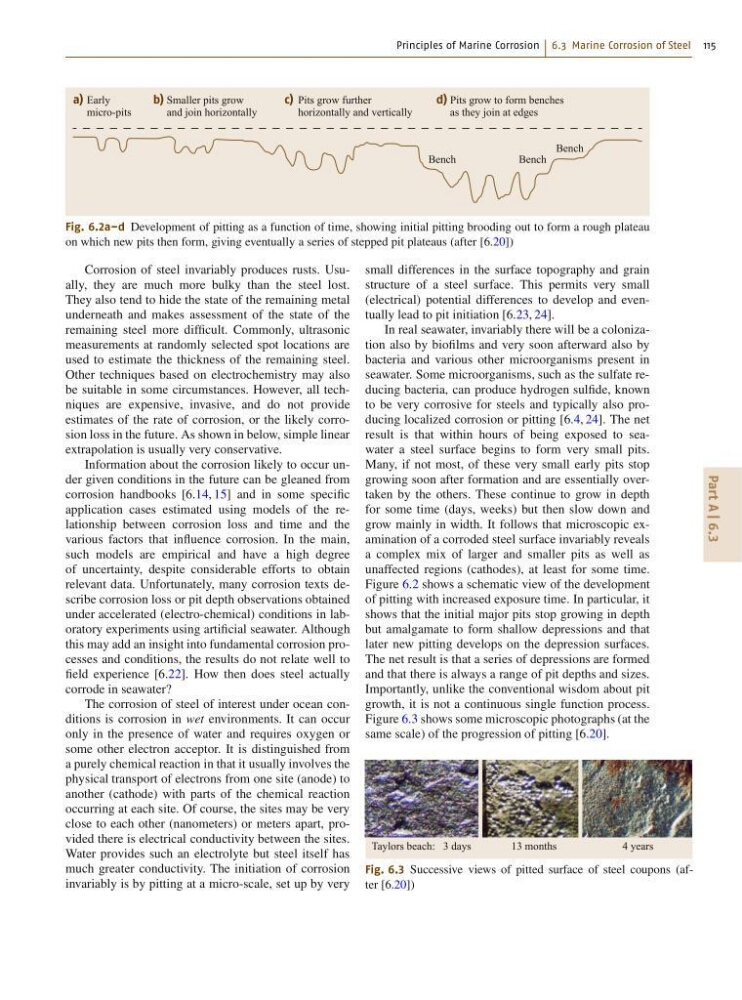
Fig. 6.2a–d Development of pitting as a function of time, showing initial pitting brooding out to form a rough plateau
on which new pits then form, giving eventually a series of stepped pit plateaus (after [6.20])
Corrosion of steel invariably produces rusts. Usually, they are much more bulky than the steel lost.
They also tend to hide the state of the remaining metal
underneath and makes assessment of the state of the
remaining steel more difficult. Commonly, ultrasonic
measurements at randomly selected spot locations are
used to estimate the thickness of the remaining steel.
Other techniques based on electrochemistry may also
be suitable in some circumstances. However, all techniques are expensive, invasive, and do not provide
estimates of the rate of corrosion, or the likely corrosion loss in the future. As shown in below, simple linear
extrapolation is usually very conservative.
Information about the corrosion likely to occur under given conditions in the future can be gleaned from
corrosion handbooks [6.14, 15] and in some specific
application cases estimated using models of the relationship between corrosion loss and time and the
various factors that influence corrosion. In the main,
such models are empirical and have a high degree
of uncertainty, despite considerable efforts to obtain
relevant data. Unfortunately, many corrosion texts describe corrosion loss or pit depth observations obtained
under accelerated (electro-chemical) conditions in laboratory experiments using artificial seawater. Although
this may add an insight into fundamental corrosion processes and conditions, the results do not relate well to
field experience [6.22]. How then does steel actually
corrode in seawater?
The corrosion of steel of interest under ocean conditions is corrosion in wet environments. It can occur
only in the presence of water and requires oxygen or
some other electron acceptor. It is distinguished from
a purely chemical reaction in that it usually involves the
physical transport of electrons from one site (anode) to
another (cathode) with parts of the chemical reaction
occurring at each site. Of course, the sites may be very
close to each other (nanometers) or meters apart, provided there is electrical conductivity between the sites.
Water provides such an electrolyte but steel itself has
much greater conductivity. The initiation of corrosion
invariably is by pitting at a micro-scale, set up by very
small differences in the surface topography and grain
structure of a steel surface. This permits very small
(electrical) potential differences to develop and eventually lead to pit initiation [6.23, 24].
In real seawater, invariably there will be a colonization also by biofilms and very soon afterward also by
bacteria and various other microorganisms present in
seawater. Some microorganisms, such as the sulfate reducing bacteria, can produce hydrogen sulfide, known
to be very corrosive for steels and typically also producing localized corrosion or pitting [6.4, 24]. The net
result is that within hours of being exposed to seawater a steel surface begins to form very small pits.
Many, if not most, of these very small early pits stop
growing soon after formation and are essentially overtaken by the others. These continue to grow in depth
for some time (days, weeks) but then slow down and
grow mainly in width. It follows that microscopic examination of a corroded steel surface invariably reveals
a complex mix of larger and smaller pits as well as
unaffected regions (cathodes), at least for some time.
Figure 6.2 shows a schematic view of the development
of pitting with increased exposure time. In particular, it
shows that the initial major pits stop growing in depth
but amalgamate to form shallow depressions and that
later new pitting develops on the depression surfaces.
The net result is that a series of depressions are formed
and that there is always a range of pit depths and sizes.
Importantly, unlike the conventional wisdom about pit
growth, it is not a continuous single function process.
Figure 6.3 shows some microscopic photographs (at the
same scale) of the progression of pitting [6.20].
Taylors beach: 3 days
13 months
4 years
Fig. 6.3 Successive views of pitted surface of steel coupons (after [6.20])
Part A | 6.3
a) Early
micro-pits
b) Smaller pits grow
and join horizontally
c) Pits grow further
horizontally and vertically
d) Pits grow to form benches
as they join at edges
Bench
Bench
Bench
Fig. 6.2a–d Development of pitting as a function of time, showing initial pitting brooding out to form a rough plateau
on which new pits then form, giving eventually a series of stepped pit plateaus (after [6.20])
Corrosion of steel invariably produces rusts. Usually, they are much more bulky than the steel lost.
They also tend to hide the state of the remaining metal
underneath and makes assessment of the state of the
remaining steel more difficult. Commonly, ultrasonic
measurements at randomly selected spot locations are
used to estimate the thickness of the remaining steel.
Other techniques based on electrochemistry may also
be suitable in some circumstances. However, all techniques are expensive, invasive, and do not provide
estimates of the rate of corrosion, or the likely corrosion loss in the future. As shown in below, simple linear
extrapolation is usually very conservative.
Information about the corrosion likely to occur under given conditions in the future can be gleaned from
corrosion handbooks [6.14, 15] and in some specific
application cases estimated using models of the relationship between corrosion loss and time and the
various factors that influence corrosion. In the main,
such models are empirical and have a high degree
of uncertainty, despite considerable efforts to obtain
relevant data. Unfortunately, many corrosion texts describe corrosion loss or pit depth observations obtained
under accelerated (electro-chemical) conditions in laboratory experiments using artificial seawater. Although
this may add an insight into fundamental corrosion processes and conditions, the results do not relate well to
field experience [6.22]. How then does steel actually
corrode in seawater?
The corrosion of steel of interest under ocean conditions is corrosion in wet environments. It can occur
only in the presence of water and requires oxygen or
some other electron acceptor. It is distinguished from
a purely chemical reaction in that it usually involves the
physical transport of electrons from one site (anode) to
another (cathode) with parts of the chemical reaction
occurring at each site. Of course, the sites may be very
close to each other (nanometers) or meters apart, provided there is electrical conductivity between the sites.
Water provides such an electrolyte but steel itself has
much greater conductivity. The initiation of corrosion
invariably is by pitting at a micro-scale, set up by very
small differences in the surface topography and grain
structure of a steel surface. This permits very small
(electrical) potential differences to develop and eventually lead to pit initiation [6.23, 24].
In real seawater, invariably there will be a colonization also by biofilms and very soon afterward also by
bacteria and various other microorganisms present in
seawater. Some microorganisms, such as the sulfate reducing bacteria, can produce hydrogen sulfide, known
to be very corrosive for steels and typically also producing localized corrosion or pitting [6.4, 24]. The net
result is that within hours of being exposed to seawater a steel surface begins to form very small pits.
Many, if not most, of these very small early pits stop
growing soon after formation and are essentially overtaken by the others. These continue to grow in depth
for some time (days, weeks) but then slow down and
grow mainly in width. It follows that microscopic examination of a corroded steel surface invariably reveals
a complex mix of larger and smaller pits as well as
unaffected regions (cathodes), at least for some time.
Figure 6.2 shows a schematic view of the development
of pitting with increased exposure time. In particular, it
shows that the initial major pits stop growing in depth
but amalgamate to form shallow depressions and that
later new pitting develops on the depression surfaces.
The net result is that a series of depressions are formed
and that there is always a range of pit depths and sizes.
Importantly, unlike the conventional wisdom about pit
growth, it is not a continuous single function process.
Figure 6.3 shows some microscopic photographs (at the
same scale) of the progression of pitting [6.20].
Taylors beach: 3 days
13 months
4 years
Fig. 6.3 Successive views of pitted surface of steel coupons (after [6.20])