

Part A | 5.11
108 Part A Fundamentals
Limits of prevailing noise
Wind-dependent bubble and spray noise
Heavy precipitation
Heavy traffic noise
Usual traffic noise–shallow water
Usual traffic noise–deep water
Thermal noise
Extrapolations
Low-frquency very-shallow-water
wind dependence
General pattern of noise from
earthquakes and explosions
10
1Sound pressure spectrum level (db re 0.0002 dyne/cm
2
)
10
2
10
3
10
4
10
5
Wind force
(beaufort)
8
5
3
2
1
Turbulent-pressure
fluctuations
Prevailing noises
Intermittent and local effects
Oceanic traffic
Sea ice
Biologics
Ships, industrial activity
Precipitation
Earthquakes
and explosions
Surfaces waves–second-order pressure effects
(seismic background)
Bubbles and spray
(surface agitation) Molecular
agitation
Frequency (cps)
120
100
80
60
40
20
0
–20
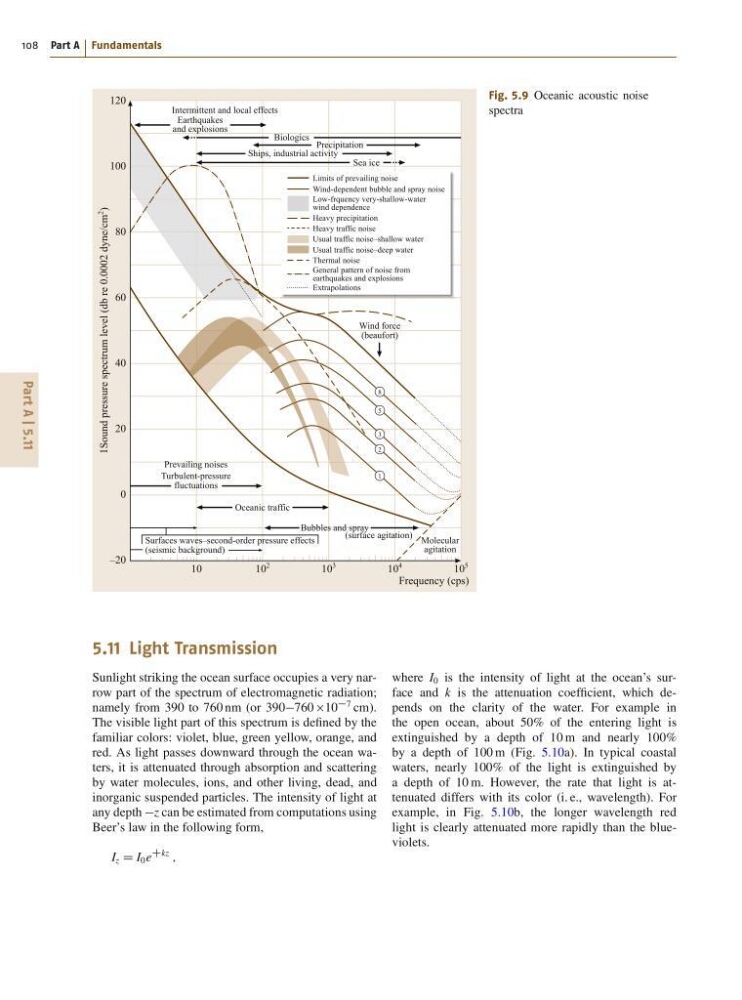
Fig. 5.9 Oceanic acoustic noise
spectra
5.11 Light Transmission
Sunlight striking the ocean surface occupies a very narrow part of the spectrum of electromagnetic radiation;
namely from 390 to 760 nm (or 390760 10
7 cm).
The visible light part of this spectrum is defined by the
familiar colors: violet, blue, green yellow, orange, and
red. As light passes downward through the ocean waters, it is attenuated through absorption and scattering
by water molecules, ions, and other living, dead, and
inorganic suspended particles. The intensity of light at
any depth z can be estimated from computations using
Beer’s law in the following form,
I z D I 0 e
Ckz
;
where I 0 is the intensity of light at the ocean’s surface and k is the attenuation coefficient, which depends on the clarity of the water. For example in
the open ocean, about 50% of the entering light is
extinguished by a depth of 10 m and nearly 100%
by a depth of 100 m (Fig. 5.10a). In typical coastal
waters, nearly 100% of the light is extinguished by
a depth of 10 m. However, the rate that light is attenuated differs with its color (i. e., wavelength). For
example, in Fig. 5.10b, the longer wavelength red
light is clearly attenuated more rapidly than the blueviolets.
108 Part A Fundamentals
Limits of prevailing noise
Wind-dependent bubble and spray noise
Heavy precipitation
Heavy traffic noise
Usual traffic noise–shallow water
Usual traffic noise–deep water
Thermal noise
Extrapolations
Low-frquency very-shallow-water
wind dependence
General pattern of noise from
earthquakes and explosions
10
1Sound pressure spectrum level (db re 0.0002 dyne/cm
2
)
10
2
10
3
10
4
10
5
Wind force
(beaufort)
8
5
3
2
1
Turbulent-pressure
fluctuations
Prevailing noises
Intermittent and local effects
Oceanic traffic
Sea ice
Biologics
Ships, industrial activity
Precipitation
Earthquakes
and explosions
Surfaces waves–second-order pressure effects
(seismic background)
Bubbles and spray
(surface agitation) Molecular
agitation
Frequency (cps)
120
100
80
60
40
20
0
–20
Fig. 5.9 Oceanic acoustic noise
spectra
5.11 Light Transmission
Sunlight striking the ocean surface occupies a very narrow part of the spectrum of electromagnetic radiation;
namely from 390 to 760 nm (or 390760 10
7 cm).
The visible light part of this spectrum is defined by the
familiar colors: violet, blue, green yellow, orange, and
red. As light passes downward through the ocean waters, it is attenuated through absorption and scattering
by water molecules, ions, and other living, dead, and
inorganic suspended particles. The intensity of light at
any depth z can be estimated from computations using
Beer’s law in the following form,
I z D I 0 e
Ckz
;
where I 0 is the intensity of light at the ocean’s surface and k is the attenuation coefficient, which depends on the clarity of the water. For example in
the open ocean, about 50% of the entering light is
extinguished by a depth of 10 m and nearly 100%
by a depth of 100 m (Fig. 5.10a). In typical coastal
waters, nearly 100% of the light is extinguished by
a depth of 10 m. However, the rate that light is attenuated differs with its color (i. e., wavelength). For
example, in Fig. 5.10b, the longer wavelength red
light is clearly attenuated more rapidly than the blueviolets.