

Physical Properties of Seawater 5.10 Acoustic Ambient Noise 107
Part A | 5.11
5.9 Sound Velocity
Communication in the ocean is done primarily with
sound, because the ocean is opaque to all forms of electromagnetic radiation (from long-radio waves through
short ultraviolet). Relative to electromagnetic radiation
the ocean is relatively transparent to sound transmission. This is because sea water is compressible and
so can support waves of compression and expansion,
or small fluctuations in pressure about the mean – or
sound. In the ocean, sound travels with a velocity of
about 1500 m=s or about five times faster than in air.
Acoustics are a valuable tool for communication and
getting a view through the ocean. The velocity of sound
is a function of the temperature, salinity, and pressure,
increasing with all three factors. (The work by Chen
and Millers [5.10] used standard sea water and so it is
both consistent with the Practical Salinity Scale of 1978
and in good agreement with values computed from the
1980 equation of state of sea water.) Temperature effects dominate the sound velocity profile in the upper
ocean causing a decrease in sound velocity with depth.
Pressure effects dominate in the deep ocean; increasing sound velocity with depth. Therefore, the resulting
sound speed profile has a minimum at about 1200 m
depth. The variations in sound velocity with depth have
little effect on vertical or near-vertical transmissions of
sound. However, the sound velocity profile and the minimum or sound channel have important implications for
horizontal or near-horizontal transmission of sound.
Sound traveling from a point source will spread out
spherically, so that the sound energy will decrease as
the square of the distance from the source. The limit to
the distance for effective sound transmission is reached
when the energy density equals that of the ambient
noise level (see below). If the sound energy can be confined between two vertical surfaces, then the reduction
in energy is dictated by cylindrical spreading to be proportional to the distance. Under those circumstances,
sound will travel further than in the point source case.
Sound travels along paths or rays whose orientation  (angle from vertical) is dictated by sound speed
C differences in two oceanic layers according to Snell’s
law
C 1 sin  2 D C 2 sin  1 ;
(5.9)
where the indices refer the 2 different oceanic layers.
From this relationship, it is obvious that the rays are
bent or refracted toward lower velocity. Thus, a ray path
from a source at the depth of the sound channel will be
refracted toward the sound channel. The energy contained within a solid angle marked by four rays being
emitted from the source is constant. Thus when the energy is concentrated in the sound channel, the energy
density loses are dictated more by cylindrical spreading
than spherical spreading. Hence, it is not surprising that
large distances can be obtained by transmitting near the
depth of the sound velocity minimum.
Sound transmission in the upper ocean is more difficult. Consider the case of a mixed layer where the
sound velocity is controlled by pressure and increases
with depth. Any sound transmitted into this region
will be bent toward the surface. If this layer is above
a layer with decreasing temperature which dominates
over pressure, then rays penetrating into this layer will
be refracted toward the bottom. This results in a shadow
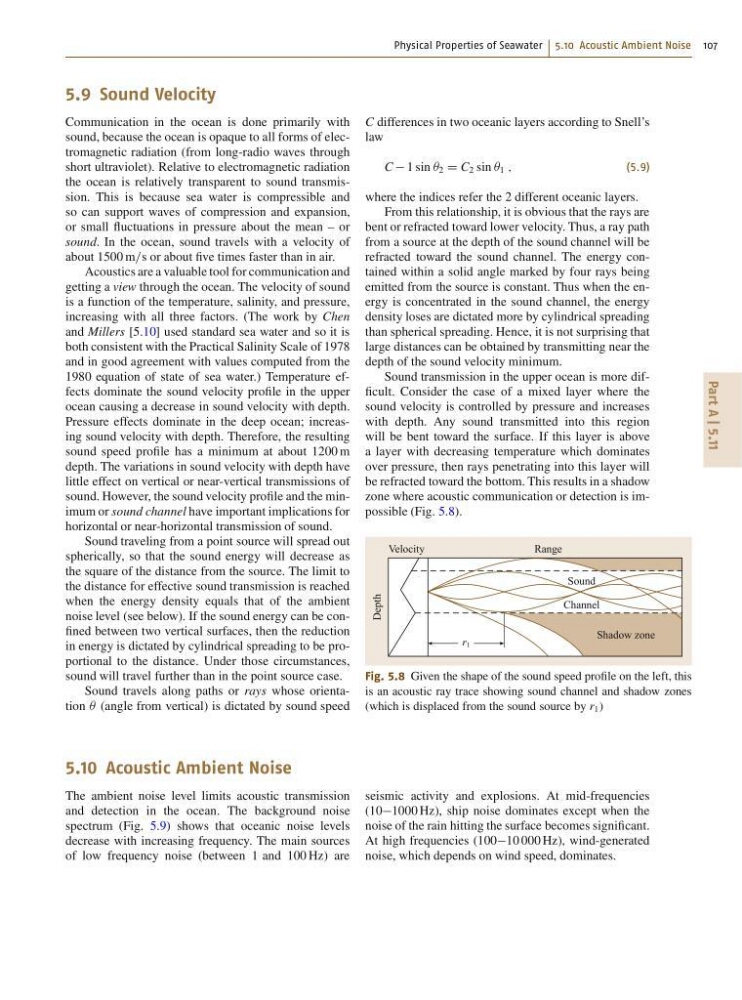
zone where acoustic communication or detection is impossible (Fig. 5.8).
r 1
Velocity
Range
Shadow zone
Channel
Sound
Depth
Fig. 5.8 Given the shape of the sound speed profile on the left, this
is an acoustic ray trace showing sound channel and shadow zones
(which is displaced from the sound source by r 1 )
5.10 Acoustic Ambient Noise
The ambient noise level limits acoustic transmission
and detection in the ocean. The background noise
spectrum (Fig. 5.9) shows that oceanic noise levels
decrease with increasing frequency. The main sources
of low frequency noise (between 1 and 100 Hz) are
seismic activity and explosions. At mid-frequencies
(101000 Hz), ship noise dominates except when the
noise of the rain hitting the surface becomes significant.
At high frequencies (10010 000 Hz), wind-generated
noise, which depends on wind speed, dominates.
Part A | 5.11
5.9 Sound Velocity
Communication in the ocean is done primarily with
sound, because the ocean is opaque to all forms of electromagnetic radiation (from long-radio waves through
short ultraviolet). Relative to electromagnetic radiation
the ocean is relatively transparent to sound transmission. This is because sea water is compressible and
so can support waves of compression and expansion,
or small fluctuations in pressure about the mean – or
sound. In the ocean, sound travels with a velocity of
about 1500 m=s or about five times faster than in air.
Acoustics are a valuable tool for communication and
getting a view through the ocean. The velocity of sound
is a function of the temperature, salinity, and pressure,
increasing with all three factors. (The work by Chen
and Millers [5.10] used standard sea water and so it is
both consistent with the Practical Salinity Scale of 1978
and in good agreement with values computed from the
1980 equation of state of sea water.) Temperature effects dominate the sound velocity profile in the upper
ocean causing a decrease in sound velocity with depth.
Pressure effects dominate in the deep ocean; increasing sound velocity with depth. Therefore, the resulting
sound speed profile has a minimum at about 1200 m
depth. The variations in sound velocity with depth have
little effect on vertical or near-vertical transmissions of
sound. However, the sound velocity profile and the minimum or sound channel have important implications for
horizontal or near-horizontal transmission of sound.
Sound traveling from a point source will spread out
spherically, so that the sound energy will decrease as
the square of the distance from the source. The limit to
the distance for effective sound transmission is reached
when the energy density equals that of the ambient
noise level (see below). If the sound energy can be confined between two vertical surfaces, then the reduction
in energy is dictated by cylindrical spreading to be proportional to the distance. Under those circumstances,
sound will travel further than in the point source case.
Sound travels along paths or rays whose orientation  (angle from vertical) is dictated by sound speed
C differences in two oceanic layers according to Snell’s
law
C 1 sin  2 D C 2 sin  1 ;
(5.9)
where the indices refer the 2 different oceanic layers.
From this relationship, it is obvious that the rays are
bent or refracted toward lower velocity. Thus, a ray path
from a source at the depth of the sound channel will be
refracted toward the sound channel. The energy contained within a solid angle marked by four rays being
emitted from the source is constant. Thus when the energy is concentrated in the sound channel, the energy
density loses are dictated more by cylindrical spreading
than spherical spreading. Hence, it is not surprising that
large distances can be obtained by transmitting near the
depth of the sound velocity minimum.
Sound transmission in the upper ocean is more difficult. Consider the case of a mixed layer where the
sound velocity is controlled by pressure and increases
with depth. Any sound transmitted into this region
will be bent toward the surface. If this layer is above
a layer with decreasing temperature which dominates
over pressure, then rays penetrating into this layer will
be refracted toward the bottom. This results in a shadow
zone where acoustic communication or detection is impossible (Fig. 5.8).
r 1
Velocity
Range
Shadow zone
Channel
Sound
Depth
Fig. 5.8 Given the shape of the sound speed profile on the left, this
is an acoustic ray trace showing sound channel and shadow zones
(which is displaced from the sound source by r 1 )
5.10 Acoustic Ambient Noise
The ambient noise level limits acoustic transmission
and detection in the ocean. The background noise
spectrum (Fig. 5.9) shows that oceanic noise levels
decrease with increasing frequency. The main sources
of low frequency noise (between 1 and 100 Hz) are
seismic activity and explosions. At mid-frequencies
(101000 Hz), ship noise dominates except when the
noise of the rain hitting the surface becomes significant.
At high frequencies (10010 000 Hz), wind-generated
noise, which depends on wind speed, dominates.