

Part A | 5.8
106 Part A Fundamentals
34
35
Atlantic ocean
South pacific ocean
Indian ocean
M
e d i t e r r a n e a n
w a t e r
2000 m
2000 m
2000 m
Suba ntarc tic wate r
Su
ba
nta
rct
ic
wa
ter
Su ba nta rct ic wa ter
North atlantic deep and
bottom water
A n ta r c ti c in te r m e d ia te
A n ta rc ti c
in te rm
e d ia te
w a te r
A n ta r c ti c
in te r m e d ia te
w a te r
w a te r
Antarctic
bottom
water
Antarctic bottom water
Circumpolar water
(1000– 4000 m)
Circumpolar water
(1000– 4000 m)
Circumpolar water
(1000 – 4000 m)
S o u th
a tl a n ti c c e n tr a l w a te r
E a st so u th p a c if ii c c e n tr a l w a te r
W e s t s o u th
p a c if ic
c e n tr a l w a te r
P a c if ic e q u a to ri a l
w a te r
Eq uat ori al wa ter
In d ia n c e n tr a l w a te r R e d s e a w a te r
N o rt h a tl a n ti c c e n tr a l w a te r
36
Temperature (°C)
Salinity (psu)
15
10
5
0
34
35
36
Temperature (°C)
Salinity (psu)
15
10
5
0
34
35
36
Temperature (°C)
Salinity (psu)
15
10
5
0
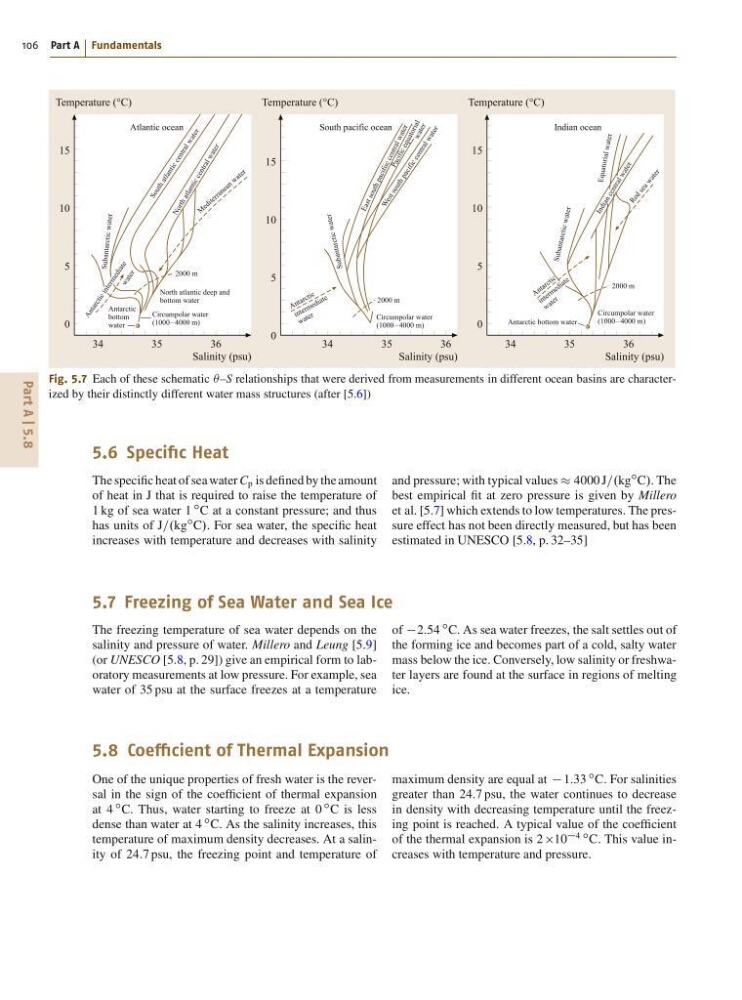
Fig. 5.7 Each of these schematic –S relationships that were derived from measurements in different ocean basins are characterized by their distinctly different water mass structures (after [5.6])
5.6 Specific Heat
The specific heat of sea water C p is defined by the amount
of heat in J that is required to raise the temperature of
1 kg of sea water 1
ı C at a constant pressure; and thus
has units of J=.kg
ı C/. For sea water, the specific heat
increases with temperature and decreases with salinity
and pressure; with typical values 4000 J=.kg
ı C/. The
best empirical fit at zero pressure is given by Millero
et al. [5.7] which extends to low temperatures. The pressure effect has not been directly measured, but has been
estimated in UNESCO [5.8, p. 32–35]
5.7 Freezing of Sea Water and Sea Ice
The freezing temperature of sea water depends on the
salinity and pressure of water. Millero and Leung [5.9]
(or UNESCO [5.8, p. 29]) give an empirical form to laboratory measurements at low pressure. For example, sea
water of 35 psu at the surface freezes at a temperature
of 2:54
ı C. As sea water freezes, the salt settles out of
the forming ice and becomes part of a cold, salty water
mass below the ice. Conversely, low salinity or freshwater layers are found at the surface in regions of melting
ice.
5.8 Coefficient of Thermal Expansion
One of the unique properties of fresh water is the reversal in the sign of the coefficient of thermal expansion
at 4
ı C. Thus, water starting to freeze at 0
ı C is less
dense than water at 4
ı C. As the salinity increases, this
temperature of maximum density decreases. At a salinity of 24:7 psu, the freezing point and temperature of
maximum density are equal at 1:33
ı C. For salinities
greater than 24:7 psu, the water continues to decrease
in density with decreasing temperature until the freezing point is reached. A typical value of the coefficient
of the thermal expansion is 2 10
4 ı C. This value increases with temperature and pressure.
106 Part A Fundamentals
34
35
Atlantic ocean
South pacific ocean
Indian ocean
M
e d i t e r r a n e a n
w a t e r
2000 m
2000 m
2000 m
Suba ntarc tic wate r
Su
ba
nta
rct
ic
wa
ter
Su ba nta rct ic wa ter
North atlantic deep and
bottom water
A n ta r c ti c in te r m e d ia te
A n ta rc ti c
in te rm
e d ia te
w a te r
A n ta r c ti c
in te r m e d ia te
w a te r
w a te r
Antarctic
bottom
water
Antarctic bottom water
Circumpolar water
(1000– 4000 m)
Circumpolar water
(1000– 4000 m)
Circumpolar water
(1000 – 4000 m)
S o u th
a tl a n ti c c e n tr a l w a te r
E a st so u th p a c if ii c c e n tr a l w a te r
W e s t s o u th
p a c if ic
c e n tr a l w a te r
P a c if ic e q u a to ri a l
w a te r
Eq uat ori al wa ter
In d ia n c e n tr a l w a te r R e d s e a w a te r
N o rt h a tl a n ti c c e n tr a l w a te r
36
Temperature (°C)
Salinity (psu)
15
10
5
0
34
35
36
Temperature (°C)
Salinity (psu)
15
10
5
0
34
35
36
Temperature (°C)
Salinity (psu)
15
10
5
0
Fig. 5.7 Each of these schematic –S relationships that were derived from measurements in different ocean basins are characterized by their distinctly different water mass structures (after [5.6])
5.6 Specific Heat
The specific heat of sea water C p is defined by the amount
of heat in J that is required to raise the temperature of
1 kg of sea water 1
ı C at a constant pressure; and thus
has units of J=.kg
ı C/. For sea water, the specific heat
increases with temperature and decreases with salinity
and pressure; with typical values 4000 J=.kg
ı C/. The
best empirical fit at zero pressure is given by Millero
et al. [5.7] which extends to low temperatures. The pressure effect has not been directly measured, but has been
estimated in UNESCO [5.8, p. 32–35]
5.7 Freezing of Sea Water and Sea Ice
The freezing temperature of sea water depends on the
salinity and pressure of water. Millero and Leung [5.9]
(or UNESCO [5.8, p. 29]) give an empirical form to laboratory measurements at low pressure. For example, sea
water of 35 psu at the surface freezes at a temperature
of 2:54
ı C. As sea water freezes, the salt settles out of
the forming ice and becomes part of a cold, salty water
mass below the ice. Conversely, low salinity or freshwater layers are found at the surface in regions of melting
ice.
5.8 Coefficient of Thermal Expansion
One of the unique properties of fresh water is the reversal in the sign of the coefficient of thermal expansion
at 4
ı C. Thus, water starting to freeze at 0
ı C is less
dense than water at 4
ı C. As the salinity increases, this
temperature of maximum density decreases. At a salinity of 24:7 psu, the freezing point and temperature of
maximum density are equal at 1:33
ı C. For salinities
greater than 24:7 psu, the water continues to decrease
in density with decreasing temperature until the freezing point is reached. A typical value of the coefficient
of the thermal expansion is 2 10
4 ı C. This value increases with temperature and pressure.