

72
Specialized buoys may come in different forms. Stainless steel, aluminum, or
fiberglass hulls provide the required buoyancy. Moorings can be simple single-line
constructs or complex systems incorporating dual anchors, elastic rubber bands, and
S-shaped inverse catenary forms incorporated into the nonelastic anchor line to
dampen chaotic buoy movement. Small spherical vessel designs under 1 m diameter
are favored for dedicated wave measurement buoys to maximize buoy response to
wave forcing (Fig. 3.3).
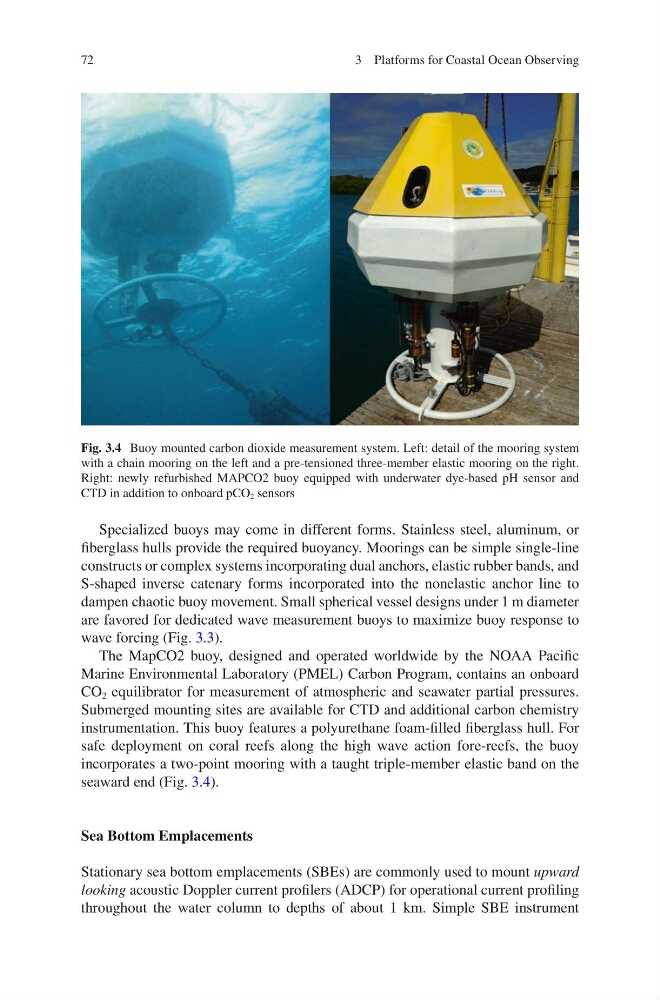
The MapCO2 buoy, designed and operated worldwide by the NOAA Pacific
Marine Environmental Laboratory (PMEL) Carbon Program, contains an onboard
CO 2 equilibrator for measurement of atmospheric and seawater partial pressures.
Submerged mounting sites are available for CTD and additional carbon chemistry
instrumentation. This buoy features a polyurethane foam-filled fiberglass hull. For
safe deployment on coral reefs along the high wave action fore-reefs, the buoy
incorporates a two-point mooring with a taught triple-member elastic band on the
seaward end (Fig. 3.4).
Sea Bottom Emplacements
Stationary sea bottom emplacements (SBEs) are commonly used to mount upward
looking acoustic Doppler current profilers (ADCP) for operational current profiling
throughout the water column to depths of about 1 km. Simple SBE instrument
Fig. 3.4 Buoy mounted carbon dioxide measurement system. Left: detail of the mooring system
with a chain mooring on the left and a pre-tensioned three-member elastic mooring on the right.
Right: newly refurbished MAPCO2 buoy equipped with underwater dye-based pH sensor and
CTD in addition to onboard pCO 2 sensors
3 Platforms for Coastal Ocean Observing
Specialized buoys may come in different forms. Stainless steel, aluminum, or
fiberglass hulls provide the required buoyancy. Moorings can be simple single-line
constructs or complex systems incorporating dual anchors, elastic rubber bands, and
S-shaped inverse catenary forms incorporated into the nonelastic anchor line to
dampen chaotic buoy movement. Small spherical vessel designs under 1 m diameter
are favored for dedicated wave measurement buoys to maximize buoy response to
wave forcing (Fig. 3.3).
The MapCO2 buoy, designed and operated worldwide by the NOAA Pacific
Marine Environmental Laboratory (PMEL) Carbon Program, contains an onboard
CO 2 equilibrator for measurement of atmospheric and seawater partial pressures.
Submerged mounting sites are available for CTD and additional carbon chemistry
instrumentation. This buoy features a polyurethane foam-filled fiberglass hull. For
safe deployment on coral reefs along the high wave action fore-reefs, the buoy
incorporates a two-point mooring with a taught triple-member elastic band on the
seaward end (Fig. 3.4).
Sea Bottom Emplacements
Stationary sea bottom emplacements (SBEs) are commonly used to mount upward
looking acoustic Doppler current profilers (ADCP) for operational current profiling
throughout the water column to depths of about 1 km. Simple SBE instrument
Fig. 3.4 Buoy mounted carbon dioxide measurement system. Left: detail of the mooring system
with a chain mooring on the left and a pre-tensioned three-member elastic mooring on the right.
Right: newly refurbished MAPCO2 buoy equipped with underwater dye-based pH sensor and
CTD in addition to onboard pCO 2 sensors
3 Platforms for Coastal Ocean Observing