

73
mounts built of aluminum or fiberglass can incorporate disposable ballast for ease
of recovery, either separate or as part of the base. To avoid entanglement in bottom
trawls, these stationary sea bottom emplacements can incorporate trawl resistant
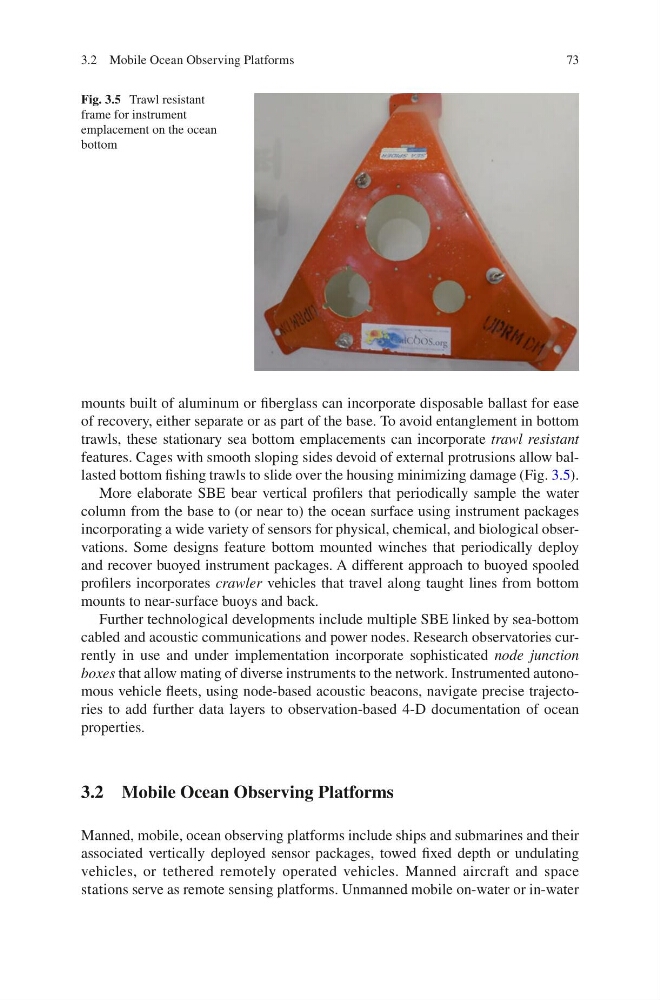
features. Cages with smooth sloping sides devoid of external protrusions allow ballasted bottom fishing trawls to slide over the housing minimizing damage (Fig. 3.5).
More elaborate SBE bear vertical profilers that periodically sample the water
column from the base to (or near to) the ocean surface using instrument packages
incorporating a wide variety of sensors for physical, chemical, and biological observations. Some designs feature bottom mounted winches that periodically deploy
and recover buoyed instrument packages. A different approach to buoyed spooled
profilers incorporates crawler vehicles that travel along taught lines from bottom
mounts to near-surface buoys and back.
Further technological developments include multiple SBE linked by sea-bottom
cabled and acoustic communications and power nodes. Research observatories currently in use and under implementation incorporate sophisticated node junction
boxes that allow mating of diverse instruments to the network. Instrumented autonomous vehicle fleets, using node-based acoustic beacons, navigate precise trajectories to add further data layers to observation-based 4-D documentation of ocean
properties.
3.2 Mobile Ocean Observing Platforms
Manned, mobile, ocean observing platforms include ships and submarines and their
associated vertically deployed sensor packages, towed fixed depth or undulating
vehicles, or tethered remotely operated vehicles. Manned aircraft and space
stations serve as remote sensing platforms. Unmanned mobile on-water or in-water
Fig. 3.5 Trawl resistant
frame for instrument
emplacement on the ocean
bottom
3.2 Mobile Ocean Observing Platforms
mounts built of aluminum or fiberglass can incorporate disposable ballast for ease
of recovery, either separate or as part of the base. To avoid entanglement in bottom
trawls, these stationary sea bottom emplacements can incorporate trawl resistant
features. Cages with smooth sloping sides devoid of external protrusions allow ballasted bottom fishing trawls to slide over the housing minimizing damage (Fig. 3.5).
More elaborate SBE bear vertical profilers that periodically sample the water
column from the base to (or near to) the ocean surface using instrument packages
incorporating a wide variety of sensors for physical, chemical, and biological observations. Some designs feature bottom mounted winches that periodically deploy
and recover buoyed instrument packages. A different approach to buoyed spooled
profilers incorporates crawler vehicles that travel along taught lines from bottom
mounts to near-surface buoys and back.
Further technological developments include multiple SBE linked by sea-bottom
cabled and acoustic communications and power nodes. Research observatories currently in use and under implementation incorporate sophisticated node junction
boxes that allow mating of diverse instruments to the network. Instrumented autonomous vehicle fleets, using node-based acoustic beacons, navigate precise trajectories to add further data layers to observation-based 4-D documentation of ocean
properties.
3.2 Mobile Ocean Observing Platforms
Manned, mobile, ocean observing platforms include ships and submarines and their
associated vertically deployed sensor packages, towed fixed depth or undulating
vehicles, or tethered remotely operated vehicles. Manned aircraft and space
stations serve as remote sensing platforms. Unmanned mobile on-water or in-water
Fig. 3.5 Trawl resistant
frame for instrument
emplacement on the ocean
bottom
3.2 Mobile Ocean Observing Platforms