

529
Soil and Vegetation Moisture Changes for Forest Fire Events
Fire detection rate = +
a
a b
.
The false-alarm rate is the proportion of nonfire cases that were incorrectly classified as fire, as calculated using the following equation:
False-alarm rate (commission error) = +
c
c d
.
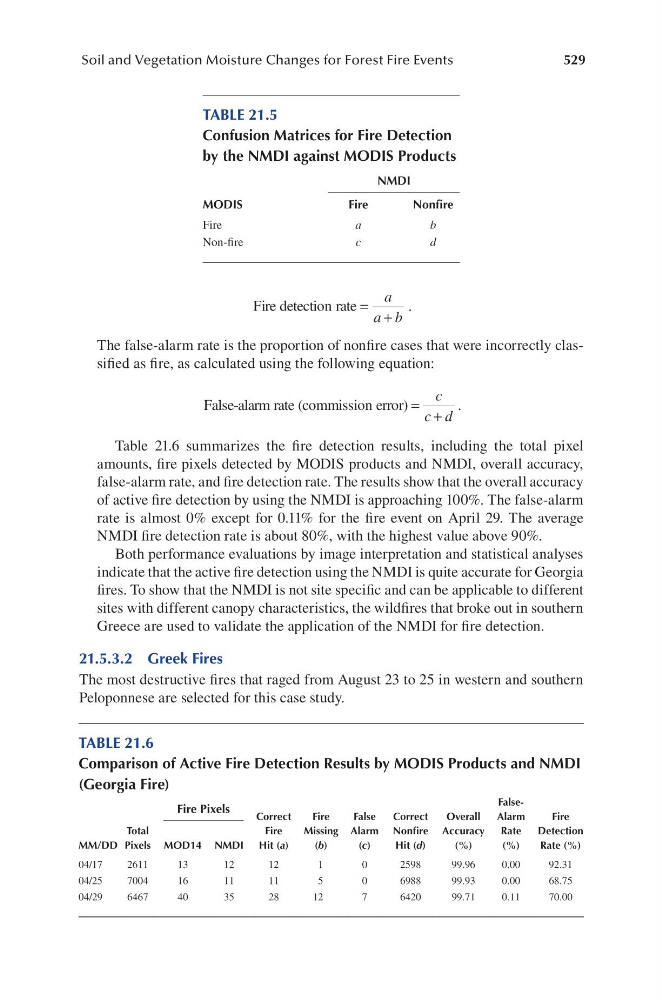
Table 21.6 summarizes the fire detection results, including the total pixel
amounts, fire pixels detected by MODIS products and NMDI, overall accuracy,
false-alarm rate, and fire detection rate. The results show that the overall accuracy
of active fire detection by using the NMDI is approaching 100%. The false-alarm
rate is almost 0% except for 0.11% for the fire event on April 29. The average
NMDI fire detection rate is about 80%, with the highest value above 90%.
Both performance evaluations by image interpretation and statistical analyses
indicate that the active fire detection using the NMDI is quite accurate for Georgia
fires. To show that the NMDI is not site specific and can be applicable to different
sites with different canopy characteristics, the wildfires that broke out in southern
Greece are used to validate the application of the NMDI for fire detection.
21.5.3.2 Greek Fires
The most destructive fires that raged from August 23 to 25 in western and southern
Peloponnese are selected for this case study.
TABLE 21.5
Confusion Matrices for Fire Detection
by the NMDI against MODIS Products
MODIS
NMDI
Fire
Nonfire
Fire
a
b
Non-fire
c
d
TABLE 21.6
Comparison of Active Fire Detection Results by MODIS Products and NMDI
(Georgia Fire)
MM/DD
Total
Pixels
Fire Pixels
Correct
Fire
Hit (a)
Fire
Missing
(b)
False
Alarm
(c)
Correct
Nonfire
Hit (d)
Overall
Accuracy
(%)
FalseAlarm
Rate
(%)
Fire
Detection
Rate (%)
MOD14 NMDI
04/17
2611
13
12
12
1
0
2598
99.96
0.00
92.31
04/25
7004
16
11
11
5
0
6988
99.93
0.00
68.75
04/29
6467
40
35
28
12
7
6420
99.71
0.11
70.00