

469
Remote Sensing and Modeling of Global Evapotranspiration
19.7 FURTHER IMPROVEMENTS
In the RS-ET algorithm, ET was calculated as the sum of the evaporation from
moist soil and the transpiration from the vegetation during daytime. Nighttime ET
was assumed to be small and negligible. Soil heat flux (G) was assumed to be zero.
For daily calculations, G might be ignored (Gavilána et al. 2007). G is a relatively
small component of the surface energy budget relative to sensible and latent energy
fluxes for most forest and grassland biomes (Ogée et al. 2001; da Rocha et al. 2004;
Tanaka et al., 2008) and is generally less than 20% of net incoming radiation for the
forest and grassland sites from this investigation (e.g., Weber et al. 2007; Granger
1999, http://www.taiga.net/wolfcreek/Proceedings_04.pdf). However, the assumption of negligible G in the RS-ET algorithm is a significant concern for tundra. In
the Arctic–Boreal regions, G can be a substantial amount of net radiation, especially early in the growing season. The assumption of a negligible G may be valid
in midlatitude regions on a daily basis; however, in these areas, a substantial portion
of net radiation melts ice in the active layer, especially early in the growing season
(Harazono et al. 1995; Engstrom et al. 2006). The RS-ET algorithm neglected the
evaporation from the intercepted precipitation from plant canopy. After the event of
precipitation, part of the vegetation and soil surface is covered by water. The evaporation from the saturated soil surface is much higher than the evaporation from the
unsaturated soil surface, and the evaporation from the intercepted water by canopy
is different from the canopy transpiration. Mu et al. (2011) have improved the RS-ET
algorithm by (1) simplifying the calculation of vegetation cover fraction; (2) calculating ET as the sum of daytime and nighttime components; (3) calculating soil heat
flux; (4) improving the methods of estimating stomatal conductance, aerodynamic
resistance, and boundary layer resistance; (5) separating dry canopy surface from the
wet, and hence, canopy water loss includes evaporation from the wet canopy surface
800
GMAO
ERA40
NCEP1
600
400
200
0
–60
–40
–20
0
20
40
Latitude ()
ET (mm ∙ year –1
)
60
80
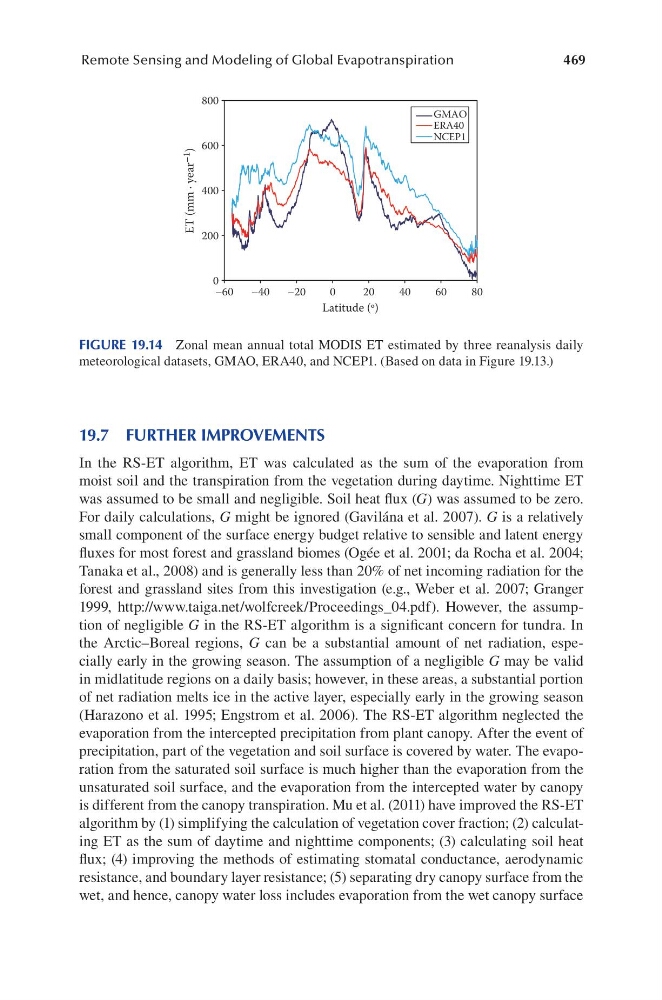
FIGURE 19.14 Zonal mean annual total MODIS ET estimated by three reanalysis daily
meteorological datasets, GMAO, ERA40, and NCEP1. (Based on data in Figure 19.13.)
Remote Sensing and Modeling of Global Evapotranspiration
19.7 FURTHER IMPROVEMENTS
In the RS-ET algorithm, ET was calculated as the sum of the evaporation from
moist soil and the transpiration from the vegetation during daytime. Nighttime ET
was assumed to be small and negligible. Soil heat flux (G) was assumed to be zero.
For daily calculations, G might be ignored (Gavilána et al. 2007). G is a relatively
small component of the surface energy budget relative to sensible and latent energy
fluxes for most forest and grassland biomes (Ogée et al. 2001; da Rocha et al. 2004;
Tanaka et al., 2008) and is generally less than 20% of net incoming radiation for the
forest and grassland sites from this investigation (e.g., Weber et al. 2007; Granger
1999, http://www.taiga.net/wolfcreek/Proceedings_04.pdf). However, the assumption of negligible G in the RS-ET algorithm is a significant concern for tundra. In
the Arctic–Boreal regions, G can be a substantial amount of net radiation, especially early in the growing season. The assumption of a negligible G may be valid
in midlatitude regions on a daily basis; however, in these areas, a substantial portion
of net radiation melts ice in the active layer, especially early in the growing season
(Harazono et al. 1995; Engstrom et al. 2006). The RS-ET algorithm neglected the
evaporation from the intercepted precipitation from plant canopy. After the event of
precipitation, part of the vegetation and soil surface is covered by water. The evaporation from the saturated soil surface is much higher than the evaporation from the
unsaturated soil surface, and the evaporation from the intercepted water by canopy
is different from the canopy transpiration. Mu et al. (2011) have improved the RS-ET
algorithm by (1) simplifying the calculation of vegetation cover fraction; (2) calculating ET as the sum of daytime and nighttime components; (3) calculating soil heat
flux; (4) improving the methods of estimating stomatal conductance, aerodynamic
resistance, and boundary layer resistance; (5) separating dry canopy surface from the
wet, and hence, canopy water loss includes evaporation from the wet canopy surface
800
GMAO
ERA40
NCEP1
600
400
200
0
–60
–40
–20
0
20
40
Latitude ()
ET (mm ∙ year –1
)
60
80
FIGURE 19.14 Zonal mean annual total MODIS ET estimated by three reanalysis daily
meteorological datasets, GMAO, ERA40, and NCEP1. (Based on data in Figure 19.13.)