

465
Remote Sensing and Modeling of Global Evapotranspiration
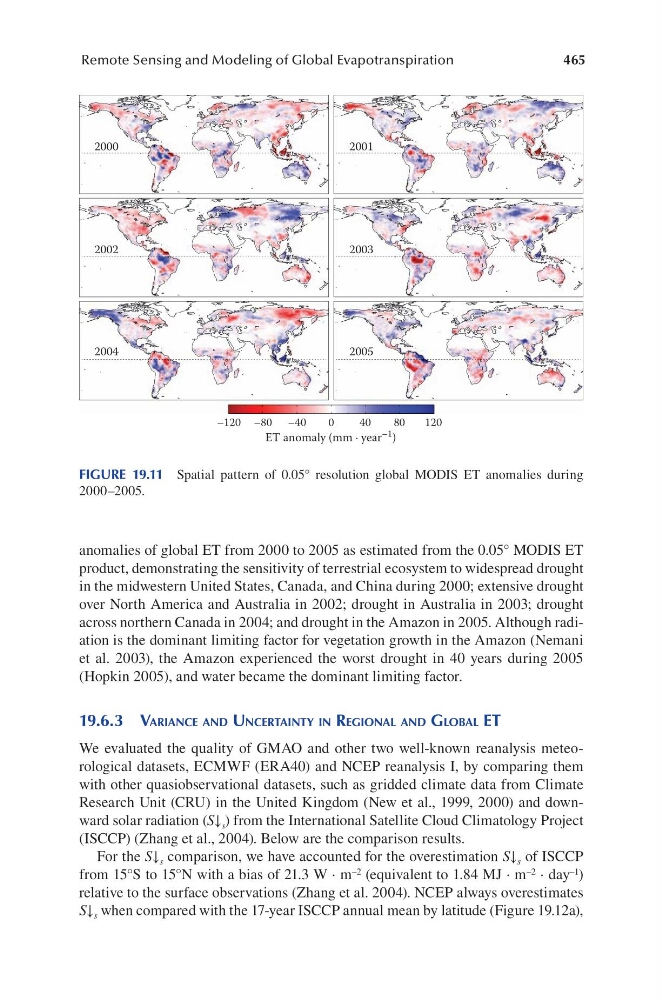
anomalies of global ET from 2000 to 2005 as estimated from the 0.05° MODIS ET
product, demonstrating the sensitivity of terrestrial ecosystem to widespread drought
in the midwestern United States, Canada, and China during 2000; extensive drought
over North America and Australia in 2002; drought in Australia in 2003; drought
across northern Canada in 2004; and drought in the Amazon in 2005. Although radiation is the dominant limiting factor for vegetation growth in the Amazon (Nemani
et al. 2003), the Amazon experienced the worst drought in 40 years during 2005
(Hopkin 2005), and water became the dominant limiting factor.
19.6.3 vaRiance and unceRtainty in Regional and gloBal et
We evaluated the quality of GMAO and other two well-known reanalysis meteorological datasets, ECMWF (ERA40) and NCEP reanalysis I, by comparing them
with other quasiobservational datasets, such as gridded climate data from Climate
Research Unit (CRU) in the United Kingdom (New et al., 1999, 2000) and downward solar radiation (S↓ s ) from the International Satellite Cloud Climatology Project
(ISCCP) (Zhang et al., 2004). Below are the comparison results.
For the S↓ s comparison, we have accounted for the overestimation S↓ s of ISCCP
from 15°S to 15°N with a bias of 21.3 W ∙ m –2 (equivalent to 1.84 MJ ∙ m –2 ∙ day –1 )
relative to the surface observations (Zhang et al. 2004). NCEP always overestimates
S↓ s when compared with the 17-year ISCCP annual mean by latitude (Figure 19.12a),
2000
2001
2002
2003
2004
2005
ET anomaly (mm ∙ year –1 )
–120 –80 –40
0
40
80
120
FIGURE 19.11 Spatial pattern of 0.05° resolution global MODIS ET anomalies during
2000–2005.
Remote Sensing and Modeling of Global Evapotranspiration
anomalies of global ET from 2000 to 2005 as estimated from the 0.05° MODIS ET
product, demonstrating the sensitivity of terrestrial ecosystem to widespread drought
in the midwestern United States, Canada, and China during 2000; extensive drought
over North America and Australia in 2002; drought in Australia in 2003; drought
across northern Canada in 2004; and drought in the Amazon in 2005. Although radiation is the dominant limiting factor for vegetation growth in the Amazon (Nemani
et al. 2003), the Amazon experienced the worst drought in 40 years during 2005
(Hopkin 2005), and water became the dominant limiting factor.
19.6.3 vaRiance and unceRtainty in Regional and gloBal et
We evaluated the quality of GMAO and other two well-known reanalysis meteorological datasets, ECMWF (ERA40) and NCEP reanalysis I, by comparing them
with other quasiobservational datasets, such as gridded climate data from Climate
Research Unit (CRU) in the United Kingdom (New et al., 1999, 2000) and downward solar radiation (S↓ s ) from the International Satellite Cloud Climatology Project
(ISCCP) (Zhang et al., 2004). Below are the comparison results.
For the S↓ s comparison, we have accounted for the overestimation S↓ s of ISCCP
from 15°S to 15°N with a bias of 21.3 W ∙ m –2 (equivalent to 1.84 MJ ∙ m –2 ∙ day –1 )
relative to the surface observations (Zhang et al. 2004). NCEP always overestimates
S↓ s when compared with the 17-year ISCCP annual mean by latitude (Figure 19.12a),
2000
2001
2002
2003
2004
2005
ET anomaly (mm ∙ year –1 )
–120 –80 –40
0
40
80
120
FIGURE 19.11 Spatial pattern of 0.05° resolution global MODIS ET anomalies during
2000–2005.