

451
Remote Sensing and Modeling of Global Evapotranspiration
term, which use the blue band to correct for aerosol influences in the red band; and
G F (gain factor) = 2.5. More details can be found in the work of Huete et al. (2002).
F C is defined as the fraction of ground surface covered by the maximum extent of
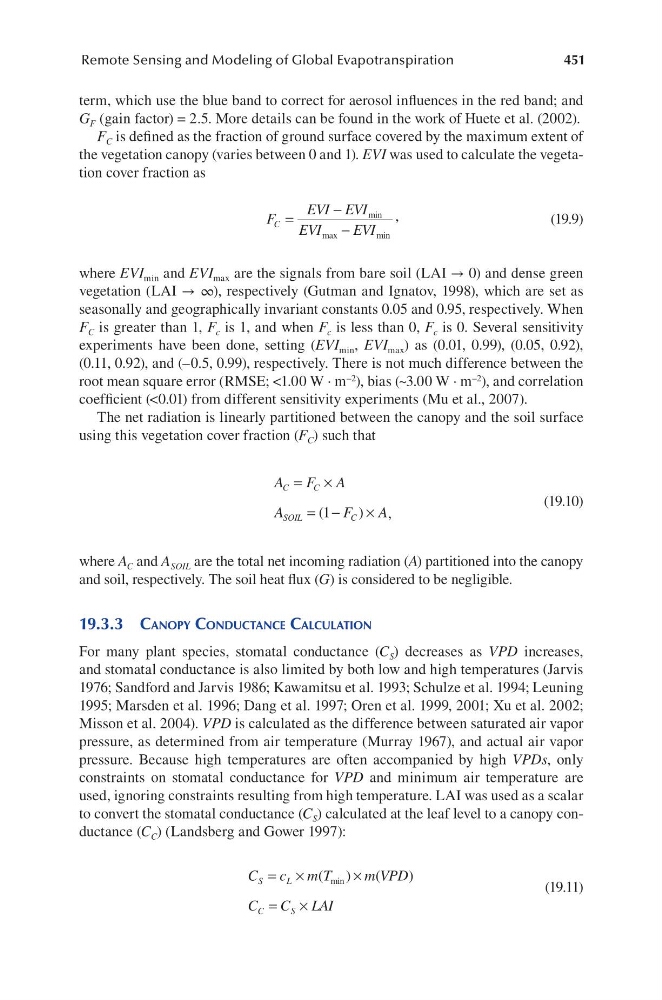
the vegetation canopy (varies between 0 and 1). EVI was used to calculate the vegetation cover fraction as
F
EVI EVI
EVI
EVI
C =
−
−
min
max
min
,
(19.9)
where EVI min and EVI max are the signals from bare soil (LAI → 0) and dense green
vegetation (LAI → ∞), respectively (Gutman and Ignatov, 1998), which are set as
seasonally and geographically invariant constants 0.05 and 0.95, respectively. When
F C is greater than 1, F c is 1, and when F c is less than 0, F c is 0. Several sensitivity
experiments have been done, setting (EVI min , EVI max ) as (0.01, 0.99), (0.05, 0.92),
(0.11, 0.92), and (–0.5, 0.99), respectively. There is not much difference between the
root mean square error (RMSE; <1.00 W ∙ m –2 ), bias (~3.00 W ∙ m –2 ), and correlation
coefficient (<0.01) from different sensitivity experiments (Mu et al., 2007).
The net radiation is linearly partitioned between the canopy and the soil surface
using this vegetation cover fraction (F C ) such that
A F A
A
F
A
C
C
SOIL
C
= ×
= −
×
(
)
1
,
(19.10)
where A C and A SOIL are the total net incoming radiation (A) partitioned into the canopy
and soil, respectively. The soil heat flux (G) is considered to be negligible.
19.3.3 canoPy conductance calculation
For many plant species, stomatal conductance (C S ) decreases as VPD increases,
and stomatal conductance is also limited by both low and high temperatures (Jarvis
1976; Sandford and Jarvis 1986; Kawamitsu et al. 1993; Schulze et al. 1994; Leuning
1995; Marsden et al. 1996; Dang et al. 1997; Oren et al. 1999, 2001; Xu et al. 2002;
Misson et al. 2004). VPD is calculated as the difference between saturated air vapor
pressure, as determined from air temperature (Murray 1967), and actual air vapor
pressure. Because high temperatures are often accompanied by high VPDs, only
constraints on stomatal conductance for VPD and minimum air temperature are
used, ignoring constraints resulting from high temperature. LAI was used as a scalar
to convert the stomatal conductance (C S ) calculated at the leaf level to a canopy conductance (C C ) (Landsberg and Gower 1997):
C c m T
m VPD
C C LAI
S
L
C
S
= ×
×
=
×
(
)
(
)
min
(19.11)
Remote Sensing and Modeling of Global Evapotranspiration
term, which use the blue band to correct for aerosol influences in the red band; and
G F (gain factor) = 2.5. More details can be found in the work of Huete et al. (2002).
F C is defined as the fraction of ground surface covered by the maximum extent of
the vegetation canopy (varies between 0 and 1). EVI was used to calculate the vegetation cover fraction as
F
EVI EVI
EVI
EVI
C =
−
−
min
max
min
,
(19.9)
where EVI min and EVI max are the signals from bare soil (LAI → 0) and dense green
vegetation (LAI → ∞), respectively (Gutman and Ignatov, 1998), which are set as
seasonally and geographically invariant constants 0.05 and 0.95, respectively. When
F C is greater than 1, F c is 1, and when F c is less than 0, F c is 0. Several sensitivity
experiments have been done, setting (EVI min , EVI max ) as (0.01, 0.99), (0.05, 0.92),
(0.11, 0.92), and (–0.5, 0.99), respectively. There is not much difference between the
root mean square error (RMSE; <1.00 W ∙ m –2 ), bias (~3.00 W ∙ m –2 ), and correlation
coefficient (<0.01) from different sensitivity experiments (Mu et al., 2007).
The net radiation is linearly partitioned between the canopy and the soil surface
using this vegetation cover fraction (F C ) such that
A F A
A
F
A
C
C
SOIL
C
= ×
= −
×
(
)
1
,
(19.10)
where A C and A SOIL are the total net incoming radiation (A) partitioned into the canopy
and soil, respectively. The soil heat flux (G) is considered to be negligible.
19.3.3 canoPy conductance calculation
For many plant species, stomatal conductance (C S ) decreases as VPD increases,
and stomatal conductance is also limited by both low and high temperatures (Jarvis
1976; Sandford and Jarvis 1986; Kawamitsu et al. 1993; Schulze et al. 1994; Leuning
1995; Marsden et al. 1996; Dang et al. 1997; Oren et al. 1999, 2001; Xu et al. 2002;
Misson et al. 2004). VPD is calculated as the difference between saturated air vapor
pressure, as determined from air temperature (Murray 1967), and actual air vapor
pressure. Because high temperatures are often accompanied by high VPDs, only
constraints on stomatal conductance for VPD and minimum air temperature are
used, ignoring constraints resulting from high temperature. LAI was used as a scalar
to convert the stomatal conductance (C S ) calculated at the leaf level to a canopy conductance (C C ) (Landsberg and Gower 1997):
C c m T
m VPD
C C LAI
S
L
C
S
= ×
×
=
×
(
)
(
)
min
(19.11)