

452
Multiscale Hydrologic Remote Sensing: Perspectives and Applications
where c L is the mean potential stomatal conductance per unit leaf area, m(T min ) is a
multiplier that limits the potential stomatal conductance by minimum air temperatures (T min ), and m(VPD) is a multiplier used to reduce the potential stomatal conductance when VPD is high enough to inhibit photosynthesis (Jarvis 1976; Sandford and
Jarvis 1986; Kawamitsu et al. 1993; Schulze et al. 1994; Leuning 1995; Marsden et
al. 1996; Dang et al. 1997; Oren et al. 1999, 2001; Xu and Baldocchi 2002; Misson
et al. 2004). In the case of plant transpiration, the surface conductance is equal to
the canopy conductance, and hence, the surface resistance (r s ) is the inverse of the
canopy conductance (C C ). In Equation 19.5, r a is set as a constant 20 m/s. The LAI
in Equation 19.11 is obtained from the global 8-day standard MODIS LAI product,
which is estimated using a canopy radiation transfer model combined with remotely
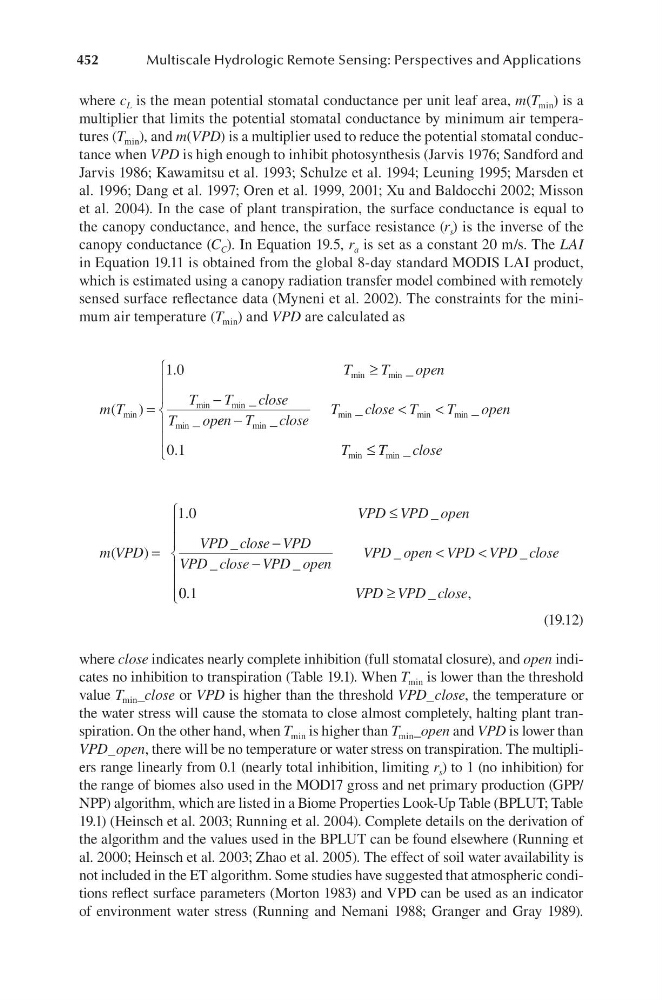
sensed surface reflectance data (Myneni et al. 2002). The constraints for the minimum air temperature (T min ) and VPD are calculated as
m T
T
T
open
T
T
close
T
op
(
)
.
_
_
_
min
min
min
min
min
min
=
≥
−
1 0
e en T
close
T
close T
T
open
T
−
<
<
≤
min
min
min
min
min
_
_
_
.
0 1
T
T
close
m VPD
VPD VPD open
VPD clo
min _
(
)
.
_
_
=
≤
1 0
s se VPD
VPD close VPD open
VPD open VPD VPD close
−
−
<
<
_
_
_
_
0 0 1
.
_
,
VPD VPD close
≥
(19.12)
where close indicates nearly complete inhibition (full stomatal closure), and open indicates no inhibition to transpiration (Table 19.1). When T min is lower than the threshold
value T min _close or VPD is higher than the threshold VPD_close, the temperature or
the water stress will cause the stomata to close almost completely, halting plant transpiration. On the other hand, when T min is higher than T min _open and VPD is lower than
VPD_open, there will be no temperature or water stress on transpiration. The multipliers range linearly from 0.1 (nearly total inhibition, limiting r s ) to 1 (no inhibition) for
the range of biomes also used in the MOD17 gross and net primary production (GPP/
NPP) algorithm, which are listed in a Biome Properties Look-Up Table (BPLUT; Table
19.1) (Heinsch et al. 2003; Running et al. 2004). Complete details on the derivation of
the algorithm and the values used in the BPLUT can be found elsewhere (Running et
al. 2000; Heinsch et al. 2003; Zhao et al. 2005). The effect of soil water availability is
not included in the ET algorithm. Some studies have suggested that atmospheric conditions reflect surface parameters (Morton 1983) and VPD can be used as an indicator
of environment water stress (Running and Nemani 1988; Granger and Gray 1989).
Multiscale Hydrologic Remote Sensing: Perspectives and Applications
where c L is the mean potential stomatal conductance per unit leaf area, m(T min ) is a
multiplier that limits the potential stomatal conductance by minimum air temperatures (T min ), and m(VPD) is a multiplier used to reduce the potential stomatal conductance when VPD is high enough to inhibit photosynthesis (Jarvis 1976; Sandford and
Jarvis 1986; Kawamitsu et al. 1993; Schulze et al. 1994; Leuning 1995; Marsden et
al. 1996; Dang et al. 1997; Oren et al. 1999, 2001; Xu and Baldocchi 2002; Misson
et al. 2004). In the case of plant transpiration, the surface conductance is equal to
the canopy conductance, and hence, the surface resistance (r s ) is the inverse of the
canopy conductance (C C ). In Equation 19.5, r a is set as a constant 20 m/s. The LAI
in Equation 19.11 is obtained from the global 8-day standard MODIS LAI product,
which is estimated using a canopy radiation transfer model combined with remotely
sensed surface reflectance data (Myneni et al. 2002). The constraints for the minimum air temperature (T min ) and VPD are calculated as
m T
T
T
open
T
T
close
T
op
(
)
.
_
_
_
min
min
min
min
min
min
=
≥
−
1 0
e en T
close
T
close T
T
open
T
−
<
<
≤
min
min
min
min
min
_
_
_
.
0 1
T
T
close
m VPD
VPD VPD open
VPD clo
min _
(
)
.
_
_
=
≤
1 0
s se VPD
VPD close VPD open
VPD open VPD VPD close
−
−
<
<
_
_
_
_
0 0 1
.
_
,
VPD VPD close
≥
(19.12)
where close indicates nearly complete inhibition (full stomatal closure), and open indicates no inhibition to transpiration (Table 19.1). When T min is lower than the threshold
value T min _close or VPD is higher than the threshold VPD_close, the temperature or
the water stress will cause the stomata to close almost completely, halting plant transpiration. On the other hand, when T min is higher than T min _open and VPD is lower than
VPD_open, there will be no temperature or water stress on transpiration. The multipliers range linearly from 0.1 (nearly total inhibition, limiting r s ) to 1 (no inhibition) for
the range of biomes also used in the MOD17 gross and net primary production (GPP/
NPP) algorithm, which are listed in a Biome Properties Look-Up Table (BPLUT; Table
19.1) (Heinsch et al. 2003; Running et al. 2004). Complete details on the derivation of
the algorithm and the values used in the BPLUT can be found elsewhere (Running et
al. 2000; Heinsch et al. 2003; Zhao et al. 2005). The effect of soil water availability is
not included in the ET algorithm. Some studies have suggested that atmospheric conditions reflect surface parameters (Morton 1983) and VPD can be used as an indicator
of environment water stress (Running and Nemani 1988; Granger and Gray 1989).