

447
Remote Sensing and Modeling of Global Evapotranspiration
of cloud-free LST (Wan et al. 2002), and thus, an 8-day composite daytime LST may
be overestimated at the average overpass time due to the exclusion of cloudy days.
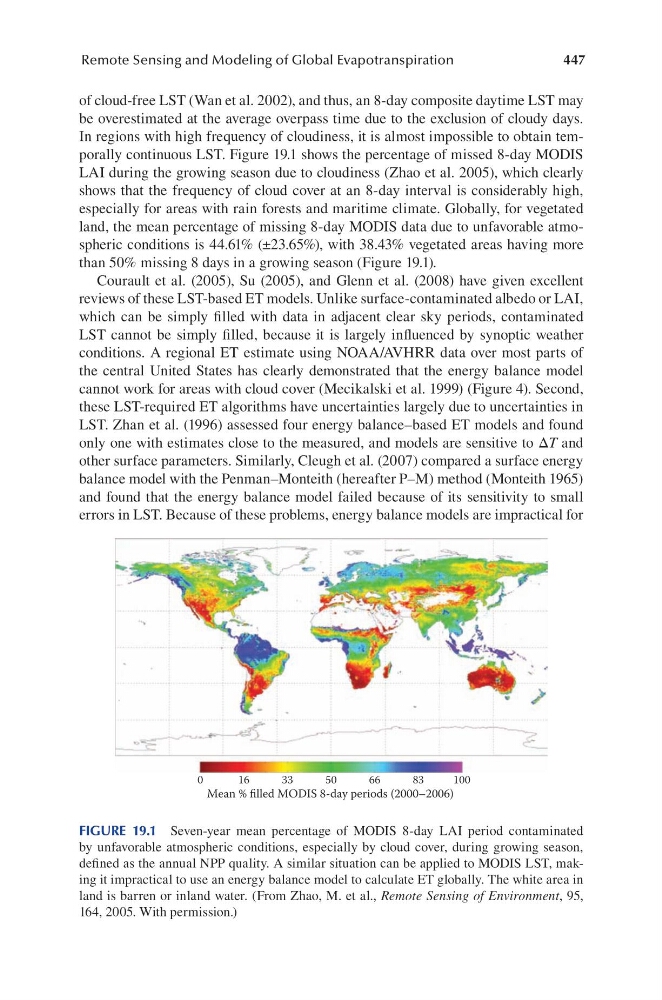
In regions with high frequency of cloudiness, it is almost impossible to obtain temporally continuous LST. Figure 19.1 shows the percentage of missed 8-day MODIS
LAI during the growing season due to cloudiness (Zhao et al. 2005), which clearly
shows that the frequency of cloud cover at an 8-day interval is considerably high,
especially for areas with rain forests and maritime climate. Globally, for vegetated
land, the mean percentage of missing 8-day MODIS data due to unfavorable atmospheric conditions is 44.61% (±23.65%), with 38.43% vegetated areas having more
than 50% missing 8 days in a growing season (Figure 19.1).
Courault et al. (2005), Su (2005), and Glenn et al. (2008) have given excellent
reviews of these LST-based ET models. Unlike surface-contaminated albedo or LAI,
which can be simply filled with data in adjacent clear sky periods, contaminated
LST cannot be simply filled, because it is largely influenced by synoptic weather
conditions. A regional ET estimate using NOAA/AVHRR data over most parts of
the central United States has clearly demonstrated that the energy balance model
cannot work for areas with cloud cover (Mecikalski et al. 1999) (Figure 4). Second,
these LST-required ET algorithms have uncertainties largely due to uncertainties in
LST. Zhan et al. (1996) assessed four energy balance–based ET models and found
only one with estimates close to the measured, and models are sensitive to ΔT and
other surface parameters. Similarly, Cleugh et al. (2007) compared a surface energy
balance model with the Penman–Monteith (hereafter P–M) method (Monteith 1965)
and found that the energy balance model failed because of its sensitivity to small
errors in LST. Because of these problems, energy balance models are impractical for
0
16
33
Mean % filled MODIS 8-day periods (2000–2006)
50
66
83
100
FIGURE 19.1 Seven-year mean percentage of MODIS 8-day LAI period contaminated
by unfavorable atmospheric conditions, especially by cloud cover, during growing season,
defined as the annual NPP quality. A similar situation can be applied to MODIS LST, making it impractical to use an energy balance model to calculate ET globally. The white area in
land is barren or inland water. (From Zhao, M. et al., Remote Sensing of Environment, 95,
164, 2005. With permission.)
Remote Sensing and Modeling of Global Evapotranspiration
of cloud-free LST (Wan et al. 2002), and thus, an 8-day composite daytime LST may
be overestimated at the average overpass time due to the exclusion of cloudy days.
In regions with high frequency of cloudiness, it is almost impossible to obtain temporally continuous LST. Figure 19.1 shows the percentage of missed 8-day MODIS
LAI during the growing season due to cloudiness (Zhao et al. 2005), which clearly
shows that the frequency of cloud cover at an 8-day interval is considerably high,
especially for areas with rain forests and maritime climate. Globally, for vegetated
land, the mean percentage of missing 8-day MODIS data due to unfavorable atmospheric conditions is 44.61% (±23.65%), with 38.43% vegetated areas having more
than 50% missing 8 days in a growing season (Figure 19.1).
Courault et al. (2005), Su (2005), and Glenn et al. (2008) have given excellent
reviews of these LST-based ET models. Unlike surface-contaminated albedo or LAI,
which can be simply filled with data in adjacent clear sky periods, contaminated
LST cannot be simply filled, because it is largely influenced by synoptic weather
conditions. A regional ET estimate using NOAA/AVHRR data over most parts of
the central United States has clearly demonstrated that the energy balance model
cannot work for areas with cloud cover (Mecikalski et al. 1999) (Figure 4). Second,
these LST-required ET algorithms have uncertainties largely due to uncertainties in
LST. Zhan et al. (1996) assessed four energy balance–based ET models and found
only one with estimates close to the measured, and models are sensitive to ΔT and
other surface parameters. Similarly, Cleugh et al. (2007) compared a surface energy
balance model with the Penman–Monteith (hereafter P–M) method (Monteith 1965)
and found that the energy balance model failed because of its sensitivity to small
errors in LST. Because of these problems, energy balance models are impractical for
0
16
33
Mean % filled MODIS 8-day periods (2000–2006)
50
66
83
100
FIGURE 19.1 Seven-year mean percentage of MODIS 8-day LAI period contaminated
by unfavorable atmospheric conditions, especially by cloud cover, during growing season,
defined as the annual NPP quality. A similar situation can be applied to MODIS LST, making it impractical to use an energy balance model to calculate ET globally. The white area in
land is barren or inland water. (From Zhao, M. et al., Remote Sensing of Environment, 95,
164, 2005. With permission.)