

419
Microwave Vegetation Indices from Satellite Passive Microwave Sensors
18.3 DERIVATION OF THE MICROWAVE VEGETATION
INDICES FROM SENSOR MEASUREMENTS AND
THEIR PHYSICAL CHARACTERISTICS
18.3.1 deRivation of MicRowave vegetation indiceS
fRoM aMSR-e MeaSuReMentS
At the passive microwave footprint scale, the observed vegetation canopy signals
represent the overall effect of the mixture of different vegetation canopy types presthe mixture of different vegetation canopy types presdifferent vegetation canopy types presy types prestypes pres- present. When many different types of vegetation canopies with different scatter sizes,
shapes, and orientations are averaged, we may reasonably assume that there is no
significant impact on the polarization dependence of the vegetation signals. This
assumption has been widely used in many studies for deriving soil moisture and
vegetation properties using passive microwave sensors (Owe et al. 2001; Paloscia
et al. 2006; Njoku and Chan 2006; van de Griend and Wigneron 2004), although
it needs to be further investigated. On the basis of this assumption, the vegetation
components of V e in Equation 18.3 and V a in Equation 18.4 and the microwave vegetation indeces A p and B p in Equation 18.10 will be independent of polarization. The
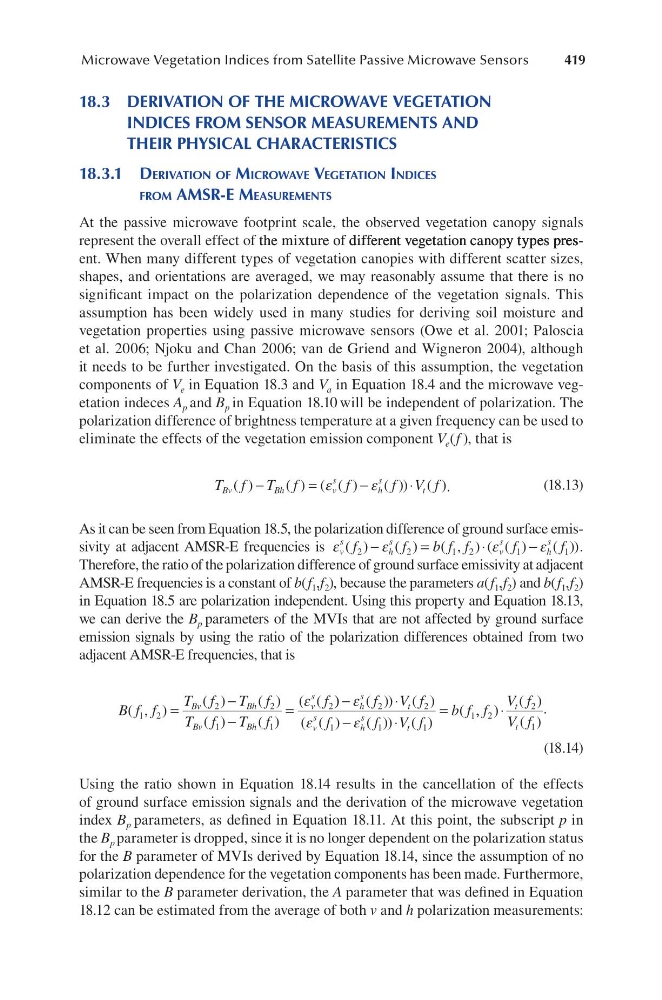
polarization difference of brightness temperature at a given frequency can be used to
eliminate the effects of the vegetation emission component V e (f ), that is
T f T f
f
f V f
Bv
Bh
v
s
h
s
t
( )
( ) ( ( )
( )) ( )
−
=
−
⋅
ε
ε
.
(18.13)
As it can be seen from Equation 18.5, the polarization difference of ground surface emissivity at adjacent AMSR-E frequencies is ε
ε
ε
ε
v
s
h
s
v
s
h
s
f
f
b f f
f
f
( )
( )
( , ) ( ( )
( ))
2
2
1 2
1
1
−
=
⋅
−
.
Therefore, the ratio of the polarization difference of ground surface emissivity at adjacent
AMSR-E frequencies is a constant of b(f 1 ,f 2 ), because the parameters a(f 1 ,f 2 ) and b(f 1 ,f 2 )
in Equation 18.5 are polarization independent. Using this property and Equation 18.13,
we can derive the B p parameters of the MVIs that are not affected by ground surface
emission signals by using the ratio of the polarization differences obtained from two
adjacent AMSR-E frequencies, that is
B f f
T f
T f
T f
T f
f
Bv
Bh
Bv
Bh
v
s
( , )
( )
( )
( )
( )
( (
1 2
2
2
1
1
2
=
−
−
=
ε
) )
( )) ( )
( ( )
( )) ( )
(
−
⋅
−
⋅
=
ε
ε
ε
h
s
t
v
s
h
s
t
f V f
f
f V f
b f
2
2
1
1
1
1 , , )
( )
( )
f
V f
V f
t
t
2
2
1
⋅
.
(18.14)
Using the ratio shown in Equation 18.14 results in the cancellation of the effects
of ground surface emission signals and the derivation of the microwave vegetation
index B p parameters, as defined in Equation 18.11. At this point, the subscript p in
the B p parameter is dropped, since it is no longer dependent on the polarization status
for the B parameter of MVIs derived by Equation 18.14, since the assumption of no
polarization dependence for the vegetation components has been made. Furthermore,
similar to the B parameter derivation, the A parameter that was defined in Equation
18.12 can be estimated from the average of both v and h polarization measurements:
Microwave Vegetation Indices from Satellite Passive Microwave Sensors
18.3 DERIVATION OF THE MICROWAVE VEGETATION
INDICES FROM SENSOR MEASUREMENTS AND
THEIR PHYSICAL CHARACTERISTICS
18.3.1 deRivation of MicRowave vegetation indiceS
fRoM aMSR-e MeaSuReMentS
At the passive microwave footprint scale, the observed vegetation canopy signals
represent the overall effect of the mixture of different vegetation canopy types presthe mixture of different vegetation canopy types presdifferent vegetation canopy types presy types prestypes pres- present. When many different types of vegetation canopies with different scatter sizes,
shapes, and orientations are averaged, we may reasonably assume that there is no
significant impact on the polarization dependence of the vegetation signals. This
assumption has been widely used in many studies for deriving soil moisture and
vegetation properties using passive microwave sensors (Owe et al. 2001; Paloscia
et al. 2006; Njoku and Chan 2006; van de Griend and Wigneron 2004), although
it needs to be further investigated. On the basis of this assumption, the vegetation
components of V e in Equation 18.3 and V a in Equation 18.4 and the microwave vegetation indeces A p and B p in Equation 18.10 will be independent of polarization. The
polarization difference of brightness temperature at a given frequency can be used to
eliminate the effects of the vegetation emission component V e (f ), that is
T f T f
f
f V f
Bv
Bh
v
s
h
s
t
( )
( ) ( ( )
( )) ( )
−
=
−
⋅
ε
ε
.
(18.13)
As it can be seen from Equation 18.5, the polarization difference of ground surface emissivity at adjacent AMSR-E frequencies is ε
ε
ε
ε
v
s
h
s
v
s
h
s
f
f
b f f
f
f
( )
( )
( , ) ( ( )
( ))
2
2
1 2
1
1
−
=
⋅
−
.
Therefore, the ratio of the polarization difference of ground surface emissivity at adjacent
AMSR-E frequencies is a constant of b(f 1 ,f 2 ), because the parameters a(f 1 ,f 2 ) and b(f 1 ,f 2 )
in Equation 18.5 are polarization independent. Using this property and Equation 18.13,
we can derive the B p parameters of the MVIs that are not affected by ground surface
emission signals by using the ratio of the polarization differences obtained from two
adjacent AMSR-E frequencies, that is
B f f
T f
T f
T f
T f
f
Bv
Bh
Bv
Bh
v
s
( , )
( )
( )
( )
( )
( (
1 2
2
2
1
1
2
=
−
−
=
ε
) )
( )) ( )
( ( )
( )) ( )
(
−
⋅
−
⋅
=
ε
ε
ε
h
s
t
v
s
h
s
t
f V f
f
f V f
b f
2
2
1
1
1
1 , , )
( )
( )
f
V f
V f
t
t
2
2
1
⋅
.
(18.14)
Using the ratio shown in Equation 18.14 results in the cancellation of the effects
of ground surface emission signals and the derivation of the microwave vegetation
index B p parameters, as defined in Equation 18.11. At this point, the subscript p in
the B p parameter is dropped, since it is no longer dependent on the polarization status
for the B parameter of MVIs derived by Equation 18.14, since the assumption of no
polarization dependence for the vegetation components has been made. Furthermore,
similar to the B parameter derivation, the A parameter that was defined in Equation
18.12 can be estimated from the average of both v and h polarization measurements: