

362
Multiscale Hydrologic Remote Sensing: Perspectives and Applications
14.3.4.1 OPO-Based DIAL
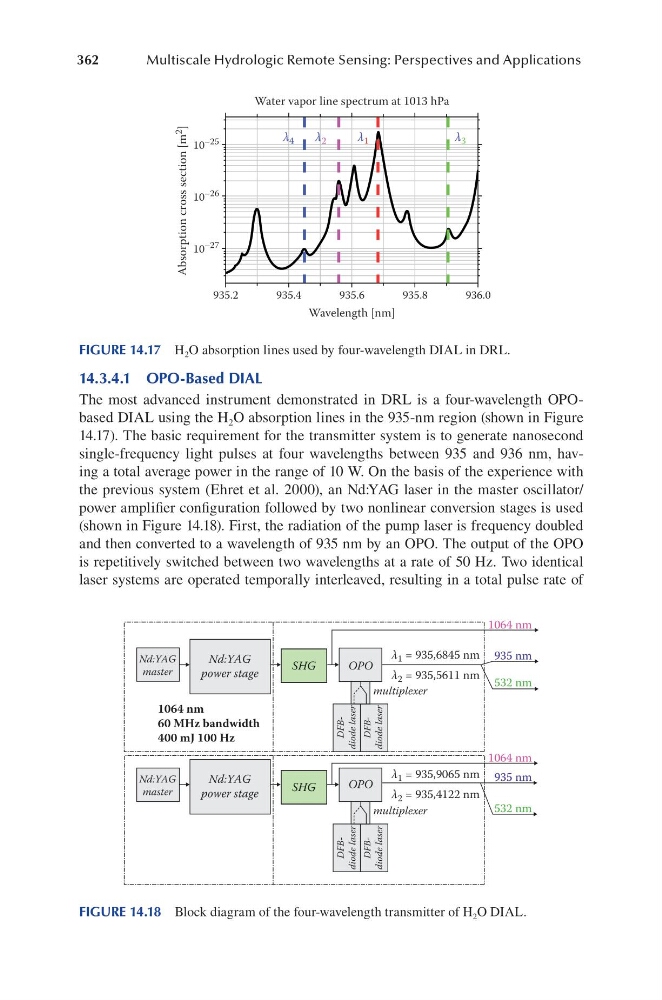
The most advanced instrument demonstrated in DRL is a four-wavelength OPObased DIAL using the H 2 O absorption lines in the 935-nm region (shown in Figure
14.17). The basic requirement for the transmitter system is to generate nanosecond
single-frequency light pulses at four wavelengths between 935 and 936 nm, having a total average power in the range of 10 W. On the basis of the experience with
the previous system (Ehret et al. 2000), an Nd:YAG laser in the master oscillator/
power amplifier configuration followed by two nonlinear conversion stages is used
(shown in Figure 14.18). First, the radiation of the pump laser is frequency doubled
and then converted to a wavelength of 935 nm by an OPO. The output of the OPO
is repetitively switched between two wavelengths at a rate of 50 Hz. Two identical
laser systems are operated temporally interleaved, resulting in a total pulse rate of
10
–25
λ 4
λ 2
λ 1
λ 3
10
–26
10
–27
935.2
935.4
935.6
935.8
936.0
Wavelength [nm]
Water vapor line spectrum at 1013 hPa
Absorption cross section [m 2
]
FIGURE 14.17 H 2 O absorption lines used by four-wavelength DIAL in DRL.
Nd:YAG
master
Nd:YAG
power stage
Nd:YAG
master
Nd:YAG
power stage
1064 nm
60 MHz bandwidth
400 mJ 100 Hz
SHG
OPO
λ 1 = 935,6845 nm
1064 nm
935 nm
935 nm
532 nm
532 nm
1064 nm
λ 2 = 935,5611 nm
λ 1 = 935,9065 nm
multiplexer
multiplexer
DFBdiode laser
DFBdiode laser
DFBdiode laser
DFBdiode laser
λ 2 = 935,4122 nm
OPO
SHG
FIGURE 14.18 Block diagram of the four-wavelength transmitter of H 2 O DIAL.
Multiscale Hydrologic Remote Sensing: Perspectives and Applications
14.3.4.1 OPO-Based DIAL
The most advanced instrument demonstrated in DRL is a four-wavelength OPObased DIAL using the H 2 O absorption lines in the 935-nm region (shown in Figure
14.17). The basic requirement for the transmitter system is to generate nanosecond
single-frequency light pulses at four wavelengths between 935 and 936 nm, having a total average power in the range of 10 W. On the basis of the experience with
the previous system (Ehret et al. 2000), an Nd:YAG laser in the master oscillator/
power amplifier configuration followed by two nonlinear conversion stages is used
(shown in Figure 14.18). First, the radiation of the pump laser is frequency doubled
and then converted to a wavelength of 935 nm by an OPO. The output of the OPO
is repetitively switched between two wavelengths at a rate of 50 Hz. Two identical
laser systems are operated temporally interleaved, resulting in a total pulse rate of
10
–25
λ 4
λ 2
λ 1
λ 3
10
–26
10
–27
935.2
935.4
935.6
935.8
936.0
Wavelength [nm]
Water vapor line spectrum at 1013 hPa
Absorption cross section [m 2
]
FIGURE 14.17 H 2 O absorption lines used by four-wavelength DIAL in DRL.
Nd:YAG
master
Nd:YAG
power stage
Nd:YAG
master
Nd:YAG
power stage
1064 nm
60 MHz bandwidth
400 mJ 100 Hz
SHG
OPO
λ 1 = 935,6845 nm
1064 nm
935 nm
935 nm
532 nm
532 nm
1064 nm
λ 2 = 935,5611 nm
λ 1 = 935,9065 nm
multiplexer
multiplexer
DFBdiode laser
DFBdiode laser
DFBdiode laser
DFBdiode laser
λ 2 = 935,4122 nm
OPO
SHG
FIGURE 14.18 Block diagram of the four-wavelength transmitter of H 2 O DIAL.