

363
Airborne Water Vapor Differential Absorption Lidar
200 Hz and a repetition rate for the four-wavelength pulse train of 50 Hz (see Figure
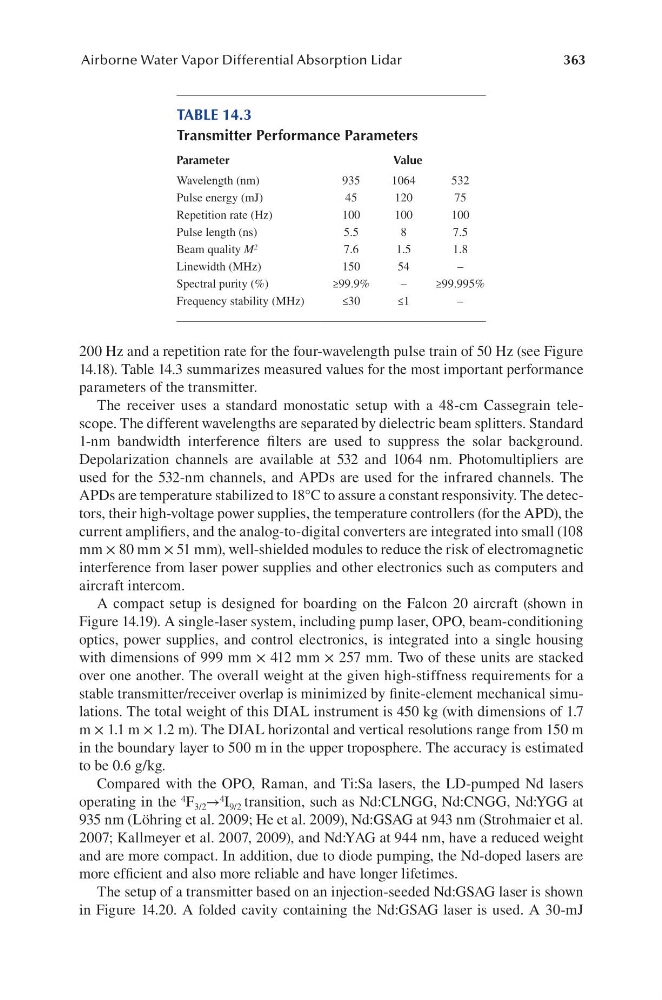
14.18). Table 14.3 summarizes measured values for the most important performance
parameters of the transmitter.
The receiver uses a standard monostatic setup with a 48-cm Cassegrain telescope. The different wavelengths are separated by dielectric beam splitters. Standard
1-nm bandwidth interference filters are used to suppress the solar background.
Depolarization channels are available at 532 and 1064 nm. Photomultipliers are
used for the 532-nm channels, and APDs are used for the infrared channels. The
APDs are temperature stabilized to 18°C to assure a constant responsivity. The detectors, their high-voltage power supplies, the temperature controllers (for the APD), the
current amplifiers, and the analog-to-digital converters are integrated into small (108
mm × 80 mm × 51 mm), well-shielded modules to reduce the risk of electromagnetic
interference from laser power supplies and other electronics such as computers and
aircraft intercom.
A compact setup is designed for boarding on the Falcon 20 aircraft (shown in
Figure 14.19). A single-laser system, including pump laser, OPO, beam-conditioning
optics, power supplies, and control electronics, is integrated into a single housing
with dimensions of 999 mm × 412 mm × 257 mm. Two of these units are stacked
over one another. The overall weight at the given high-stiffness requirements for a
stable transmitter/receiver overlap is minimized by finite-element mechanical simulations. The total weight of this DIAL instrument is 450 kg (with dimensions of 1.7
m × 1.1 m × 1.2 m). The DIAL horizontal and vertical resolutions range from 150 m
in the boundary layer to 500 m in the upper troposphere. The accuracy is estimated
to be 0.6 g/kg.
Compared with the OPO, Raman, and Ti:Sa lasers, the LD-pumped Nd lasers
operating in the 4 F 3/2 → 4 I 9/2 transition, such as Nd:CLNGG, Nd:CNGG, Nd:YGG at
935 nm (Löhring et al. 2009; He et al. 2009), Nd:GSAG at 943 nm (Strohmaier et al.
2007; Kallmeyer et al. 2007, 2009), and Nd:YAG at 944 nm, have a reduced weight
and are more compact. In addition, due to diode pumping, the Nd-doped lasers are
more efficient and also more reliable and have longer lifetimes.
The setup of a transmitter based on an injection-seeded Nd:GSAG laser is shown
in Figure 14.20. A folded cavity containing the Nd:GSAG laser is used. A 30-mJ
TABLE 14.3
Transmitter Performance Parameters
Parameter
Value
Wavelength (nm)
935
1064
532
Pulse energy (mJ)
45
120
75
Repetition rate (Hz)
100
100
100
Pulse length (ns)
5.5
8
7.5
Beam quality M 2
7.6
1.5
1.8
Linewidth (MHz)
150
54
–
Spectral purity (%)
≥99.9%
–
≥99.995%
Frequency stability (MHz)
≤30
≤1
–
Airborne Water Vapor Differential Absorption Lidar
200 Hz and a repetition rate for the four-wavelength pulse train of 50 Hz (see Figure
14.18). Table 14.3 summarizes measured values for the most important performance
parameters of the transmitter.
The receiver uses a standard monostatic setup with a 48-cm Cassegrain telescope. The different wavelengths are separated by dielectric beam splitters. Standard
1-nm bandwidth interference filters are used to suppress the solar background.
Depolarization channels are available at 532 and 1064 nm. Photomultipliers are
used for the 532-nm channels, and APDs are used for the infrared channels. The
APDs are temperature stabilized to 18°C to assure a constant responsivity. The detectors, their high-voltage power supplies, the temperature controllers (for the APD), the
current amplifiers, and the analog-to-digital converters are integrated into small (108
mm × 80 mm × 51 mm), well-shielded modules to reduce the risk of electromagnetic
interference from laser power supplies and other electronics such as computers and
aircraft intercom.
A compact setup is designed for boarding on the Falcon 20 aircraft (shown in
Figure 14.19). A single-laser system, including pump laser, OPO, beam-conditioning
optics, power supplies, and control electronics, is integrated into a single housing
with dimensions of 999 mm × 412 mm × 257 mm. Two of these units are stacked
over one another. The overall weight at the given high-stiffness requirements for a
stable transmitter/receiver overlap is minimized by finite-element mechanical simulations. The total weight of this DIAL instrument is 450 kg (with dimensions of 1.7
m × 1.1 m × 1.2 m). The DIAL horizontal and vertical resolutions range from 150 m
in the boundary layer to 500 m in the upper troposphere. The accuracy is estimated
to be 0.6 g/kg.
Compared with the OPO, Raman, and Ti:Sa lasers, the LD-pumped Nd lasers
operating in the 4 F 3/2 → 4 I 9/2 transition, such as Nd:CLNGG, Nd:CNGG, Nd:YGG at
935 nm (Löhring et al. 2009; He et al. 2009), Nd:GSAG at 943 nm (Strohmaier et al.
2007; Kallmeyer et al. 2007, 2009), and Nd:YAG at 944 nm, have a reduced weight
and are more compact. In addition, due to diode pumping, the Nd-doped lasers are
more efficient and also more reliable and have longer lifetimes.
The setup of a transmitter based on an injection-seeded Nd:GSAG laser is shown
in Figure 14.20. A folded cavity containing the Nd:GSAG laser is used. A 30-mJ
TABLE 14.3
Transmitter Performance Parameters
Parameter
Value
Wavelength (nm)
935
1064
532
Pulse energy (mJ)
45
120
75
Repetition rate (Hz)
100
100
100
Pulse length (ns)
5.5
8
7.5
Beam quality M 2
7.6
1.5
1.8
Linewidth (MHz)
150
54
–
Spectral purity (%)
≥99.9%
–
≥99.995%
Frequency stability (MHz)
≤30
≤1
–