

359
Airborne Water Vapor Differential Absorption Lidar
This allowed proper absorption line selection. The seeder wavelength is stabilized
by a computer-controlled feedback loop based on the transmission measurements
of the seed beam through the absorption cell (photodiodes PD1 and PD2 in Figure
14.14). The seed beam is transferred by a single-mode polarization maintaining fiber
and injected into the OPO cavity via one of the cavity mirrors. To stabilize the output wavelength of OPO, the cavity length of OPO is matched to the wavelength of
the seed beam by a PZT element attached to the cavity mirror. The spectral linewidth of the OPO at 935 nm is measured to be 140 MHz when seeded and approxiMHz when seeded and approxiMHz when seeded and approximately 90 GHz (0.26 nm) in the unseeded operation. Since the spectral width of
the latter is much broader compared with the bandwidth of water vapor absorption
line (1–2 GHz), the unseeded multimode signal can be used as offline wavelength.
Therefore, dual-wavelength operation is simply achieved by chopping the seed beam
at a repetition rate of 50 Hz. The spectral purity is measured by a long-pass (100-m)
absorption cell filled with water vapor. The transmitted energy is measured by a photodiode (PD3). The ratio of the transmission signals for the seeded (narrowband) and
unseeded (broadband) pulses give an absolute measure of the spectral purity. A computer controls feedback loop–maintained maximum spectral purity by changing the
voltage on the PZT element, which adjusted the OPO cavity length. This stabilization technique was proved to be very efficient and reliable during in-flight operation.
14.3.3.3 Receiver
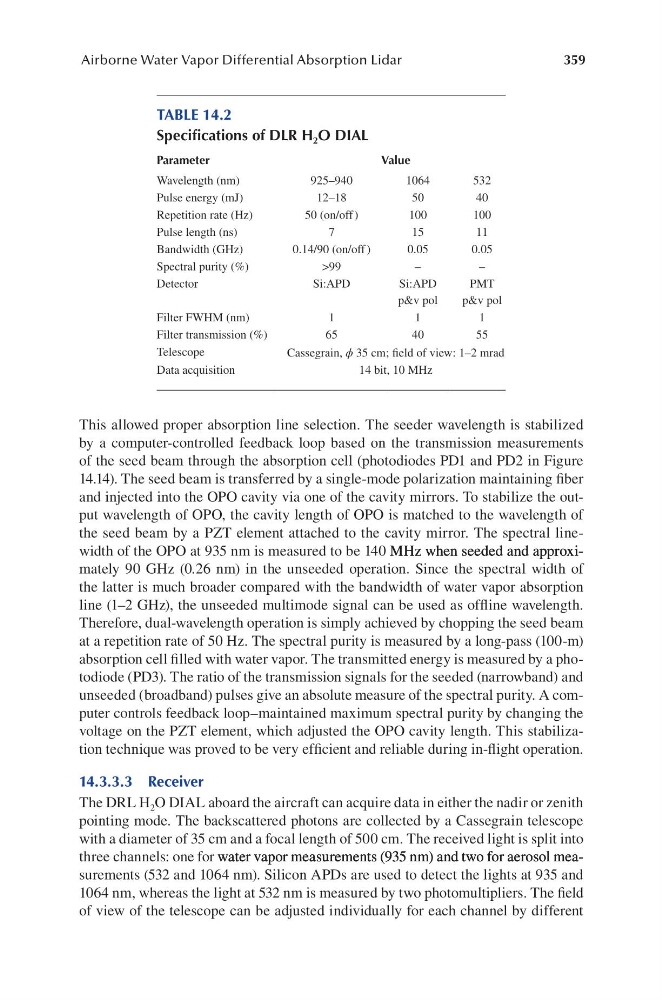
The DRL H 2 O DIAL aboard the aircraft can acquire data in either the nadir or zenith
pointing mode. The backscattered photons are collected by a Cassegrain telescope
with a diameter of 35 cm and a focal length of 500 cm. The received light is split into
three channels: one for water vapor measurements (935 nm) and two for aerosol meawater vapor measurements (935 nm) and two for aerosol meawater vapor measurements (935 nm) and two for aerosol measurements (532 and 1064 nm). Silicon APDs are used to detect the lights at 935 and
1064 nm, whereas the light at 532 nm is measured by two photomultipliers. The field
of view of the telescope can be adjusted individually for each channel by different
TABLE 14.2
Specifications of DLR H 2 O DIAL
Parameter
Value
Wavelength (nm)
925–940
1064
532
Pulse energy (mJ)
12–18
50
40
Repetition rate (Hz)
50 (on/off )
100
100
Pulse length (ns)
7
15
11
Bandwidth (GHz)
0.14/90 (on/off )
0.05
0.05
Spectral purity (%)
>99
–
–
Detector
Si:APD
Si:APD
p&v pol
PMT
p&v pol
Filter FWHM (nm)
1
1
1
Filter transmission (%)
65
40
55
Telescope
Cassegrain, ϕ 35 cm; field of view: 1–2 mrad
Data acquisition
14 bit, 10 MHz
Airborne Water Vapor Differential Absorption Lidar
This allowed proper absorption line selection. The seeder wavelength is stabilized
by a computer-controlled feedback loop based on the transmission measurements
of the seed beam through the absorption cell (photodiodes PD1 and PD2 in Figure
14.14). The seed beam is transferred by a single-mode polarization maintaining fiber
and injected into the OPO cavity via one of the cavity mirrors. To stabilize the output wavelength of OPO, the cavity length of OPO is matched to the wavelength of
the seed beam by a PZT element attached to the cavity mirror. The spectral linewidth of the OPO at 935 nm is measured to be 140 MHz when seeded and approxiMHz when seeded and approxiMHz when seeded and approximately 90 GHz (0.26 nm) in the unseeded operation. Since the spectral width of
the latter is much broader compared with the bandwidth of water vapor absorption
line (1–2 GHz), the unseeded multimode signal can be used as offline wavelength.
Therefore, dual-wavelength operation is simply achieved by chopping the seed beam
at a repetition rate of 50 Hz. The spectral purity is measured by a long-pass (100-m)
absorption cell filled with water vapor. The transmitted energy is measured by a photodiode (PD3). The ratio of the transmission signals for the seeded (narrowband) and
unseeded (broadband) pulses give an absolute measure of the spectral purity. A computer controls feedback loop–maintained maximum spectral purity by changing the
voltage on the PZT element, which adjusted the OPO cavity length. This stabilization technique was proved to be very efficient and reliable during in-flight operation.
14.3.3.3 Receiver
The DRL H 2 O DIAL aboard the aircraft can acquire data in either the nadir or zenith
pointing mode. The backscattered photons are collected by a Cassegrain telescope
with a diameter of 35 cm and a focal length of 500 cm. The received light is split into
three channels: one for water vapor measurements (935 nm) and two for aerosol meawater vapor measurements (935 nm) and two for aerosol meawater vapor measurements (935 nm) and two for aerosol measurements (532 and 1064 nm). Silicon APDs are used to detect the lights at 935 and
1064 nm, whereas the light at 532 nm is measured by two photomultipliers. The field
of view of the telescope can be adjusted individually for each channel by different
TABLE 14.2
Specifications of DLR H 2 O DIAL
Parameter
Value
Wavelength (nm)
925–940
1064
532
Pulse energy (mJ)
12–18
50
40
Repetition rate (Hz)
50 (on/off )
100
100
Pulse length (ns)
7
15
11
Bandwidth (GHz)
0.14/90 (on/off )
0.05
0.05
Spectral purity (%)
>99
–
–
Detector
Si:APD
Si:APD
p&v pol
PMT
p&v pol
Filter FWHM (nm)
1
1
1
Filter transmission (%)
65
40
55
Telescope
Cassegrain, ϕ 35 cm; field of view: 1–2 mrad
Data acquisition
14 bit, 10 MHz