

358
Multiscale Hydrologic Remote Sensing: Perspectives and Applications
simulta neously both at 1064 and 532 nm. The most important specifications of the
instrument are summarized in Table 14.2.
14.3.3.2 Transmitter
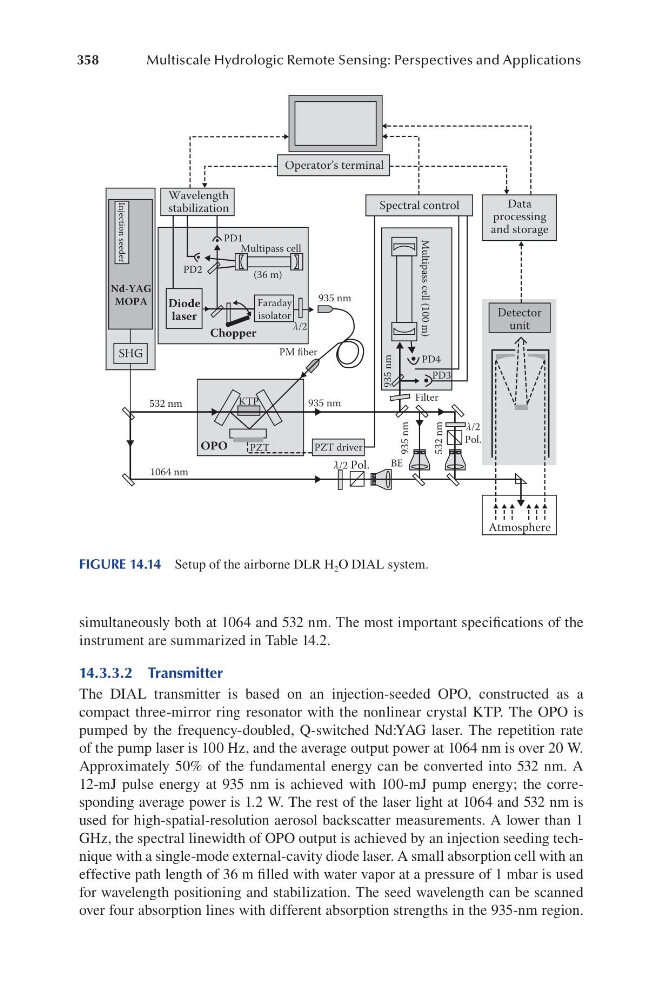
The DIAL transmitter is based on an injection-seeded OPO, constructed as a
compact three-mirror ring resonator with the nonlinear crystal KTP. The OPO is
pumped by the frequency-doubled, Q-switched Nd:YAG laser. The repetition rate
of the pump laser is 100 Hz, and the average output power at 1064 nm is over 20 W.
Approximately 50% of the fundamental energy can be converted into 532 nm. A
12-mJ pulse energy at 935 nm is achieved with 100-mJ pump energy; the corresponding average power is 1.2 W. The rest of the laser light at 1064 and 532 nm is
used for high-spatial-resolution aerosol backscatter measurements. A lower than 1
GHz, the spectral linewidth of OPO output is achieved by an injection seeding technique with a single-mode external-cavity diode laser. A small absorption cell with an
effective path length of 36 m filled with water vapor at a pressure of 1 mbar is used
for wavelength positioning and stabilization. The seed wavelength can be scanned
over four absorption lines with different absorption strengths in the 935-nm region.
Operator’s terminal
Wavelength
stabilization
PD1
PD2
(36 m)
935 nm
Multipass cell
Multipass cell (100 m)
Chopper
Faraday
isolator
PM fiber
Filter
PD3
PD4
λ/2
λ/2
Pol.
935 nm
935 nm
532 nm
SHG
Diode
laser
532 nm
1064 nm
935 nm
BE
OPO
PZT
λ/2 Pol.
PZT driver
KTP
Nd-YAG
MOPA
Injection seeder
Spectral control
Data
processing
and storage
Detector
unit
Atmosphere
FIGURE 14.14 Setup of the airborne DLR H 2 O DIAL system.
Multiscale Hydrologic Remote Sensing: Perspectives and Applications
simulta neously both at 1064 and 532 nm. The most important specifications of the
instrument are summarized in Table 14.2.
14.3.3.2 Transmitter
The DIAL transmitter is based on an injection-seeded OPO, constructed as a
compact three-mirror ring resonator with the nonlinear crystal KTP. The OPO is
pumped by the frequency-doubled, Q-switched Nd:YAG laser. The repetition rate
of the pump laser is 100 Hz, and the average output power at 1064 nm is over 20 W.
Approximately 50% of the fundamental energy can be converted into 532 nm. A
12-mJ pulse energy at 935 nm is achieved with 100-mJ pump energy; the corresponding average power is 1.2 W. The rest of the laser light at 1064 and 532 nm is
used for high-spatial-resolution aerosol backscatter measurements. A lower than 1
GHz, the spectral linewidth of OPO output is achieved by an injection seeding technique with a single-mode external-cavity diode laser. A small absorption cell with an
effective path length of 36 m filled with water vapor at a pressure of 1 mbar is used
for wavelength positioning and stabilization. The seed wavelength can be scanned
over four absorption lines with different absorption strengths in the 935-nm region.
Operator’s terminal
Wavelength
stabilization
PD1
PD2
(36 m)
935 nm
Multipass cell
Multipass cell (100 m)
Chopper
Faraday
isolator
PM fiber
Filter
PD3
PD4
λ/2
λ/2
Pol.
935 nm
935 nm
532 nm
SHG
Diode
laser
532 nm
1064 nm
935 nm
BE
OPO
PZT
λ/2 Pol.
PZT driver
KTP
Nd-YAG
MOPA
Injection seeder
Spectral control
Data
processing
and storage
Detector
unit
Atmosphere
FIGURE 14.14 Setup of the airborne DLR H 2 O DIAL system.