

282
Multiscale Hydrologic Remote Sensing: Perspectives and Applications
12.3.2.6 Simple Kriging with Varying Local Means
Goovaerts (2000) used SKlm to incorporate secondary information for improving
spatial prediction of precipitation. Similar to RK, SKlm also uses linear regression to
estimate the varying means: m(x) = β 0 + β 1 R(x). The major differences between RK
and SKlm are that (1) SKlm uses OLS to estimate the varying means and (2) SKlm
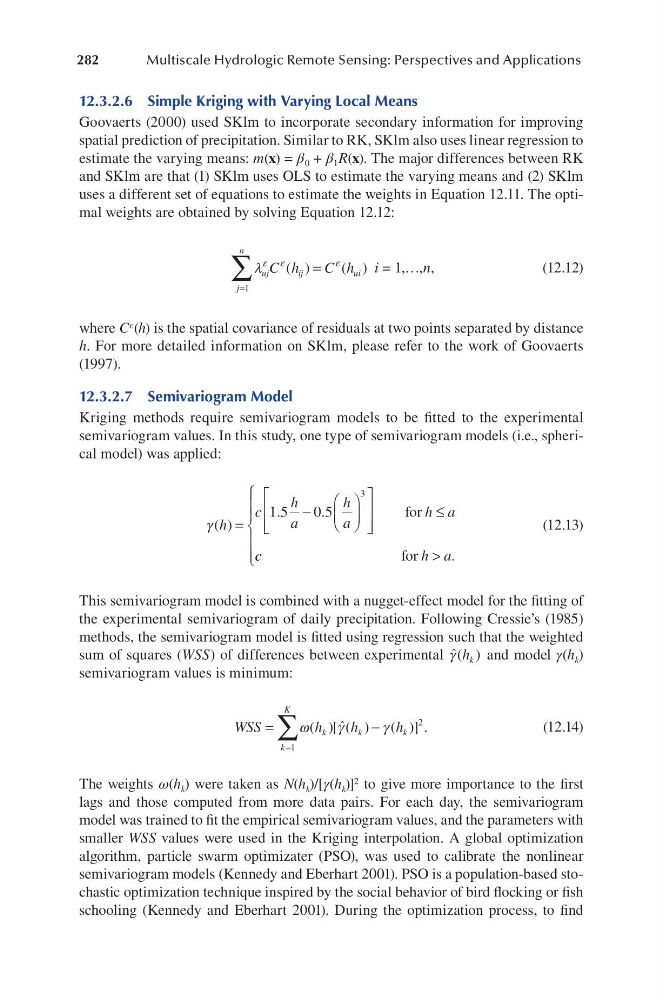
uses a different set of equations to estimate the weights in Equation 12.11. The optimal weights are obtained by solving Equation 12.12:
λ
ε ε
ε
uj
j
n
ij
ui
C h
C h
=
∑
=
1
( )
( ) i = 1,…,n,
(12.12)
where C ε (h) is the spatial covariance of residuals at two points separated by distance
h. For more detailed information on SKlm, please refer to the work of Goovaerts
(1997).
12.3.2.7 Semivariogram Model
Kriging methods require semivariogram models to be fitted to the experimental
semivariogram values. In this study, one type of semivariogram models (i.e., spherical model) was applied:
γ ( )
.
.
h
c
h
a
h
a
h a
=
−
≤
1 5
0 5
3
for
c c
h a
for > .
(12.13)
This semivariogram model is combined with a nugget-effect model for the fitting of
the experimental semivariogram of daily precipitation. Following Cressie’s (1985)
methods, the semivariogram model is fitted using regression such that the weighted
sum of squares (WSS) of differences between experimental ˆ ( )
γ h k and model γ(h k )
semivariogram values is minimum:
WSS
h
h
h
k
k
k
k
K
=
−
=
∑ ω γ γ
( )[ ( ) ( )] .
ˆ
2
1
(12.14)
The weights ω(h k ) were taken as N(h k )/[γ(h k )] 2 to give more importance to the first
lags and those computed from more data pairs. For each day, the semivariogram
model was trained to fit the empirical semivariogram values, and the parameters with
smaller WSS values were used in the Kriging interpolation. A global optimization
algorithm, particle swarm optimizater (PSO), was used to calibrate the nonlinear
semivariogram models (Kennedy and Eberhart 2001). PSO is a population-based stochastic optimization technique inspired by the social behavior of bird flocking or fish
schooling (Kennedy and Eberhart 2001). During the optimization process, to find
Multiscale Hydrologic Remote Sensing: Perspectives and Applications
12.3.2.6 Simple Kriging with Varying Local Means
Goovaerts (2000) used SKlm to incorporate secondary information for improving
spatial prediction of precipitation. Similar to RK, SKlm also uses linear regression to
estimate the varying means: m(x) = β 0 + β 1 R(x). The major differences between RK
and SKlm are that (1) SKlm uses OLS to estimate the varying means and (2) SKlm
uses a different set of equations to estimate the weights in Equation 12.11. The optimal weights are obtained by solving Equation 12.12:
λ
ε ε
ε
uj
j
n
ij
ui
C h
C h
=
∑
=
1
( )
( ) i = 1,…,n,
(12.12)
where C ε (h) is the spatial covariance of residuals at two points separated by distance
h. For more detailed information on SKlm, please refer to the work of Goovaerts
(1997).
12.3.2.7 Semivariogram Model
Kriging methods require semivariogram models to be fitted to the experimental
semivariogram values. In this study, one type of semivariogram models (i.e., spherical model) was applied:
γ ( )
.
.
h
c
h
a
h
a
h a
=
−
≤
1 5
0 5
3
for
c c
h a
for > .
(12.13)
This semivariogram model is combined with a nugget-effect model for the fitting of
the experimental semivariogram of daily precipitation. Following Cressie’s (1985)
methods, the semivariogram model is fitted using regression such that the weighted
sum of squares (WSS) of differences between experimental ˆ ( )
γ h k and model γ(h k )
semivariogram values is minimum:
WSS
h
h
h
k
k
k
k
K
=
−
=
∑ ω γ γ
( )[ ( ) ( )] .
ˆ
2
1
(12.14)
The weights ω(h k ) were taken as N(h k )/[γ(h k )] 2 to give more importance to the first
lags and those computed from more data pairs. For each day, the semivariogram
model was trained to fit the empirical semivariogram values, and the parameters with
smaller WSS values were used in the Kriging interpolation. A global optimization
algorithm, particle swarm optimizater (PSO), was used to calibrate the nonlinear
semivariogram models (Kennedy and Eberhart 2001). PSO is a population-based stochastic optimization technique inspired by the social behavior of bird flocking or fish
schooling (Kennedy and Eberhart 2001). During the optimization process, to find