

283
Precipitation Estimate Using NEXRAD Ground-Based Radar Images
the global optimum, each particle in the population adjusts its “flying” according to
its own flying experience and its companions’ flying experience (Eberhart and Shi
1998). The basic PSO algorithm consists of three steps: (1) generating particles’ positions (coordinate in the parameter space) and velocities (flying direction and speed),
(2) updating the velocity of each particle using the information from the best solution
that it has achieved so far (personal best) and another particle with the best fitness
value obtained so far by all the particles in the population (global best), and finally,
(3) calculating the new position of each particle by adding the updated velocity to
the current position. For further information about PSO, please refer to the work of
Kennedy and Eberhart (2001).
12.3.3 accuRacy evaluation coefficientS
Multiple evaluation coefficients have been applied to validate the accuracy of
NEXRAD precipitation images and compare the performance of different calibration techniques. Following previous research (e.g., Jayakrishnan et al. 2004; Xie et
al. 2006; Haberlandt 2007; Wang et al. 2008; Young and Brunsell 2008), we assumed
the rain gauge observation as the ground truth for validating NEXRAD data in this
study. Several evaluation coefficients were selected to compare the rain gauge observations with NEXRAD estimates and predicted values by different techniques:
1. NEXRAD detection conditioned on gauge observations exceeding a given
threshold (Young and Brunsell 2008)
D
P z thresh z thresh
z thresh
z
rain
j
j
=
≥
≥
=
≥
( ˆ
|
)
( ˆ
and ≥ ≥
≥
×
=
=
∑
∑
thresh
z thresh
j
S
j
j
L
)
(
)
,
1
1
100
(12.15)
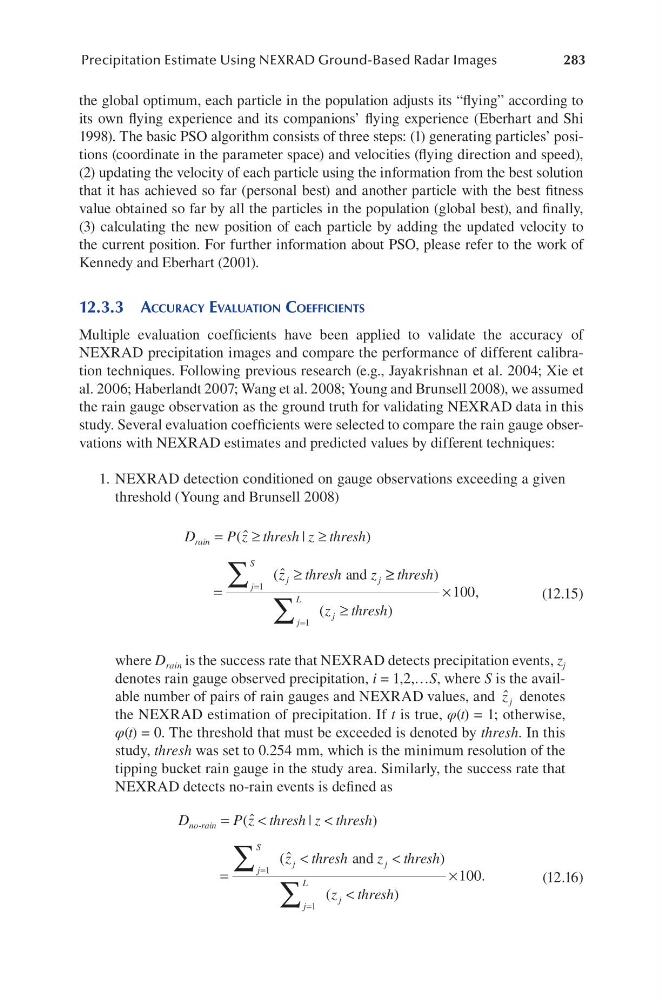
where D rain is the success rate that NEXRAD detects precipitation events, z j
denotes rain gauge observed precipitation, i = 1,2,…S, where S is the available number of pairs of rain gauges and NEXRAD values, and ˆ
z j denotes
the NEXRAD estimation of precipitation. If t is true, φ(t) = 1; otherwise,
φ(t) = 0. The threshold that must be exceeded is denoted by thresh. In this
study, thresh was set to 0.254 mm, which is the minimum resolution of the
tipping bucket rain gauge in the study area. Similarly, the success rate that
NEXRAD detects no-rain events is defined as
D
P z thresh z thresh
z thresh
no rain
j
-
and
=
<
<
=
<
( ˆ
|
)
( ˆ
z thresh
z thresh
j
j
S
j
j
L
<
<
×
=
=
∑
∑
)
(
)
.
1
1
100
(12.16)
Precipitation Estimate Using NEXRAD Ground-Based Radar Images
the global optimum, each particle in the population adjusts its “flying” according to
its own flying experience and its companions’ flying experience (Eberhart and Shi
1998). The basic PSO algorithm consists of three steps: (1) generating particles’ positions (coordinate in the parameter space) and velocities (flying direction and speed),
(2) updating the velocity of each particle using the information from the best solution
that it has achieved so far (personal best) and another particle with the best fitness
value obtained so far by all the particles in the population (global best), and finally,
(3) calculating the new position of each particle by adding the updated velocity to
the current position. For further information about PSO, please refer to the work of
Kennedy and Eberhart (2001).
12.3.3 accuRacy evaluation coefficientS
Multiple evaluation coefficients have been applied to validate the accuracy of
NEXRAD precipitation images and compare the performance of different calibration techniques. Following previous research (e.g., Jayakrishnan et al. 2004; Xie et
al. 2006; Haberlandt 2007; Wang et al. 2008; Young and Brunsell 2008), we assumed
the rain gauge observation as the ground truth for validating NEXRAD data in this
study. Several evaluation coefficients were selected to compare the rain gauge observations with NEXRAD estimates and predicted values by different techniques:
1. NEXRAD detection conditioned on gauge observations exceeding a given
threshold (Young and Brunsell 2008)
D
P z thresh z thresh
z thresh
z
rain
j
j
=
≥
≥
=
≥
( ˆ
|
)
( ˆ
and ≥ ≥
≥
×
=
=
∑
∑
thresh
z thresh
j
S
j
j
L
)
(
)
,
1
1
100
(12.15)
where D rain is the success rate that NEXRAD detects precipitation events, z j
denotes rain gauge observed precipitation, i = 1,2,…S, where S is the available number of pairs of rain gauges and NEXRAD values, and ˆ
z j denotes
the NEXRAD estimation of precipitation. If t is true, φ(t) = 1; otherwise,
φ(t) = 0. The threshold that must be exceeded is denoted by thresh. In this
study, thresh was set to 0.254 mm, which is the minimum resolution of the
tipping bucket rain gauge in the study area. Similarly, the success rate that
NEXRAD detects no-rain events is defined as
D
P z thresh z thresh
z thresh
no rain
j
-
and
=
<
<
=
<
( ˆ
|
)
( ˆ
z thresh
z thresh
j
j
S
j
j
L
<
<
×
=
=
∑
∑
)
(
)
.
1
1
100
(12.16)