

projects far enough into mid-latitudes to a have a
temperate desert climate, and only on the east side
of the Andes Mountains in Patagonia, Argentina.
These desert regions have low rainfall and
strong temperature contrasts between summer
and winter. In the intermountain region of the
western United States, between the Pacific and
Rocky Mountains, the temperate desert has
characteristics of a sagebrush semi-desert, with
a pronounced drought season and a short humid
season. Most precipitation falls in the winter,
despite a peak in May (see Fig. 7.1, climate
diagram of Taschkent, Uzbekistan). Aridity
increases markedly in the rain shadow of the
Pacific mountain ranges. Even at intermediate
elevations, winters are long and cold, with
temperatures below 0
C.
These desert areas have the highest percentage of possible sunshine of any of the midlatitude climates. Because of low humidity,
over 90 % of the sun’s radiation reaches the
ground. These deserts experience high daily temperature fluctuations. During the summer when
the days are long and the sun high in the sky,
temperatures will reach 50
C. At sunset, heat is
lost rapidly because of the lack of insulating
clouds. The nighttime temperature can drop
over 44
C from the daytime high, with winter
temperatures in Asia’s Gobi Desert plummeting
to À21
C.
Under the Ko ¨ppen-Trewartha system, this is
the true desert, BWk. The letter k signifies that at
least 1 month has an average temperature below
0
C. These deserts differ from those at lower
latitude chiefly in their far greater annual temperature range and much lower winter temperatures.
Unlike the dry climates of the tropics, middlelatitude dry climates receive a portion of their
precipitation as snow.
Temperate deserts support the sparse xerophytic shrub vegetation typical of semi-deserts.
One example is the sagebrush vegetation of the
Great Basin (Fig. 7.17) and northern Colorado
Plateau region of the United States. Recently,
semi-desert shrub vegetation seems to have
invaded wide areas of the western United States
that were formerly steppe grasslands, due to
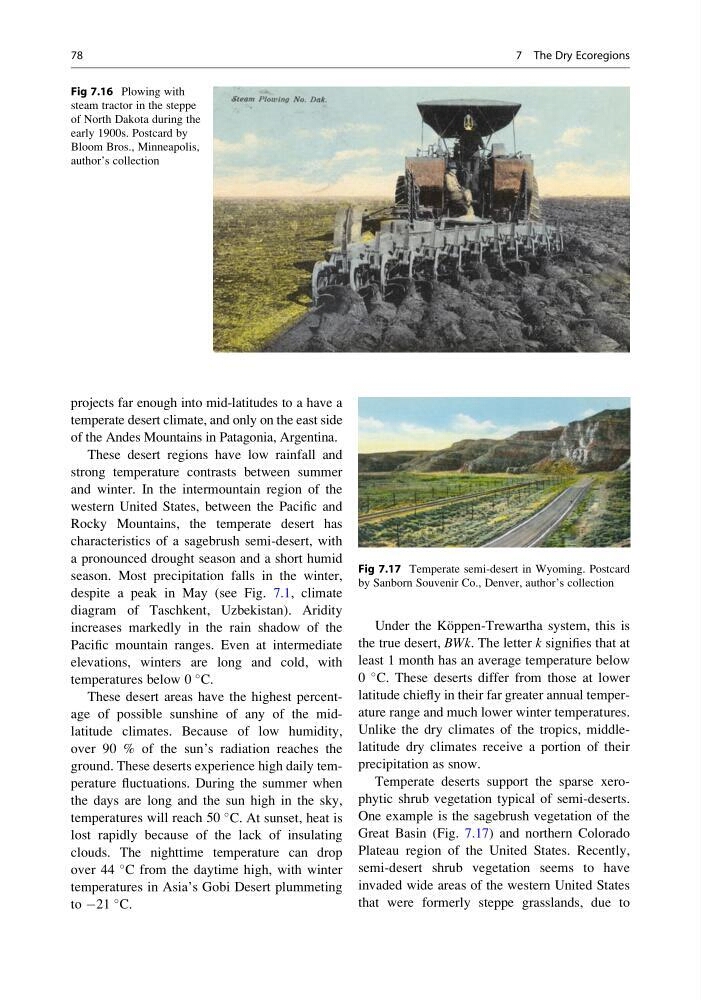
Fig 7.16 Plowing with
steam tractor in the steppe
of North Dakota during the
early 1900s. Postcard by
Bloom Bros., Minneapolis,
author’s collection
Fig 7.17 Temperate semi-desert in Wyoming. Postcard
by Sanborn Souvenir Co., Denver, author’s collection
78
7 The Dry Ecoregions
temperate desert climate, and only on the east side
of the Andes Mountains in Patagonia, Argentina.
These desert regions have low rainfall and
strong temperature contrasts between summer
and winter. In the intermountain region of the
western United States, between the Pacific and
Rocky Mountains, the temperate desert has
characteristics of a sagebrush semi-desert, with
a pronounced drought season and a short humid
season. Most precipitation falls in the winter,
despite a peak in May (see Fig. 7.1, climate
diagram of Taschkent, Uzbekistan). Aridity
increases markedly in the rain shadow of the
Pacific mountain ranges. Even at intermediate
elevations, winters are long and cold, with
temperatures below 0
C.
These desert areas have the highest percentage of possible sunshine of any of the midlatitude climates. Because of low humidity,
over 90 % of the sun’s radiation reaches the
ground. These deserts experience high daily temperature fluctuations. During the summer when
the days are long and the sun high in the sky,
temperatures will reach 50
C. At sunset, heat is
lost rapidly because of the lack of insulating
clouds. The nighttime temperature can drop
over 44
C from the daytime high, with winter
temperatures in Asia’s Gobi Desert plummeting
to À21
C.
Under the Ko ¨ppen-Trewartha system, this is
the true desert, BWk. The letter k signifies that at
least 1 month has an average temperature below
0
C. These deserts differ from those at lower
latitude chiefly in their far greater annual temperature range and much lower winter temperatures.
Unlike the dry climates of the tropics, middlelatitude dry climates receive a portion of their
precipitation as snow.
Temperate deserts support the sparse xerophytic shrub vegetation typical of semi-deserts.
One example is the sagebrush vegetation of the
Great Basin (Fig. 7.17) and northern Colorado
Plateau region of the United States. Recently,
semi-desert shrub vegetation seems to have
invaded wide areas of the western United States
that were formerly steppe grasslands, due to
Fig 7.16 Plowing with
steam tractor in the steppe
of North Dakota during the
early 1900s. Postcard by
Bloom Bros., Minneapolis,
author’s collection
Fig 7.17 Temperate semi-desert in Wyoming. Postcard
by Sanborn Souvenir Co., Denver, author’s collection
78
7 The Dry Ecoregions