

overgrazing and trampling by livestock. Soils of
the temperate desert are sierozems (Aridisols),
low in humus and high in calcium carbonate.
Poorly drained areas develop saline soils, and
salt deposits cover dry lake beds.
Productivity is low due to drought and low
temperatures. Growth is thus limited to a short
period between winter cold and summer drought.
Much of the small production goes into woody
tissue. This is in contrast to the production of
digestible foods in grasslands. Consequently,
although there are herbivores in the desert, the
weight in animals per unit area is small.
The surface features of these deserts consist of
vast depressions surrounded by mountains or
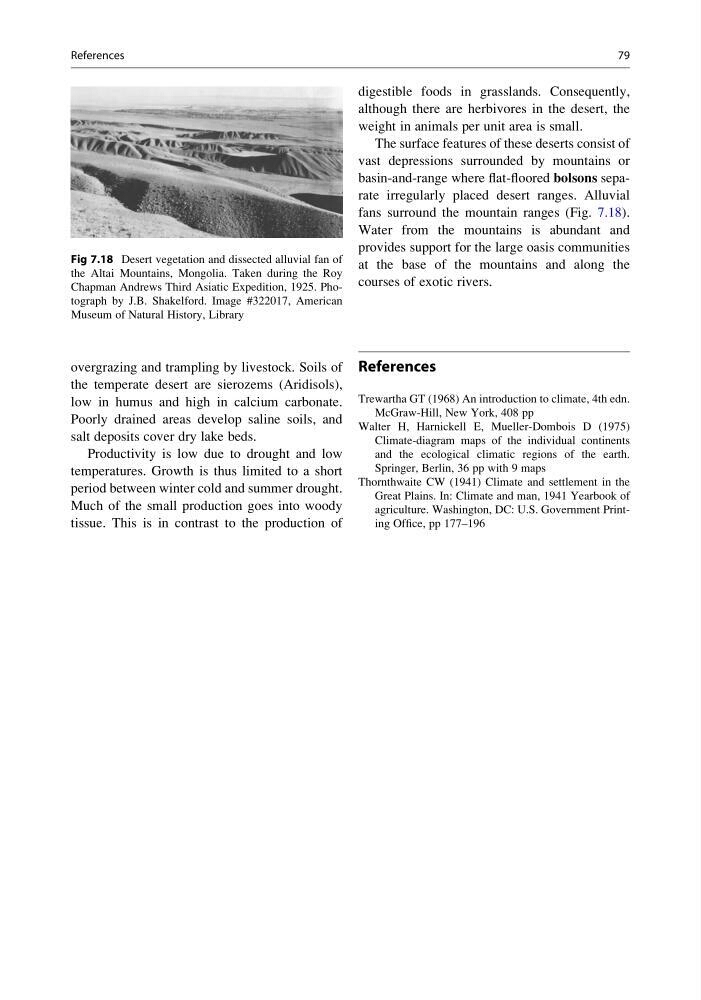
basin-and-range where flat-floored bolsons separate irregularly placed desert ranges. Alluvial
fans surround the mountain ranges (Fig. 7.18).
Water from the mountains is abundant and
provides support for the large oasis communities
at the base of the mountains and along the
courses of exotic rivers.
References
Trewartha GT (1968) An introduction to climate, 4th edn.
McGraw-Hill, New York, 408 pp
Walter H, Harnickell E, Mueller-Dombois D (1975)
Climate-diagram maps of the individual continents
and the ecological climatic regions of the earth.
Springer, Berlin, 36 pp with 9 maps
Thornthwaite CW (1941) Climate and settlement in the
Great Plains. In: Climate and man, 1941 Yearbook of
agriculture. Washington, DC: U.S. Government Printing Office, pp 177–196
Fig 7.18 Desert vegetation and dissected alluvial fan of
the Altai Mountains, Mongolia. Taken during the Roy
Chapman Andrews Third Asiatic Expedition, 1925. Photograph by J.B. Shakelford. Image #322017, American
Museum of Natural History, Library
References
79
the temperate desert are sierozems (Aridisols),
low in humus and high in calcium carbonate.
Poorly drained areas develop saline soils, and
salt deposits cover dry lake beds.
Productivity is low due to drought and low
temperatures. Growth is thus limited to a short
period between winter cold and summer drought.
Much of the small production goes into woody
tissue. This is in contrast to the production of
digestible foods in grasslands. Consequently,
although there are herbivores in the desert, the
weight in animals per unit area is small.
The surface features of these deserts consist of
vast depressions surrounded by mountains or
basin-and-range where flat-floored bolsons separate irregularly placed desert ranges. Alluvial
fans surround the mountain ranges (Fig. 7.18).
Water from the mountains is abundant and
provides support for the large oasis communities
at the base of the mountains and along the
courses of exotic rivers.
References
Trewartha GT (1968) An introduction to climate, 4th edn.
McGraw-Hill, New York, 408 pp
Walter H, Harnickell E, Mueller-Dombois D (1975)
Climate-diagram maps of the individual continents
and the ecological climatic regions of the earth.
Springer, Berlin, 36 pp with 9 maps
Thornthwaite CW (1941) Climate and settlement in the
Great Plains. In: Climate and man, 1941 Yearbook of
agriculture. Washington, DC: U.S. Government Printing Office, pp 177–196
Fig 7.18 Desert vegetation and dissected alluvial fan of
the Altai Mountains, Mongolia. Taken during the Roy
Chapman Andrews Third Asiatic Expedition, 1925. Photograph by J.B. Shakelford. Image #322017, American
Museum of Natural History, Library
References
79