

7.5
340 Temperate Desert Division
Temperate deserts are located in the interior of
continents, although they merge with tropical
deserts equatorward. They are found in North
America in the Great Basin, from Arizona, northward into Washington. In Eurasia they are found
embedded in the trans-Eurasian cordillera or lie on
the flanks of these mountains. Most occur in the
Turkestan and Gobi regions of central Asia. In the
Southern Hemisphere, only South America
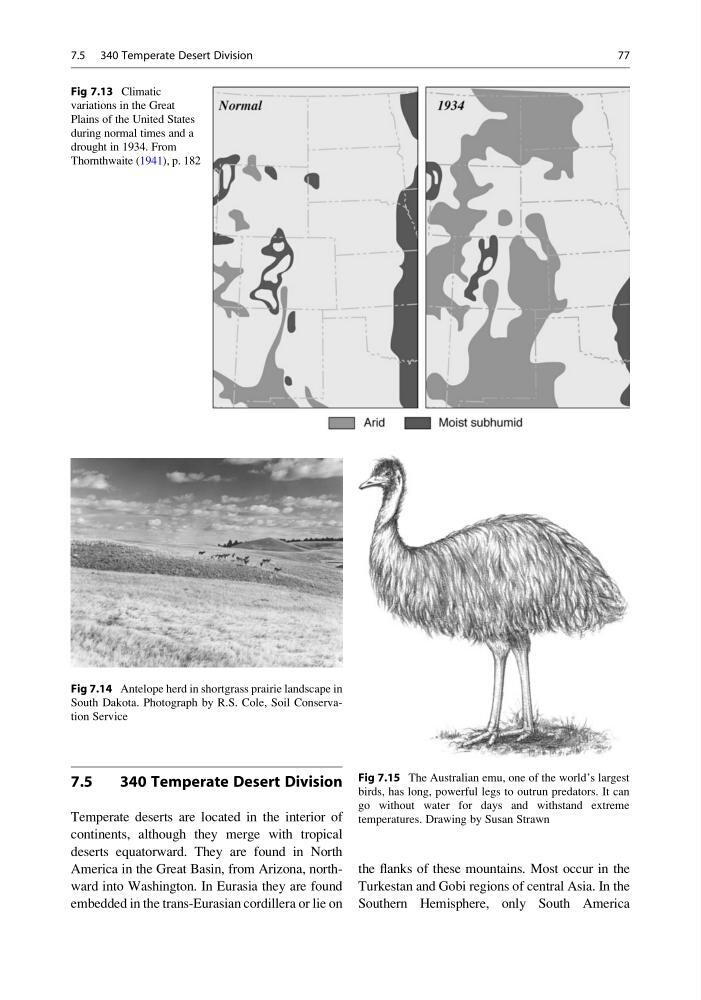
Fig 7.13 Climatic
variations in the Great
Plains of the United States
during normal times and a
drought in 1934. From
Thornthwaite (1941), p. 182
Fig 7.14 Antelope herd in shortgrass prairie landscape in
South Dakota. Photograph by R.S. Cole, Soil Conservation Service
Fig 7.15 The Australian emu, one of the world’s largest
birds, has long, powerful legs to outrun predators. It can
go without water for days and withstand extreme
temperatures. Drawing by Susan Strawn
7.5 340 Temperate Desert Division
77
340 Temperate Desert Division
Temperate deserts are located in the interior of
continents, although they merge with tropical
deserts equatorward. They are found in North
America in the Great Basin, from Arizona, northward into Washington. In Eurasia they are found
embedded in the trans-Eurasian cordillera or lie on
the flanks of these mountains. Most occur in the
Turkestan and Gobi regions of central Asia. In the
Southern Hemisphere, only South America
Fig 7.13 Climatic
variations in the Great
Plains of the United States
during normal times and a
drought in 1934. From
Thornthwaite (1941), p. 182
Fig 7.14 Antelope herd in shortgrass prairie landscape in
South Dakota. Photograph by R.S. Cole, Soil Conservation Service
Fig 7.15 The Australian emu, one of the world’s largest
birds, has long, powerful legs to outrun predators. It can
go without water for days and withstand extreme
temperatures. Drawing by Susan Strawn
7.5 340 Temperate Desert Division
77