

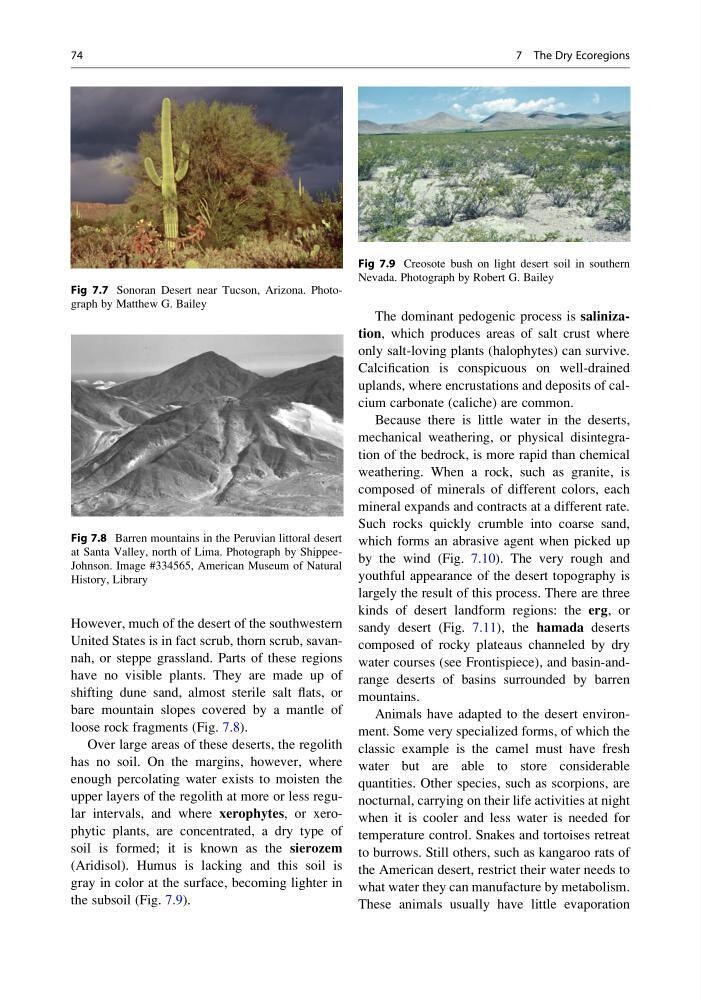
However, much of the desert of the southwestern
United States is in fact scrub, thorn scrub, savannah, or steppe grassland. Parts of these regions
have no visible plants. They are made up of
shifting dune sand, almost sterile salt flats, or
bare mountain slopes covered by a mantle of
loose rock fragments (Fig. 7.8).
Over large areas of these deserts, the regolith
has no soil. On the margins, however, where
enough percolating water exists to moisten the
upper layers of the regolith at more or less regular intervals, and where xerophytes, or xerophytic plants, are concentrated, a dry type of
soil is formed; it is known as the sierozem
(Aridisol). Humus is lacking and this soil is
gray in color at the surface, becoming lighter in
the subsoil (Fig. 7.9).
The dominant pedogenic process is salinization, which produces areas of salt crust where
only salt-loving plants (halophytes) can survive.
Calcification is conspicuous on well-drained
uplands, where encrustations and deposits of calcium carbonate (caliche) are common.
Because there is little water in the deserts,
mechanical weathering, or physical disintegration of the bedrock, is more rapid than chemical
weathering. When a rock, such as granite, is
composed of minerals of different colors, each
mineral expands and contracts at a different rate.
Such rocks quickly crumble into coarse sand,
which forms an abrasive agent when picked up
by the wind (Fig. 7.10). The very rough and
youthful appearance of the desert topography is
largely the result of this process. There are three
kinds of desert landform regions: the erg, or
sandy desert (Fig. 7.11), the hamada deserts
composed of rocky plateaus channeled by dry
water courses (see Frontispiece), and basin-andrange deserts of basins surrounded by barren
mountains.
Animals have adapted to the desert environment. Some very specialized forms, of which the
classic example is the camel must have fresh
water but are able to store considerable
quantities. Other species, such as scorpions, are
nocturnal, carrying on their life activities at night
when it is cooler and less water is needed for
temperature control. Snakes and tortoises retreat
to burrows. Still others, such as kangaroo rats of
the American desert, restrict their water needs to
what water they can manufacture by metabolism.
These animals usually have little evaporation
Fig 7.7 Sonoran Desert near Tucson, Arizona. Photograph by Matthew G. Bailey
Fig 7.8 Barren mountains in the Peruvian littoral desert
at Santa Valley, north of Lima. Photograph by ShippeeJohnson. Image #334565, American Museum of Natural
History, Library
Fig 7.9 Creosote bush on light desert soil in southern
Nevada. Photograph by Robert G. Bailey
74
7 The Dry Ecoregions
United States is in fact scrub, thorn scrub, savannah, or steppe grassland. Parts of these regions
have no visible plants. They are made up of
shifting dune sand, almost sterile salt flats, or
bare mountain slopes covered by a mantle of
loose rock fragments (Fig. 7.8).
Over large areas of these deserts, the regolith
has no soil. On the margins, however, where
enough percolating water exists to moisten the
upper layers of the regolith at more or less regular intervals, and where xerophytes, or xerophytic plants, are concentrated, a dry type of
soil is formed; it is known as the sierozem
(Aridisol). Humus is lacking and this soil is
gray in color at the surface, becoming lighter in
the subsoil (Fig. 7.9).
The dominant pedogenic process is salinization, which produces areas of salt crust where
only salt-loving plants (halophytes) can survive.
Calcification is conspicuous on well-drained
uplands, where encrustations and deposits of calcium carbonate (caliche) are common.
Because there is little water in the deserts,
mechanical weathering, or physical disintegration of the bedrock, is more rapid than chemical
weathering. When a rock, such as granite, is
composed of minerals of different colors, each
mineral expands and contracts at a different rate.
Such rocks quickly crumble into coarse sand,
which forms an abrasive agent when picked up
by the wind (Fig. 7.10). The very rough and
youthful appearance of the desert topography is
largely the result of this process. There are three
kinds of desert landform regions: the erg, or
sandy desert (Fig. 7.11), the hamada deserts
composed of rocky plateaus channeled by dry
water courses (see Frontispiece), and basin-andrange deserts of basins surrounded by barren
mountains.
Animals have adapted to the desert environment. Some very specialized forms, of which the
classic example is the camel must have fresh
water but are able to store considerable
quantities. Other species, such as scorpions, are
nocturnal, carrying on their life activities at night
when it is cooler and less water is needed for
temperature control. Snakes and tortoises retreat
to burrows. Still others, such as kangaroo rats of
the American desert, restrict their water needs to
what water they can manufacture by metabolism.
These animals usually have little evaporation
Fig 7.7 Sonoran Desert near Tucson, Arizona. Photograph by Matthew G. Bailey
Fig 7.8 Barren mountains in the Peruvian littoral desert
at Santa Valley, north of Lima. Photograph by ShippeeJohnson. Image #334565, American Museum of Natural
History, Library
Fig 7.9 Creosote bush on light desert soil in southern
Nevada. Photograph by Robert G. Bailey
74
7 The Dry Ecoregions