

7.3
320 Tropical/Subtropical
Desert Division
The continental desert climates are south of the
Arizona-New Mexico Mountains in the United
States. They are not only extremely arid but also
have extremely high air and soil temperatures.
Direct solar radiation is very high, as is outgoing
radiation at night, causing extreme variations
between day and night temperatures, and a rare
nocturnal frost. Annual precipitation is less than
200 mm, and less than 100 mm in extreme deserts
(see Fig. 7.1, climate diagram for Lima, Peru).
These areas have climates that Trewartha (1968)
calls BWh.
The vast desert belt extending across North
Africa (Sahara Desert), Arabia, and Iran to
Pakistan (Thar Desert) is of this type. Other
important deserts in this belt are the Sonoran
Desert of the southwestern United States and
northern Mexico and the Great Australian
Desert.
Important climatic differences exist between
interior and coastal deserts at the same latitude.
Cold ocean currents upwelling from great depths
lie offshore along the west coasts. The cold ocean
current absorbs heat from the overlying air. Fog
is a persistent feature and extends inland for short
distances. Deserts here are cool and have low
annual range of temperatures. The Atacama
Desert of Chile and the Namib Desert of coastal
southwest Africa are notable examples of these
cool, foggy deserts.
Because desert rainfall is unreliable, river
channels and the beds of smaller streams are
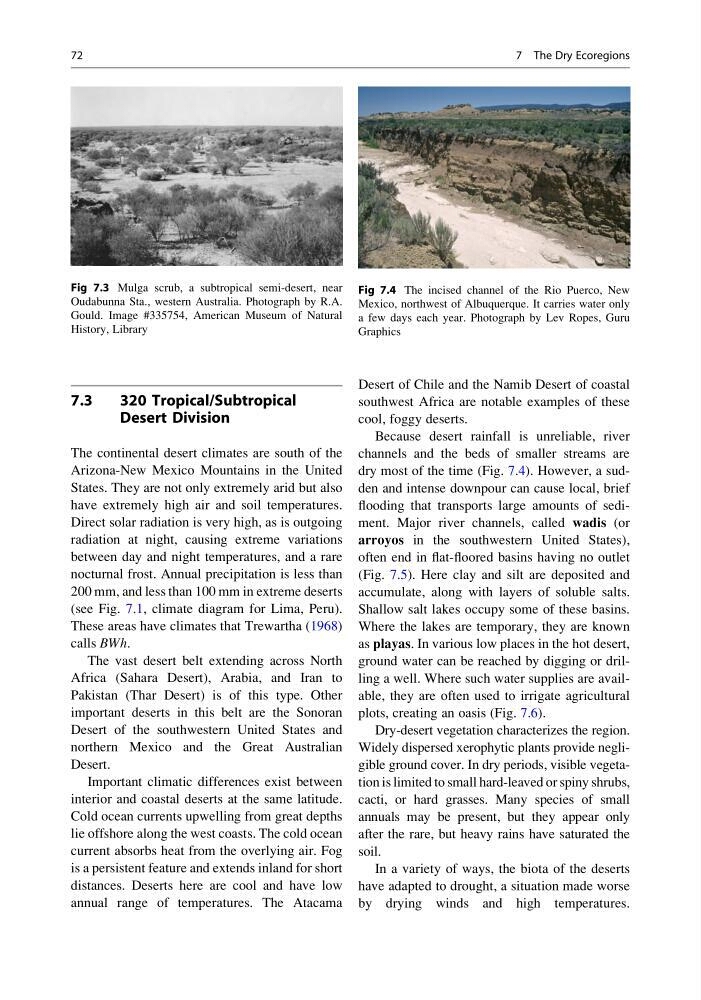
dry most of the time (Fig. 7.4). However, a sudden and intense downpour can cause local, brief
flooding that transports large amounts of sediment. Major river channels, called wadis (or
arroyos in the southwestern United States),
often end in flat-floored basins having no outlet
(Fig. 7.5). Here clay and silt are deposited and
accumulate, along with layers of soluble salts.
Shallow salt lakes occupy some of these basins.
Where the lakes are temporary, they are known
as playas. In various low places in the hot desert,
ground water can be reached by digging or drilling a well. Where such water supplies are available, they are often used to irrigate agricultural
plots, creating an oasis (Fig. 7.6).
Dry-desert vegetation characterizes the region.
Widely dispersed xerophytic plants provide negligible ground cover. In dry periods, visible vegetation is limited to small hard-leaved or spiny shrubs,
cacti, or hard grasses. Many species of small
annuals may be present, but they appear only
after the rare, but heavy rains have saturated the
soil.
In a variety of ways, the biota of the deserts
have adapted to drought, a situation made worse
by drying winds and high temperatures.
Fig 7.4 The incised channel of the Rio Puerco, New
Mexico, northwest of Albuquerque. It carries water only
a few days each year. Photograph by Lev Ropes, Guru
Graphics
Fig 7.3 Mulga scrub, a subtropical semi-desert, near
Oudabunna Sta., western Australia. Photograph by R.A.
Gould. Image #335754, American Museum of Natural
History, Library
72
7 The Dry Ecoregions
320 Tropical/Subtropical
Desert Division
The continental desert climates are south of the
Arizona-New Mexico Mountains in the United
States. They are not only extremely arid but also
have extremely high air and soil temperatures.
Direct solar radiation is very high, as is outgoing
radiation at night, causing extreme variations
between day and night temperatures, and a rare
nocturnal frost. Annual precipitation is less than
200 mm, and less than 100 mm in extreme deserts
(see Fig. 7.1, climate diagram for Lima, Peru).
These areas have climates that Trewartha (1968)
calls BWh.
The vast desert belt extending across North
Africa (Sahara Desert), Arabia, and Iran to
Pakistan (Thar Desert) is of this type. Other
important deserts in this belt are the Sonoran
Desert of the southwestern United States and
northern Mexico and the Great Australian
Desert.
Important climatic differences exist between
interior and coastal deserts at the same latitude.
Cold ocean currents upwelling from great depths
lie offshore along the west coasts. The cold ocean
current absorbs heat from the overlying air. Fog
is a persistent feature and extends inland for short
distances. Deserts here are cool and have low
annual range of temperatures. The Atacama
Desert of Chile and the Namib Desert of coastal
southwest Africa are notable examples of these
cool, foggy deserts.
Because desert rainfall is unreliable, river
channels and the beds of smaller streams are
dry most of the time (Fig. 7.4). However, a sudden and intense downpour can cause local, brief
flooding that transports large amounts of sediment. Major river channels, called wadis (or
arroyos in the southwestern United States),
often end in flat-floored basins having no outlet
(Fig. 7.5). Here clay and silt are deposited and
accumulate, along with layers of soluble salts.
Shallow salt lakes occupy some of these basins.
Where the lakes are temporary, they are known
as playas. In various low places in the hot desert,
ground water can be reached by digging or drilling a well. Where such water supplies are available, they are often used to irrigate agricultural
plots, creating an oasis (Fig. 7.6).
Dry-desert vegetation characterizes the region.
Widely dispersed xerophytic plants provide negligible ground cover. In dry periods, visible vegetation is limited to small hard-leaved or spiny shrubs,
cacti, or hard grasses. Many species of small
annuals may be present, but they appear only
after the rare, but heavy rains have saturated the
soil.
In a variety of ways, the biota of the deserts
have adapted to drought, a situation made worse
by drying winds and high temperatures.
Fig 7.4 The incised channel of the Rio Puerco, New
Mexico, northwest of Albuquerque. It carries water only
a few days each year. Photograph by Lev Ropes, Guru
Graphics
Fig 7.3 Mulga scrub, a subtropical semi-desert, near
Oudabunna Sta., western Australia. Photograph by R.A.
Gould. Image #335754, American Museum of Natural
History, Library
72
7 The Dry Ecoregions