

the fire season are associated with increased area
burned suggesting that dry fuel condition was the
key determinant of regionally synchronous fires.
In contrast, in the southwestern dry ecoprovinces
moist conditions the seasons prior to the fire
season are more important than warmer
temperatures or drought conditions in the year
of the fire suggesting that fuel abundance determined large fire years.
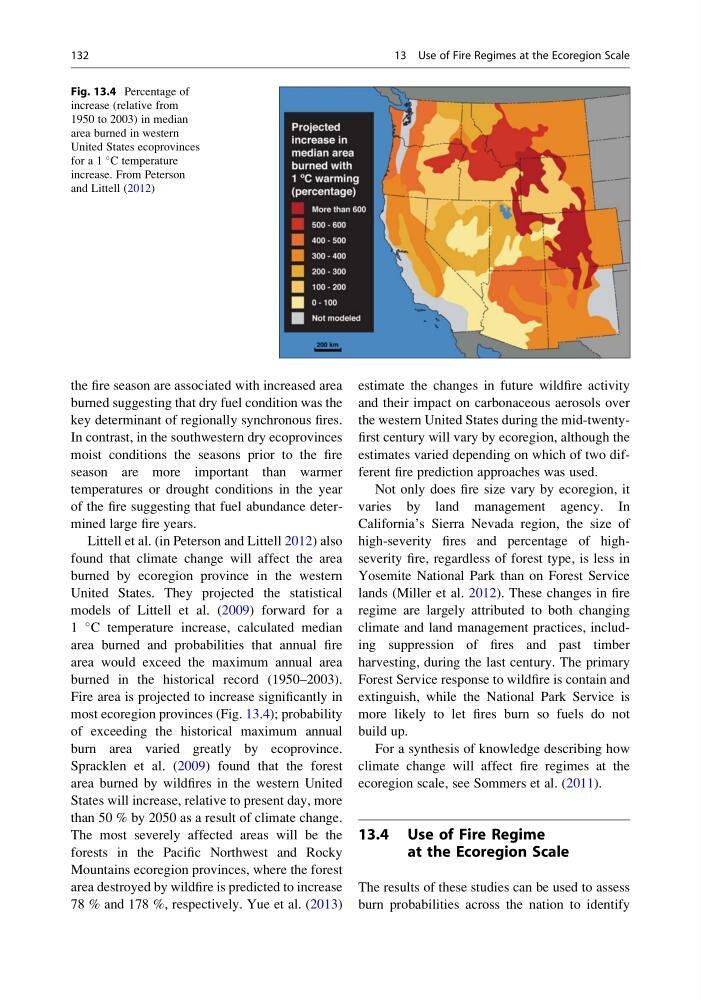
Littell et al. (in Peterson and Littell 2012) also
found that climate change will affect the area
burned by ecoregion province in the western
United States. They projected the statistical
models of Littell et al. (2009) forward for a
1
C temperature increase, calculated median
area burned and probabilities that annual fire
area would exceed the maximum annual area
burned in the historical record (1950–2003).
Fire area is projected to increase significantly in
most ecoregion provinces (Fig. 13.4); probability
of exceeding the historical maximum annual
burn area varied greatly by ecoprovince.
Spracklen et al. (2009) found that the forest
area burned by wildfires in the western United
States will increase, relative to present day, more
than 50 % by 2050 as a result of climate change.
The most severely affected areas will be the
forests in the Pacific Northwest and Rocky
Mountains ecoregion provinces, where the forest
area destroyed by wildfire is predicted to increase
78 % and 178 %, respectively. Yue et al. (2013)
estimate the changes in future wildfire activity
and their impact on carbonaceous aerosols over
the western United States during the mid-twentyfirst century will vary by ecoregion, although the
estimates varied depending on which of two different fire prediction approaches was used.
Not only does fire size vary by ecoregion, it
varies by land management agency. In
California’s Sierra Nevada region, the size of
high-severity fires and percentage of highseverity fire, regardless of forest type, is less in
Yosemite National Park than on Forest Service
lands (Miller et al. 2012). These changes in fire
regime are largely attributed to both changing
climate and land management practices, including suppression of fires and past timber
harvesting, during the last century. The primary
Forest Service response to wildfire is contain and
extinguish, while the National Park Service is
more likely to let fires burn so fuels do not
build up.
For a synthesis of knowledge describing how
climate change will affect fire regimes at the
ecoregion scale, see Sommers et al. (2011).
13.4 Use of Fire Regime
at the Ecoregion Scale
The results of these studies can be used to assess
burn probabilities across the nation to identify
Fig. 13.4 Percentage of
increase (relative from
1950 to 2003) in median
area burned in western
United States ecoprovinces
for a 1
C temperature
increase. From Peterson
and Littell (2012)
132
13 Use of Fire Regimes at the Ecoregion Scale
burned suggesting that dry fuel condition was the
key determinant of regionally synchronous fires.
In contrast, in the southwestern dry ecoprovinces
moist conditions the seasons prior to the fire
season are more important than warmer
temperatures or drought conditions in the year
of the fire suggesting that fuel abundance determined large fire years.
Littell et al. (in Peterson and Littell 2012) also
found that climate change will affect the area
burned by ecoregion province in the western
United States. They projected the statistical
models of Littell et al. (2009) forward for a
1
C temperature increase, calculated median
area burned and probabilities that annual fire
area would exceed the maximum annual area
burned in the historical record (1950–2003).
Fire area is projected to increase significantly in
most ecoregion provinces (Fig. 13.4); probability
of exceeding the historical maximum annual
burn area varied greatly by ecoprovince.
Spracklen et al. (2009) found that the forest
area burned by wildfires in the western United
States will increase, relative to present day, more
than 50 % by 2050 as a result of climate change.
The most severely affected areas will be the
forests in the Pacific Northwest and Rocky
Mountains ecoregion provinces, where the forest
area destroyed by wildfire is predicted to increase
78 % and 178 %, respectively. Yue et al. (2013)
estimate the changes in future wildfire activity
and their impact on carbonaceous aerosols over
the western United States during the mid-twentyfirst century will vary by ecoregion, although the
estimates varied depending on which of two different fire prediction approaches was used.
Not only does fire size vary by ecoregion, it
varies by land management agency. In
California’s Sierra Nevada region, the size of
high-severity fires and percentage of highseverity fire, regardless of forest type, is less in
Yosemite National Park than on Forest Service
lands (Miller et al. 2012). These changes in fire
regime are largely attributed to both changing
climate and land management practices, including suppression of fires and past timber
harvesting, during the last century. The primary
Forest Service response to wildfire is contain and
extinguish, while the National Park Service is
more likely to let fires burn so fuels do not
build up.
For a synthesis of knowledge describing how
climate change will affect fire regimes at the
ecoregion scale, see Sommers et al. (2011).
13.4 Use of Fire Regime
at the Ecoregion Scale
The results of these studies can be used to assess
burn probabilities across the nation to identify
Fig. 13.4 Percentage of
increase (relative from
1950 to 2003) in median
area burned in western
United States ecoprovinces
for a 1
C temperature
increase. From Peterson
and Littell (2012)
132
13 Use of Fire Regimes at the Ecoregion Scale