

grazing, timber harvest, water diversion, and
many others. An obvious application in livestock
grazing is determining how much livestock for
how long to maintain grazable vegetation indefinitely. Indifference to ecosystem management
can lead to overgrazing that permanently
diminishes an ecosystem’s ability to produce
grazable forage and thereby losing that
ecosystem’s ability to support livestock.
12.2.1 Local Systems Within Context
This perspective of seeing context can be applied
in assessing the connection between action at one
scale and effect at another. For example, logging
on upper slopes of an ecological unit may affect
downstream riparian and meadow habitats.
With the ecosystem approach, the interaction
between sites can be understood because processes emerge that are not evident at the site
level. An example is a snow-forest landscape
that includes dark conifers that cause snow to
melt faster than either a wholly snow-covered
or a wholly forested basin. Landscapes function
differently as a whole than would have been
predicted by analysis of the individual elements
(cf. Marston 2006).
The need for seeing context is also important
because ecosystem characteristics have no particular regional alliance. Because of compensating
factors, for example, the same forest type can
occur in markedly different ecoregions: ponderosa
pine forests occur in the Northern Rockies and the
southwest United States. This distribution does
not imply that the climate, topography, soils, and
fire regime are the same. These forests will have
different productivity and response to management. For these reasons, there is a need to recognize regional differences. Cowardin et al. (1979)
recommended the classification of Bailey (1976)
to fill the need for regionalization for their classification of wetlands and deepwater habitats of the
United States. Forest health monitoring (FHM) of
the interior part of the western U.S. was conducted
using an ecoregion approach to group inventory
plots that have similar characteristics (Rogers
et al. 2001). For the annual forest health
assessments of the country, Conkling et al. (2005
et seq.) use Bailey’s revised ecoregions (Cleland
et al. 2007) as assessment units for analysis.
12.2.2 Spatial Transferability of Models
Predictive models differ between larger
systems. The same type of forest growing in
different ecoregions will occur in a different
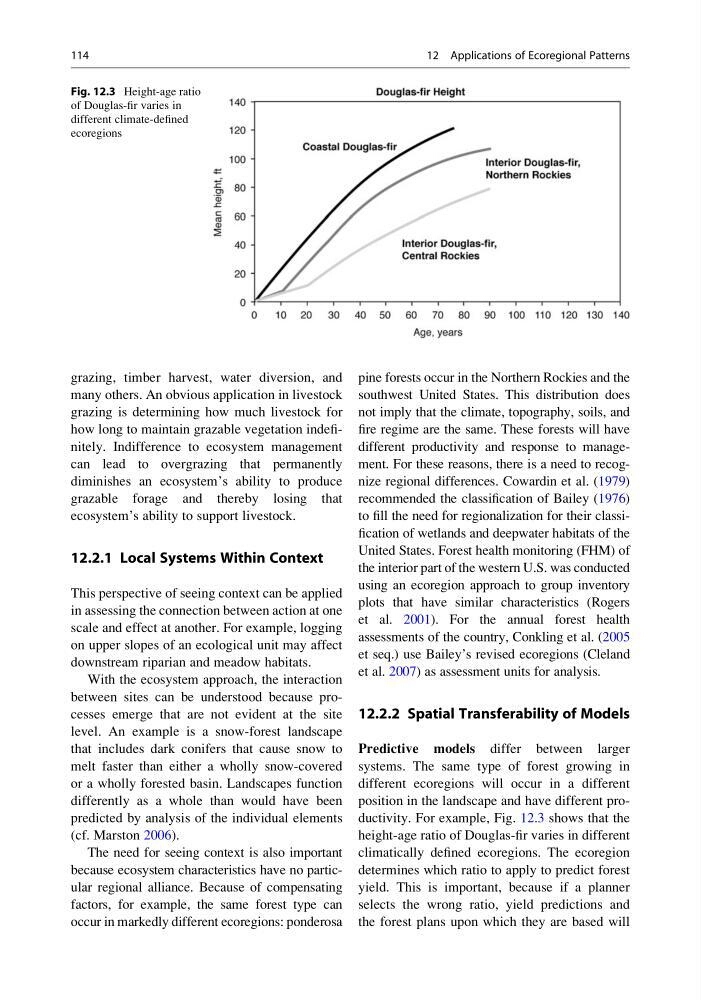
position in the landscape and have different productivity. For example, Fig. 12.3 shows that the
height-age ratio of Douglas-fir varies in different
climatically defined ecoregions. The ecoregion
determines which ratio to apply to predict forest
yield. This is important, because if a planner
selects the wrong ratio, yield predictions and
the forest plans upon which they are based will
Fig. 12.3 Height-age ratio
of Douglas-fir varies in
different climate-defined
ecoregions
114
12 Applications of Ecoregional Patterns
many others. An obvious application in livestock
grazing is determining how much livestock for
how long to maintain grazable vegetation indefinitely. Indifference to ecosystem management
can lead to overgrazing that permanently
diminishes an ecosystem’s ability to produce
grazable forage and thereby losing that
ecosystem’s ability to support livestock.
12.2.1 Local Systems Within Context
This perspective of seeing context can be applied
in assessing the connection between action at one
scale and effect at another. For example, logging
on upper slopes of an ecological unit may affect
downstream riparian and meadow habitats.
With the ecosystem approach, the interaction
between sites can be understood because processes emerge that are not evident at the site
level. An example is a snow-forest landscape
that includes dark conifers that cause snow to
melt faster than either a wholly snow-covered
or a wholly forested basin. Landscapes function
differently as a whole than would have been
predicted by analysis of the individual elements
(cf. Marston 2006).
The need for seeing context is also important
because ecosystem characteristics have no particular regional alliance. Because of compensating
factors, for example, the same forest type can
occur in markedly different ecoregions: ponderosa
pine forests occur in the Northern Rockies and the
southwest United States. This distribution does
not imply that the climate, topography, soils, and
fire regime are the same. These forests will have
different productivity and response to management. For these reasons, there is a need to recognize regional differences. Cowardin et al. (1979)
recommended the classification of Bailey (1976)
to fill the need for regionalization for their classification of wetlands and deepwater habitats of the
United States. Forest health monitoring (FHM) of
the interior part of the western U.S. was conducted
using an ecoregion approach to group inventory
plots that have similar characteristics (Rogers
et al. 2001). For the annual forest health
assessments of the country, Conkling et al. (2005
et seq.) use Bailey’s revised ecoregions (Cleland
et al. 2007) as assessment units for analysis.
12.2.2 Spatial Transferability of Models
Predictive models differ between larger
systems. The same type of forest growing in
different ecoregions will occur in a different
position in the landscape and have different productivity. For example, Fig. 12.3 shows that the
height-age ratio of Douglas-fir varies in different
climatically defined ecoregions. The ecoregion
determines which ratio to apply to predict forest
yield. This is important, because if a planner
selects the wrong ratio, yield predictions and
the forest plans upon which they are based will
Fig. 12.3 Height-age ratio
of Douglas-fir varies in
different climate-defined
ecoregions
114
12 Applications of Ecoregional Patterns