

instead of sewage treatment plants, and indigenous materials rather than imported ones.
Instead of channeling storm runoff into concrete drains and then to a sewage system,
undeveloped drainage swales can be used to
mimic nature and help provide sponges for
flood protection (Barnett and Browning
1995).
• Match development and use to the limits of
the region The solution to developing an ecological design grows from integrating design
within the limits of place. For example, in the
Lake Tahoe region of California-Nevada,
USA (Bailey 1974), I conducted a land capability analysis using ecoregional design
concepts to create land development controls
that would take into account environmental
limitations (e.g., soil erodibility) and ecological impacts (e.g., lake sedimentation). These
controls limit land coverage (Table 12.1).
• Design sites by considering their
relationships with their neighbors In a problem related to the Lake Tahoe site, I was to
distinguish capability at both a local level and
within the context of a larger area or region.
My solution was to evaluate capability in two
ways: on inherent features and limitations of
the area; and on the geomorphic features
which surround this area. This type of rating
excluded small pockets of high capability
lands, such as rolling uplands, when
surrounded by highly fragile, erosive, or
unstable lands.
12.2 Significance to Ecosystem
Management
While relevant for the design of sustainable
landscapes, the concept presented above has a
strong application for managing productive land
uses and their environmental impacts. Understanding ecoregional patterns plays a critical
role in management activities such as livestock
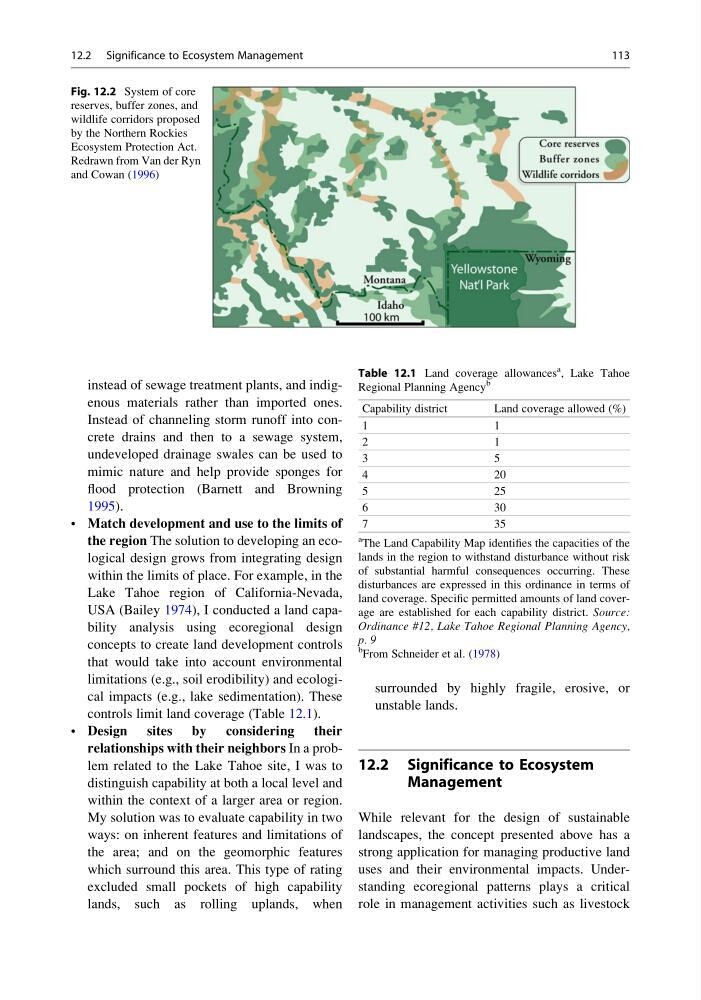
Fig. 12.2 System of core
reserves, buffer zones, and
wildlife corridors proposed
by the Northern Rockies
Ecosystem Protection Act.
Redrawn from Van der Ryn
and Cowan (1996)
Table 12.1 Land coverage allowances
a
, Lake Tahoe
Regional Planning Agency
b
Capability district
Land coverage allowed (%)
1
1
2
1
3
5
4
2 0
5
2 5
6
3 0
7
3 5
a
The Land Capability Map identifies the capacities of the
lands in the region to withstand disturbance without risk
of substantial harmful consequences occurring. These
disturbances are expressed in this ordinance in terms of
land coverage. Specific permitted amounts of land coverage are established for each capability district. Source:
Ordinance #12, Lake Tahoe Regional Planning Agency,
p. 9
b
From Schneider et al. (1978)
12.2 Significance to Ecosystem Management
113
Instead of channeling storm runoff into concrete drains and then to a sewage system,
undeveloped drainage swales can be used to
mimic nature and help provide sponges for
flood protection (Barnett and Browning
1995).
• Match development and use to the limits of
the region The solution to developing an ecological design grows from integrating design
within the limits of place. For example, in the
Lake Tahoe region of California-Nevada,
USA (Bailey 1974), I conducted a land capability analysis using ecoregional design
concepts to create land development controls
that would take into account environmental
limitations (e.g., soil erodibility) and ecological impacts (e.g., lake sedimentation). These
controls limit land coverage (Table 12.1).
• Design sites by considering their
relationships with their neighbors In a problem related to the Lake Tahoe site, I was to
distinguish capability at both a local level and
within the context of a larger area or region.
My solution was to evaluate capability in two
ways: on inherent features and limitations of
the area; and on the geomorphic features
which surround this area. This type of rating
excluded small pockets of high capability
lands, such as rolling uplands, when
surrounded by highly fragile, erosive, or
unstable lands.
12.2 Significance to Ecosystem
Management
While relevant for the design of sustainable
landscapes, the concept presented above has a
strong application for managing productive land
uses and their environmental impacts. Understanding ecoregional patterns plays a critical
role in management activities such as livestock
Fig. 12.2 System of core
reserves, buffer zones, and
wildlife corridors proposed
by the Northern Rockies
Ecosystem Protection Act.
Redrawn from Van der Ryn
and Cowan (1996)
Table 12.1 Land coverage allowances
a
, Lake Tahoe
Regional Planning Agency
b
Capability district
Land coverage allowed (%)
1
1
2
1
3
5
4
2 0
5
2 5
6
3 0
7
3 5
a
The Land Capability Map identifies the capacities of the
lands in the region to withstand disturbance without risk
of substantial harmful consequences occurring. These
disturbances are expressed in this ordinance in terms of
land coverage. Specific permitted amounts of land coverage are established for each capability district. Source:
Ordinance #12, Lake Tahoe Regional Planning Agency,
p. 9
b
From Schneider et al. (1978)
12.2 Significance to Ecosystem Management
113