

design, one can create landscapes that function
sustainably like natural ecosystems. Ecoregional
design is the act of understanding the patterns of
a region in terms of the processes that shape them
and then applying that understanding to design
and planning.
In addition:
• Observe how a region functions and try to
maintain functional integrity The tropical
rainforest, for instance, provides so much
oxygen that it can be considered as a lung of
the biosphere. So we should not use it only for
massive lumbering, but instead, take advantage of its other resources, such as medicines,
many not yet discovered. Changing the natural patterns by adding subdivisions, roads, or
other elements changes the ecological
functions. For example, animals change their
routes, water flows are changed in direction
and intensity, erosion commences, and so on.
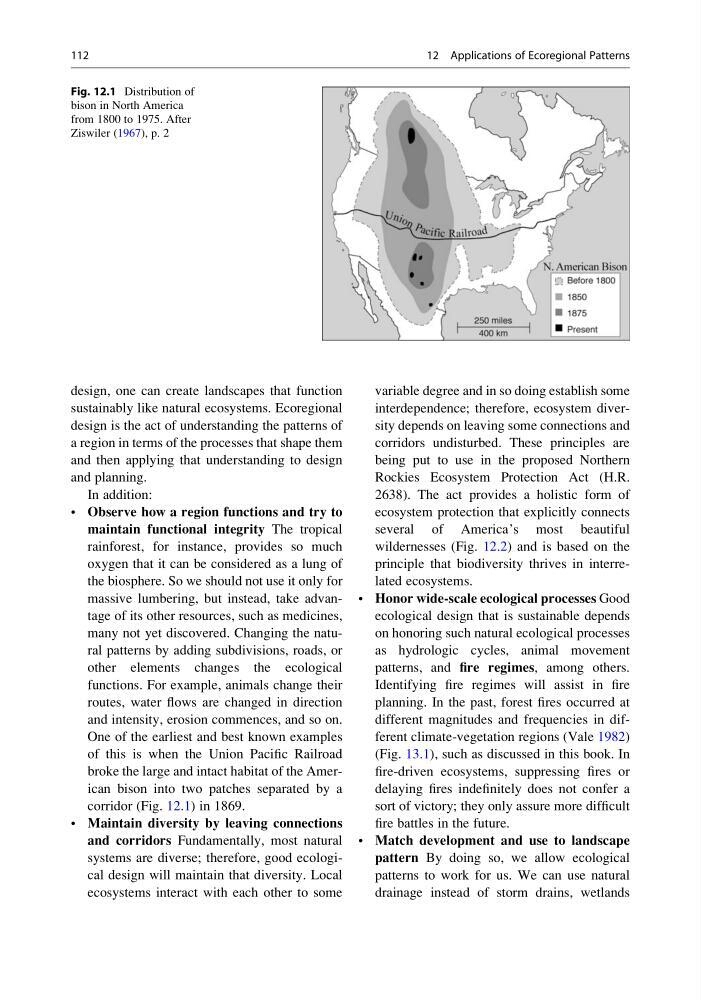
One of the earliest and best known examples
of this is when the Union Pacific Railroad
broke the large and intact habitat of the American bison into two patches separated by a
corridor (Fig. 12.1) in 1869.
• Maintain diversity by leaving connections
and corridors Fundamentally, most natural
systems are diverse; therefore, good ecological design will maintain that diversity. Local
ecosystems interact with each other to some
variable degree and in so doing establish some
interdependence; therefore, ecosystem diversity depends on leaving some connections and
corridors undisturbed. These principles are
being put to use in the proposed Northern
Rockies Ecosystem Protection Act (H.R.
2638). The act provides a holistic form of
ecosystem protection that explicitly connects
several of America’s most beautiful
wildernesses (Fig. 12.2) and is based on the
principle that biodiversity thrives in interrelated ecosystems.
• Honor wide-scale ecological processes Good
ecological design that is sustainable depends
on honoring such natural ecological processes
as hydrologic cycles, animal movement
patterns, and fire regimes, among others.
Identifying fire regimes will assist in fire
planning. In the past, forest fires occurred at
different magnitudes and frequencies in different climate-vegetation regions (Vale 1982)
(Fig. 13.1), such as discussed in this book. In
fire-driven ecosystems, suppressing fires or
delaying fires indefinitely does not confer a
sort of victory; they only assure more difficult
fire battles in the future.
• Match development and use to landscape
pattern By doing so, we allow ecological
patterns to work for us. We can use natural
drainage instead of storm drains, wetlands
Fig. 12.1 Distribution of
bison in North America
from 1800 to 1975. After
Ziswiler (1967), p. 2
112
12 Applications of Ecoregional Patterns
sustainably like natural ecosystems. Ecoregional
design is the act of understanding the patterns of
a region in terms of the processes that shape them
and then applying that understanding to design
and planning.
In addition:
• Observe how a region functions and try to
maintain functional integrity The tropical
rainforest, for instance, provides so much
oxygen that it can be considered as a lung of
the biosphere. So we should not use it only for
massive lumbering, but instead, take advantage of its other resources, such as medicines,
many not yet discovered. Changing the natural patterns by adding subdivisions, roads, or
other elements changes the ecological
functions. For example, animals change their
routes, water flows are changed in direction
and intensity, erosion commences, and so on.
One of the earliest and best known examples
of this is when the Union Pacific Railroad
broke the large and intact habitat of the American bison into two patches separated by a
corridor (Fig. 12.1) in 1869.
• Maintain diversity by leaving connections
and corridors Fundamentally, most natural
systems are diverse; therefore, good ecological design will maintain that diversity. Local
ecosystems interact with each other to some
variable degree and in so doing establish some
interdependence; therefore, ecosystem diversity depends on leaving some connections and
corridors undisturbed. These principles are
being put to use in the proposed Northern
Rockies Ecosystem Protection Act (H.R.
2638). The act provides a holistic form of
ecosystem protection that explicitly connects
several of America’s most beautiful
wildernesses (Fig. 12.2) and is based on the
principle that biodiversity thrives in interrelated ecosystems.
• Honor wide-scale ecological processes Good
ecological design that is sustainable depends
on honoring such natural ecological processes
as hydrologic cycles, animal movement
patterns, and fire regimes, among others.
Identifying fire regimes will assist in fire
planning. In the past, forest fires occurred at
different magnitudes and frequencies in different climate-vegetation regions (Vale 1982)
(Fig. 13.1), such as discussed in this book. In
fire-driven ecosystems, suppressing fires or
delaying fires indefinitely does not confer a
sort of victory; they only assure more difficult
fire battles in the future.
• Match development and use to landscape
pattern By doing so, we allow ecological
patterns to work for us. We can use natural
drainage instead of storm drains, wetlands
Fig. 12.1 Distribution of
bison in North America
from 1800 to 1975. After
Ziswiler (1967), p. 2
112
12 Applications of Ecoregional Patterns