

mass elevation”) that described the variation in
upper treeline based on the mountain size and
location. In general, large mountain ranges will
tend to have higher treelines than more isolated
ranges because of heat retention and wind sheltering. Regions of similar elevation and latitude
may have much warmer or colder climates
depending on the size of the mountain ranges.
A good example of ecosystem change in both
time and space is the vertical displacement of
vegetation types in the Great Smoky Mountains
in Tennessee and North Carolina. Using fossil
pollen data, Delcourt and Delcourt (1987) show
how the boreal forest in the valleys was displaced
upward as the climate warmed during the past
20,000 years. In the future (2100), they project
that it will be eliminated on most sites throughout
the region. In its place, southern hardwood and
pine forest, and temperate deciduous forest will
occupy the highest elevations. Barnes (2009)
provides other examples of tree response to ecosystem change.
Climate change can, in theory, cause a reduction in the spatial extent of a community. The
alpine vegetation is one example of a community
which will probably diminish as a direct result of
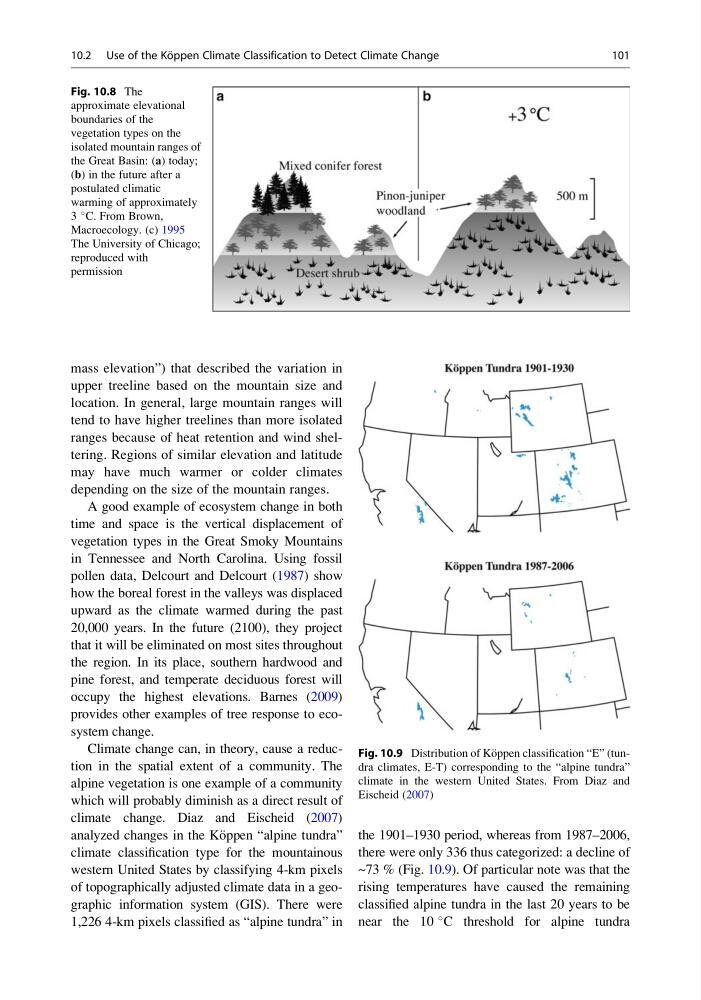
climate change. Diaz and Eischeid (2007)
analyzed changes in the Ko ¨ppen “alpine tundra”
climate classification type for the mountainous
western United States by classifying 4-km pixels
of topographically adjusted climate data in a geographic information system (GIS). There were
1,226 4-km pixels classified as “alpine tundra” in
the 1901–1930 period, whereas from 1987–2006,
there were only 336 thus categorized: a decline of
~73 % (Fig. 10.9). Of particular note was that the
rising temperatures have caused the remaining
classified alpine tundra in the last 20 years to be
near the 10
C threshold for alpine tundra
Fig. 10.9 Distribution of Ko ¨ppen classification “E” (tundra climates, E-T) corresponding to the “alpine tundra”
climate in the western United States. From Diaz and
Eischeid (2007)
Fig. 10.8 The
approximate elevational
boundaries of the
vegetation types on the
isolated mountain ranges of
the Great Basin: (a) today;
(b) in the future after a
postulated climatic
warming of approximately
3
C. From Brown,
Macroecology. (c) 1995
The University of Chicago;
reproduced with
permission
10.2 Use of the Ko ¨ ppen Climate Classification to Detect Climate Change
101
upper treeline based on the mountain size and
location. In general, large mountain ranges will
tend to have higher treelines than more isolated
ranges because of heat retention and wind sheltering. Regions of similar elevation and latitude
may have much warmer or colder climates
depending on the size of the mountain ranges.
A good example of ecosystem change in both
time and space is the vertical displacement of
vegetation types in the Great Smoky Mountains
in Tennessee and North Carolina. Using fossil
pollen data, Delcourt and Delcourt (1987) show
how the boreal forest in the valleys was displaced
upward as the climate warmed during the past
20,000 years. In the future (2100), they project
that it will be eliminated on most sites throughout
the region. In its place, southern hardwood and
pine forest, and temperate deciduous forest will
occupy the highest elevations. Barnes (2009)
provides other examples of tree response to ecosystem change.
Climate change can, in theory, cause a reduction in the spatial extent of a community. The
alpine vegetation is one example of a community
which will probably diminish as a direct result of
climate change. Diaz and Eischeid (2007)
analyzed changes in the Ko ¨ppen “alpine tundra”
climate classification type for the mountainous
western United States by classifying 4-km pixels
of topographically adjusted climate data in a geographic information system (GIS). There were
1,226 4-km pixels classified as “alpine tundra” in
the 1901–1930 period, whereas from 1987–2006,
there were only 336 thus categorized: a decline of
~73 % (Fig. 10.9). Of particular note was that the
rising temperatures have caused the remaining
classified alpine tundra in the last 20 years to be
near the 10
C threshold for alpine tundra
Fig. 10.9 Distribution of Ko ¨ppen classification “E” (tundra climates, E-T) corresponding to the “alpine tundra”
climate in the western United States. From Diaz and
Eischeid (2007)
Fig. 10.8 The
approximate elevational
boundaries of the
vegetation types on the
isolated mountain ranges of
the Great Basin: (a) today;
(b) in the future after a
postulated climatic
warming of approximately
3
C. From Brown,
Macroecology. (c) 1995
The University of Chicago;
reproduced with
permission
10.2 Use of the Ko ¨ ppen Climate Classification to Detect Climate Change
101