

greenhouse gas warming simulations and found a
retreat of regions of permafrost and the increase
of areas with tropical rainy climates and dry
climates.
Ecological impacts of the recent warming
trend in the arctic are already noted as changes
in treeline and a decrease in tundra area with the
replacement of ground cover by shrubs in northern Alaska and several locations in northern
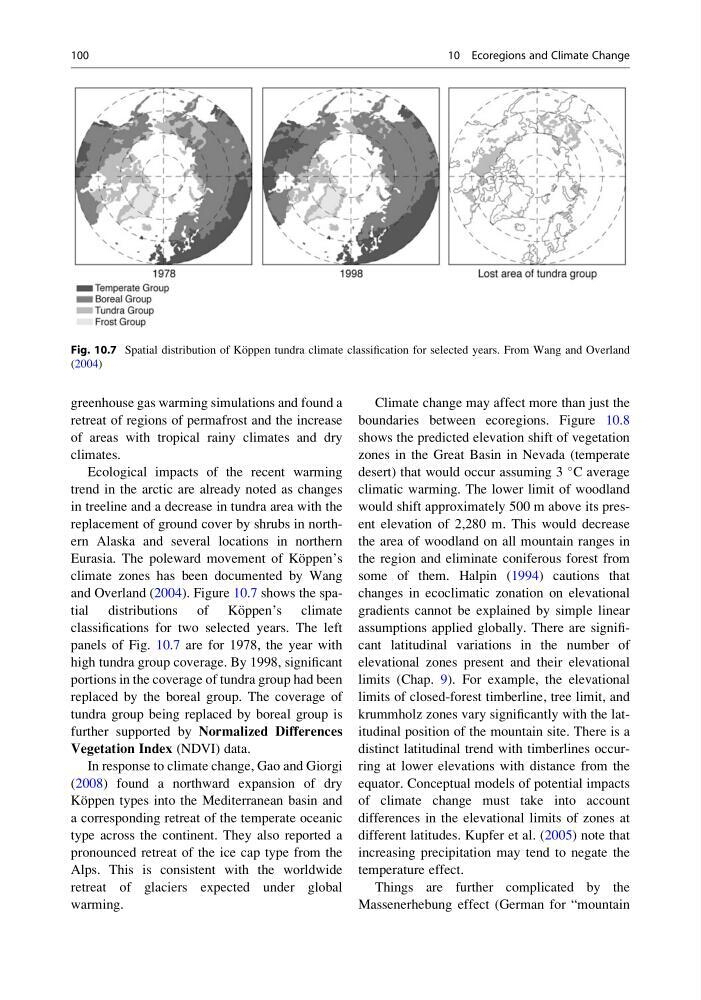
Eurasia. The poleward movement of Ko ¨ppen’s
climate zones has been documented by Wang
and Overland (2004). Figure 10.7 shows the spatial distributions of Ko ¨ppen’s climate
classifications for two selected years. The left
panels of Fig. 10.7 are for 1978, the year with
high tundra group coverage. By 1998, significant
portions in the coverage of tundra group had been
replaced by the boreal group. The coverage of
tundra group being replaced by boreal group is
further supported by Normalized Differences
Vegetation Index (NDVI) data.
In response to climate change, Gao and Giorgi
(2008) found a northward expansion of dry
Ko ¨ppen types into the Mediterranean basin and
a corresponding retreat of the temperate oceanic
type across the continent. They also reported a
pronounced retreat of the ice cap type from the
Alps. This is consistent with the worldwide
retreat of glaciers expected under global
warming.
Climate change may affect more than just the
boundaries between ecoregions. Figure 10.8
shows the predicted elevation shift of vegetation
zones in the Great Basin in Nevada (temperate
desert) that would occur assuming 3
C average
climatic warming. The lower limit of woodland
would shift approximately 500 m above its present elevation of 2,280 m. This would decrease
the area of woodland on all mountain ranges in
the region and eliminate coniferous forest from
some of them. Halpin (1994) cautions that
changes in ecoclimatic zonation on elevational
gradients cannot be explained by simple linear
assumptions applied globally. There are significant latitudinal variations in the number of
elevational zones present and their elevational
limits (Chap. 9). For example, the elevational
limits of closed-forest timberline, tree limit, and
krummholz zones vary significantly with the latitudinal position of the mountain site. There is a
distinct latitudinal trend with timberlines occurring at lower elevations with distance from the
equator. Conceptual models of potential impacts
of climate change must take into account
differences in the elevational limits of zones at
different latitudes. Kupfer et al. (2005) note that
increasing precipitation may tend to negate the
temperature effect.
Things are further complicated by the
Massenerhebung effect (German for “mountain
Fig. 10.7 Spatial distribution of Ko ¨ppen tundra climate classification for selected years. From Wang and Overland
(2004)
100
10 Ecoregions and Climate Change
retreat of regions of permafrost and the increase
of areas with tropical rainy climates and dry
climates.
Ecological impacts of the recent warming
trend in the arctic are already noted as changes
in treeline and a decrease in tundra area with the
replacement of ground cover by shrubs in northern Alaska and several locations in northern
Eurasia. The poleward movement of Ko ¨ppen’s
climate zones has been documented by Wang
and Overland (2004). Figure 10.7 shows the spatial distributions of Ko ¨ppen’s climate
classifications for two selected years. The left
panels of Fig. 10.7 are for 1978, the year with
high tundra group coverage. By 1998, significant
portions in the coverage of tundra group had been
replaced by the boreal group. The coverage of
tundra group being replaced by boreal group is
further supported by Normalized Differences
Vegetation Index (NDVI) data.
In response to climate change, Gao and Giorgi
(2008) found a northward expansion of dry
Ko ¨ppen types into the Mediterranean basin and
a corresponding retreat of the temperate oceanic
type across the continent. They also reported a
pronounced retreat of the ice cap type from the
Alps. This is consistent with the worldwide
retreat of glaciers expected under global
warming.
Climate change may affect more than just the
boundaries between ecoregions. Figure 10.8
shows the predicted elevation shift of vegetation
zones in the Great Basin in Nevada (temperate
desert) that would occur assuming 3
C average
climatic warming. The lower limit of woodland
would shift approximately 500 m above its present elevation of 2,280 m. This would decrease
the area of woodland on all mountain ranges in
the region and eliminate coniferous forest from
some of them. Halpin (1994) cautions that
changes in ecoclimatic zonation on elevational
gradients cannot be explained by simple linear
assumptions applied globally. There are significant latitudinal variations in the number of
elevational zones present and their elevational
limits (Chap. 9). For example, the elevational
limits of closed-forest timberline, tree limit, and
krummholz zones vary significantly with the latitudinal position of the mountain site. There is a
distinct latitudinal trend with timberlines occurring at lower elevations with distance from the
equator. Conceptual models of potential impacts
of climate change must take into account
differences in the elevational limits of zones at
different latitudes. Kupfer et al. (2005) note that
increasing precipitation may tend to negate the
temperature effect.
Things are further complicated by the
Massenerhebung effect (German for “mountain
Fig. 10.7 Spatial distribution of Ko ¨ppen tundra climate classification for selected years. From Wang and Overland
(2004)
100
10 Ecoregions and Climate Change