

74
Sources and Composition of Marine Sediments
.' ....
,,....
.
..
:
.....
.. .. .. ... .. ...
....
' . .. .
.. .. ..
..
...... "
.. .. .. .. '. '.
-
Distr ibut ion of upprr ash l ayltf
-, -, ..... -. . , .... . ..... ................ ............. .. .
••••• ••••• Dis tr ibution of lowrr ash tQyer
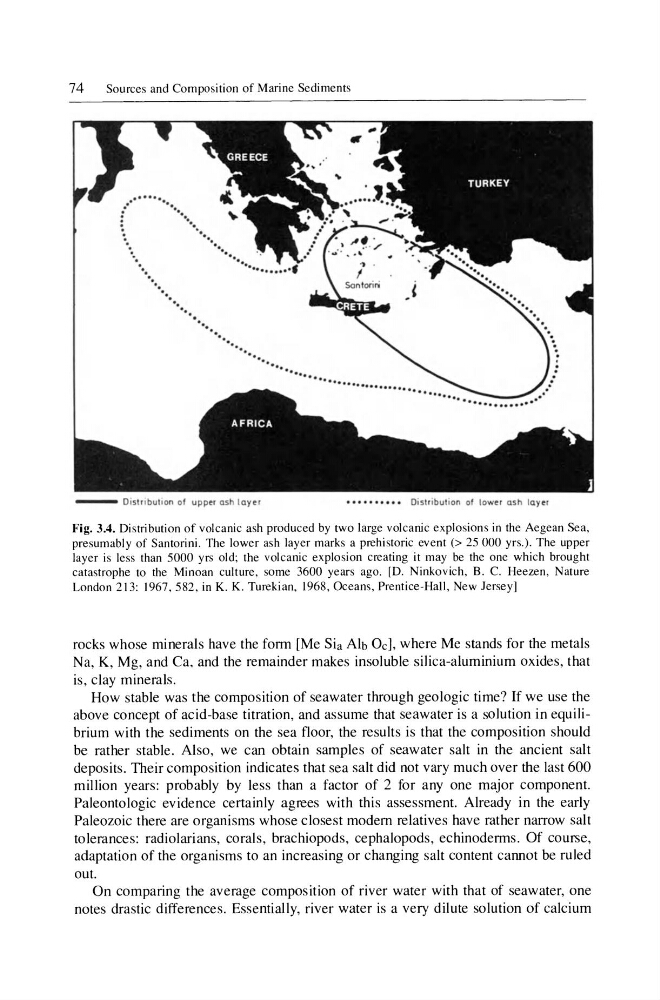
Fig. 3.4. Distribution of volcanic ash produced by two large volcanic explosions in the Aegean Sea,
presumably of Santorini. The lower ash layer marks a prehistoric event (> 25 000 yrs.). The upper
layer is less than 5000 yrs old; the volcanic explosion creating it may be the one which brought
catastrophe to the Minoan culture, some 3600 years ago. [D. Ninkovich, B. C. Heezen, Nature
London 213: 1967 , 582, in K. K. Turekian, 1968, Oceans, Prentice-Hall, New Jersey]
rocks whose minerals have the fonn [Me Sia Alb Oc], where Me stands for the metals
Na, K, Mg, and Ca, and the remainder makes insoluble silica-aluminium oxides, that
is, clay minerals.
How stable was the composition of seawater through geologic time? If we use the
above concept of acid-base titration, and assume that seawater is a solution in equilibrium with the sediments on the sea floor, the results is that the composition should
be rather stable. Also, we can obtain samples of seawater salt in the ancient salt
deposits. Their composition indicates that sea salt did not vary much over the last 600
million years: probably by less than a factor of 2 for anyone major component.
Paleontologic evidence certainly agrees with this assessment. Already in the early
Paleozoic there are organisms whose closest modem relatives have rather narrow salt
tolerances: radiolarians, corals, brachiopods, cephalopods, echinodenns. Of course,
adaptation of the organisms to an increasing or changing salt content cannot be ruled
out.
On comparing the average composition of river water with that of seawater, one
notes drastic differences. Essentially, river water is a very dilute solution of calcium
Sources and Composition of Marine Sediments
.' ....
,,....
.
..
:
.....
.. .. .. ... .. ...
....
' . .. .
.. .. ..
..
...... "
.. .. .. .. '. '.
-
Distr ibut ion of upprr ash l ayltf
-, -, ..... -. . , .... . ..... ................ ............. .. .
••••• ••••• Dis tr ibution of lowrr ash tQyer
Fig. 3.4. Distribution of volcanic ash produced by two large volcanic explosions in the Aegean Sea,
presumably of Santorini. The lower ash layer marks a prehistoric event (> 25 000 yrs.). The upper
layer is less than 5000 yrs old; the volcanic explosion creating it may be the one which brought
catastrophe to the Minoan culture, some 3600 years ago. [D. Ninkovich, B. C. Heezen, Nature
London 213: 1967 , 582, in K. K. Turekian, 1968, Oceans, Prentice-Hall, New Jersey]
rocks whose minerals have the fonn [Me Sia Alb Oc], where Me stands for the metals
Na, K, Mg, and Ca, and the remainder makes insoluble silica-aluminium oxides, that
is, clay minerals.
How stable was the composition of seawater through geologic time? If we use the
above concept of acid-base titration, and assume that seawater is a solution in equilibrium with the sediments on the sea floor, the results is that the composition should
be rather stable. Also, we can obtain samples of seawater salt in the ancient salt
deposits. Their composition indicates that sea salt did not vary much over the last 600
million years: probably by less than a factor of 2 for anyone major component.
Paleontologic evidence certainly agrees with this assessment. Already in the early
Paleozoic there are organisms whose closest modem relatives have rather narrow salt
tolerances: radiolarians, corals, brachiopods, cephalopods, echinodenns. Of course,
adaptation of the organisms to an increasing or changing salt content cannot be ruled
out.
On comparing the average composition of river water with that of seawater, one
notes drastic differences. Essentially, river water is a very dilute solution of calcium