

Sediments and Seawater Composition
75
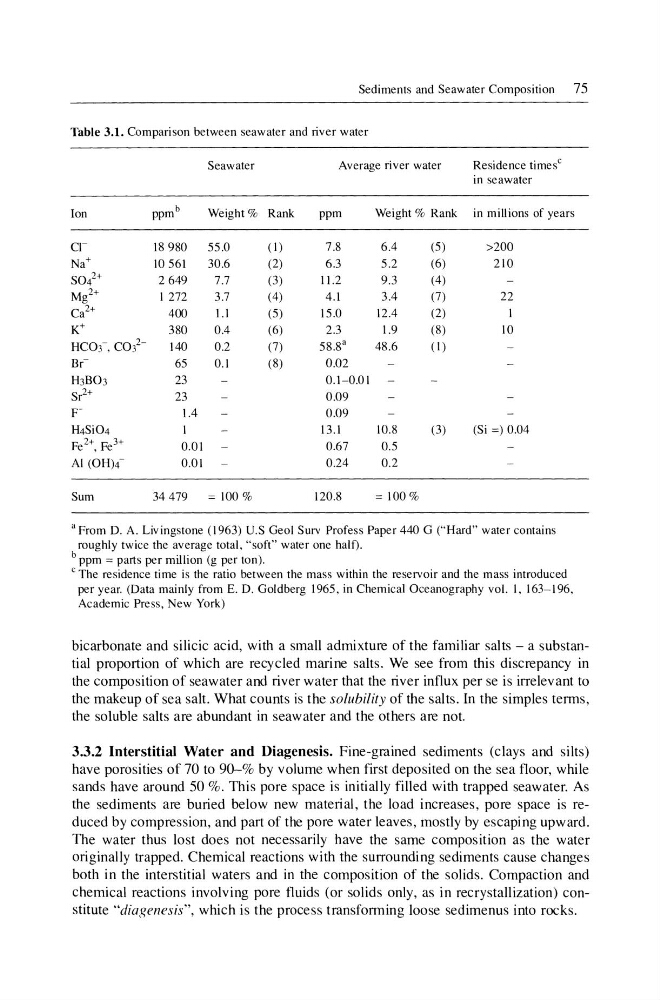
Table 3.1. Comparison between seawater and river water
Seawater
Average river water
Residence times C
in seawater
Ion
ppm b
Weight % Rank
ppm
Weight % Rank in millions of years
Cl18980
55.0
(1)
7.8
6.4
(5)
>200
Na+
10 561
30.6
(2)
6.3
5.2
(6)
210
soi+
2649
7.7
(3)
11.2
9.3
(4)
Mg2+
1272
3.7
(4)
4.1
3.4
(7)
22
Ca 2 +
400
1.1
(5)
15.0
12.4
(2)
K+
380
0.4
(6)
2.3
1.9
(8)
10
HC03 -, C03 2 -
140
0.2
(7)
58.8 a
48.6
( 1)
Br65
0.1
(8)
0.02
H3B03
23
OJ-Om
Sr2+
23
0.09
F1.4
0.09
H4Si04
1
13.1
10.8
(3)
(Si =) 0.04
Fe 2 +, Fe 3 +
0.01
0.67
0.5
AI (OH)40.01
0.24
0.2
Sum
34479
= 100 %
120.8
= 100%
a From D. A. Livingstone (1963) U.S Geol Surv Profess Paper 440 G ("Hard" water contains
roughly twice the average total, "soft" water one half).
b ppm = parts per million (g per ton).
C The residence time is the ratio between the mass within the reservoir and the mass introduced
per year. (Data mainly from E. D. Goldberg 1965, in Chemical Oceanography vol. 1, 163-196,
Academic Press, New York)
bicarbonate and silicic acid, with a small admixture of the familiar salts - a substantial proportion of which are recycled marine salts. We see from this discrepancy in
the composition of seawater and river water that the river influx per se is irrelevant to
the makeup of sea salt. What counts is the solubility of the salts. In the simples terms,
the soluble salts are abundant in seawater and the others are not.
3.3.2 Interstitial Water and Diagenesis. Fine-grained sediments (clays and silts)
have porosities of 70 to 90-% by volume when first deposited on the sea floor, while
sands have around 50 %. This pore space is initially filled with trapped seawater. As
the sediments are buried below new material, the load increases, pore space is reduced by compression, and part of the pore water leaves, mostly by escaping upward.
The water thus lost does not necessarily have the same composition as the water
originally trapped. Chemical reactions with the surrounding sediments cause changes
both in the interstitial waters and in the composition of the solids. Compaction and
chemical reactions involving pore fluids (or solids only, as in recrystallization) constitute "diagenesis", which is the process transforming loose sedimenus into rocks.
75
Table 3.1. Comparison between seawater and river water
Seawater
Average river water
Residence times C
in seawater
Ion
ppm b
Weight % Rank
ppm
Weight % Rank in millions of years
Cl18980
55.0
(1)
7.8
6.4
(5)
>200
Na+
10 561
30.6
(2)
6.3
5.2
(6)
210
soi+
2649
7.7
(3)
11.2
9.3
(4)
Mg2+
1272
3.7
(4)
4.1
3.4
(7)
22
Ca 2 +
400
1.1
(5)
15.0
12.4
(2)
K+
380
0.4
(6)
2.3
1.9
(8)
10
HC03 -, C03 2 -
140
0.2
(7)
58.8 a
48.6
( 1)
Br65
0.1
(8)
0.02
H3B03
23
OJ-Om
Sr2+
23
0.09
F1.4
0.09
H4Si04
1
13.1
10.8
(3)
(Si =) 0.04
Fe 2 +, Fe 3 +
0.01
0.67
0.5
AI (OH)40.01
0.24
0.2
Sum
34479
= 100 %
120.8
= 100%
a From D. A. Livingstone (1963) U.S Geol Surv Profess Paper 440 G ("Hard" water contains
roughly twice the average total, "soft" water one half).
b ppm = parts per million (g per ton).
C The residence time is the ratio between the mass within the reservoir and the mass introduced
per year. (Data mainly from E. D. Goldberg 1965, in Chemical Oceanography vol. 1, 163-196,
Academic Press, New York)
bicarbonate and silicic acid, with a small admixture of the familiar salts - a substantial proportion of which are recycled marine salts. We see from this discrepancy in
the composition of seawater and river water that the river influx per se is irrelevant to
the makeup of sea salt. What counts is the solubility of the salts. In the simples terms,
the soluble salts are abundant in seawater and the others are not.
3.3.2 Interstitial Water and Diagenesis. Fine-grained sediments (clays and silts)
have porosities of 70 to 90-% by volume when first deposited on the sea floor, while
sands have around 50 %. This pore space is initially filled with trapped seawater. As
the sediments are buried below new material, the load increases, pore space is reduced by compression, and part of the pore water leaves, mostly by escaping upward.
The water thus lost does not necessarily have the same composition as the water
originally trapped. Chemical reactions with the surrounding sediments cause changes
both in the interstitial waters and in the composition of the solids. Compaction and
chemical reactions involving pore fluids (or solids only, as in recrystallization) constitute "diagenesis", which is the process transforming loose sedimenus into rocks.