

Sediments and Seawater Composition 73
.25-35
.15-25
b, : , :.:.! 10- 15
[ :',:: 1 5- K)
::':'.>~ ... : :. :' . . . . . -: . .
:: . . . ' ,: ..
. '.:.:.::.::: :::'
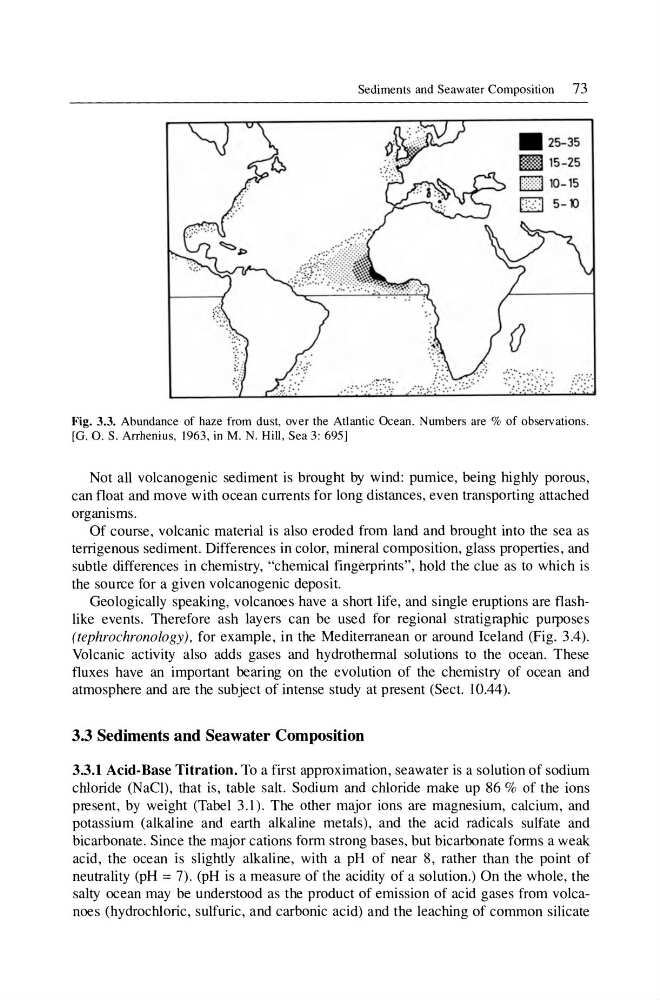
Fig. 3.3. Abundance of haze from dust, over the Atlantic Ocean. Numbers are % of observations.
[G. O. S. Arrhenius, 1963, in M. N. Hill, Sea 3: 695)
Not all volcanogenic sediment is brought by wind: pumice, being highly porous,
can float and move with ocean currents for long distances, even transporting attached
organisms.
Of course, volcanic material is also eroded from land and brought into the sea as
terrigenous sediment. Differences in color, mineral composition, glass properties, and
subtle differences in chemistry, "chemical fingerprints", hold the clue as to which is
the source for a given volcanogenic deposit.
Geologically speaking, volcanoes have a short life, and single eruptions are flashlike events. Therefore ash layers can be used for regional stratigraphic purposes
(tephrochronology), for example, in the Mediterranean or around Iceland (Fig. 3.4).
Volcanic activity also adds gases and hydrothermal solutions to the ocean. These
fluxes have an important bearing on the evolution of the chemistry of ocean and
atmosphere and are the subject of intense study at present (Sect. 10.44).
3.3 Sediments and Seawater Composition
3.3.1 Acid-Base Titration. To a first approximation, seawater is a solution of sodium
chloride (NaC\), that is, table salt. Sodium and chloride make up 86 % of the ions
present, by weight (Tabel 3.1). The other major ions are magnesium, calcium, and
potassium (alkaline and earth alkaline metals), and the acid radicals sulfate and
bicarbonate. Since the major cations form strong bases, but bicarbonate forms a weak
acid, the ocean is slightly alkaline, with a pH of near 8, rather than the point of
neutrality (pH = 7). (pH is a measure of the acidity of a solution.) On the whole, the
salty ocean may be understood as the product of emission of acid gases from volcanoes (hydrochloric, sulfuric, and carbonic acid) and the leaching of common silicate
.25-35
.15-25
b, : , :.:.! 10- 15
[ :',:: 1 5- K)
::':'.>~ ... : :. :' . . . . . -: . .
:: . . . ' ,: ..
. '.:.:.::.::: :::'
Fig. 3.3. Abundance of haze from dust, over the Atlantic Ocean. Numbers are % of observations.
[G. O. S. Arrhenius, 1963, in M. N. Hill, Sea 3: 695)
Not all volcanogenic sediment is brought by wind: pumice, being highly porous,
can float and move with ocean currents for long distances, even transporting attached
organisms.
Of course, volcanic material is also eroded from land and brought into the sea as
terrigenous sediment. Differences in color, mineral composition, glass properties, and
subtle differences in chemistry, "chemical fingerprints", hold the clue as to which is
the source for a given volcanogenic deposit.
Geologically speaking, volcanoes have a short life, and single eruptions are flashlike events. Therefore ash layers can be used for regional stratigraphic purposes
(tephrochronology), for example, in the Mediterranean or around Iceland (Fig. 3.4).
Volcanic activity also adds gases and hydrothermal solutions to the ocean. These
fluxes have an important bearing on the evolution of the chemistry of ocean and
atmosphere and are the subject of intense study at present (Sect. 10.44).
3.3 Sediments and Seawater Composition
3.3.1 Acid-Base Titration. To a first approximation, seawater is a solution of sodium
chloride (NaC\), that is, table salt. Sodium and chloride make up 86 % of the ions
present, by weight (Tabel 3.1). The other major ions are magnesium, calcium, and
potassium (alkaline and earth alkaline metals), and the acid radicals sulfate and
bicarbonate. Since the major cations form strong bases, but bicarbonate forms a weak
acid, the ocean is slightly alkaline, with a pH of near 8, rather than the point of
neutrality (pH = 7). (pH is a measure of the acidity of a solution.) On the whole, the
salty ocean may be understood as the product of emission of acid gases from volcanoes (hydrochloric, sulfuric, and carbonic acid) and the leaching of common silicate