

72
Sources and Composition of Marine Sediments
'.
•
'~ ..
. :
. ,
.. • ...
. ~ . . ...
•
•
. - •
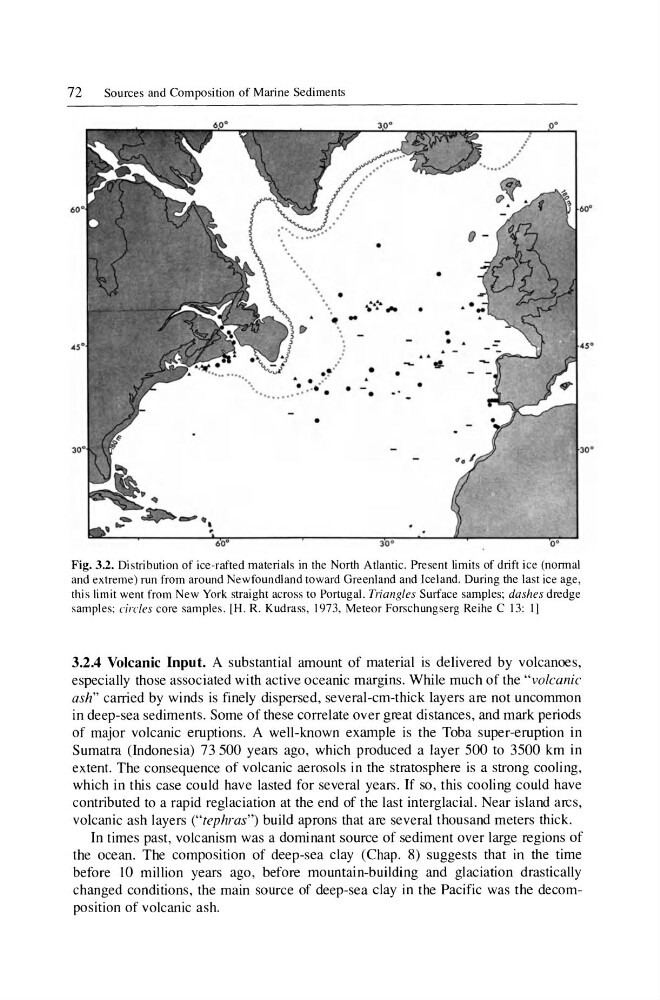
Fig. 3.2. Distribution of ice-rafted materials in the North Atlantic. Present limits of drift ice (normal
and extreme) run from around Newfoundland toward Greenland and Iceland. During the last ice age,
this limit went from New York straight acro ss lO Portugal. Triangles Surface samples; da shes dredge
samples; circles core samples. [H. R. Kudrass , 1973, Meteor Forschungserg Reihe C 13: I]
3.2.4 Volcanic Input. A substantial amount of material is delivered by volcanoes,
especially those associated with active oceanic margins. While much of the "volcanic
ash" carried by winds is finely dispersed, several-cm-thick layers are not uncommon
in deep-sea sediments. Some of these correlate over great distances, and mark periods
of major volcanic eruptions. A well-known example is the Toba super-eruption in
Sumatra (Indonesia) 73500 years ago, which produced a layer 500 to 3500 km in
extent. The consequence of volcanic aerosols in the stratosphere is a strong cooling,
which in this case could have lasted for several years. If so, this cooling could have
contributed to a rapid reglaciation at the end of the last interglacial. Near island arcs,
volcanic ash layers ("tephras") build aprons that are several thousand meters thick.
In times past, volcanism was a dominant source of sediment over large regions of
the ocean. The composition of deep-sea clay (Chap. 8) suggests that in the time
before 10 million years ago, before mountain-building and glaciation drastically
changed conditions, the main source of deep-sea clay in the Pacific was the decomposition of volcanic ash.
Sources and Composition of Marine Sediments
'.
•
'~ ..
. :
. ,
.. • ...
. ~ . . ...
•
•
. - •
Fig. 3.2. Distribution of ice-rafted materials in the North Atlantic. Present limits of drift ice (normal
and extreme) run from around Newfoundland toward Greenland and Iceland. During the last ice age,
this limit went from New York straight acro ss lO Portugal. Triangles Surface samples; da shes dredge
samples; circles core samples. [H. R. Kudrass , 1973, Meteor Forschungserg Reihe C 13: I]
3.2.4 Volcanic Input. A substantial amount of material is delivered by volcanoes,
especially those associated with active oceanic margins. While much of the "volcanic
ash" carried by winds is finely dispersed, several-cm-thick layers are not uncommon
in deep-sea sediments. Some of these correlate over great distances, and mark periods
of major volcanic eruptions. A well-known example is the Toba super-eruption in
Sumatra (Indonesia) 73500 years ago, which produced a layer 500 to 3500 km in
extent. The consequence of volcanic aerosols in the stratosphere is a strong cooling,
which in this case could have lasted for several years. If so, this cooling could have
contributed to a rapid reglaciation at the end of the last interglacial. Near island arcs,
volcanic ash layers ("tephras") build aprons that are several thousand meters thick.
In times past, volcanism was a dominant source of sediment over large regions of
the ocean. The composition of deep-sea clay (Chap. 8) suggests that in the time
before 10 million years ago, before mountain-building and glaciation drastically
changed conditions, the main source of deep-sea clay in the Pacific was the decomposition of volcanic ash.