

2 Origin and Morphology of Ocean Margins
2.1 General Features of Continental Margins
The continents are very old: they contain rocks aged thousands of millions of years.
Ultimately, they are the product of selective accumulation of low density mantle
material. Because of this low density they float on the mantle. The ocean floor, on the
other hand, is geologically young, as we have seen. The basaltic rock which forms the
ocean floor basement is rather close in composition to the mantle rock it came from.
It is slightly heavier than continental rock (largely due to its high iron content,
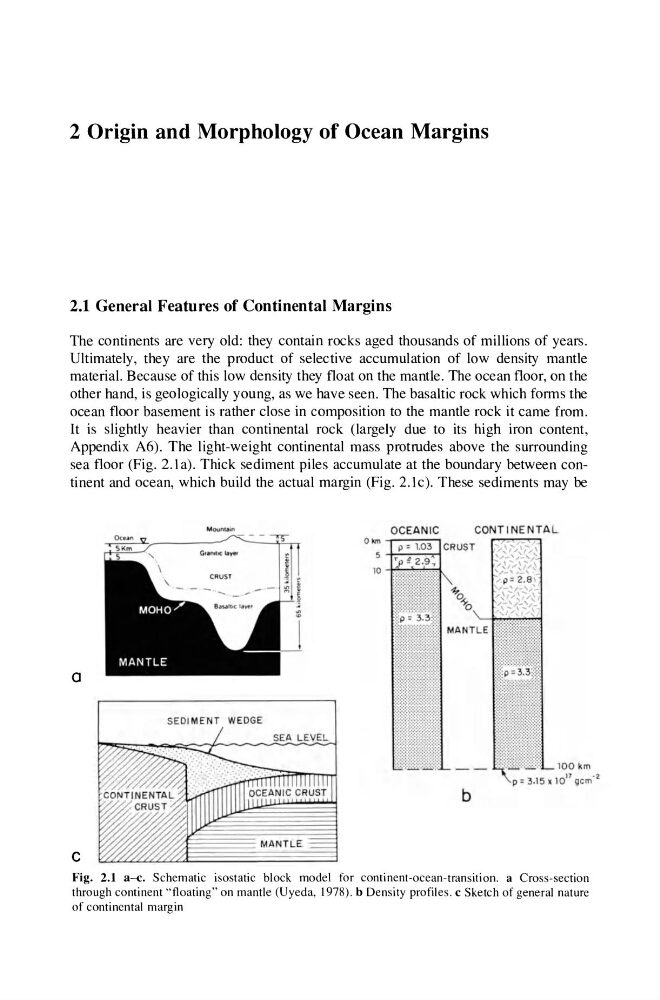
Appendix A6). The light-weight continental mass protrudes above the surrounding
sea floor (Fig. 2.1 a). Thick sediment piles accumulate at the boundary between continent and ocean, which build the actual margin (Fig. 2.1c). These sediments may be
OCEANIC
CONT I NE NTAL
Olun
p = 1.03 CRUST
t l '2Di£m ' 2g.9~110 ~,:
:\:::::)::::i:" I\
,:
. :
0
:::::::=:::},:::::,:
'S-o
) J 3: :
'----I~~~
a
SEDIMENT WEDG E
E{UFllH_ loo km
b
c
Fig. 2.1 a-c. Schematic isostatic block model for continent-ocean-transition. a Cross-section
through continent " floating" on mantle (Uyeda, 1978). b Density profiles. c Sketch of general nature
of continental margin
2.1 General Features of Continental Margins
The continents are very old: they contain rocks aged thousands of millions of years.
Ultimately, they are the product of selective accumulation of low density mantle
material. Because of this low density they float on the mantle. The ocean floor, on the
other hand, is geologically young, as we have seen. The basaltic rock which forms the
ocean floor basement is rather close in composition to the mantle rock it came from.
It is slightly heavier than continental rock (largely due to its high iron content,
Appendix A6). The light-weight continental mass protrudes above the surrounding
sea floor (Fig. 2.1 a). Thick sediment piles accumulate at the boundary between continent and ocean, which build the actual margin (Fig. 2.1c). These sediments may be
OCEANIC
CONT I NE NTAL
Olun
p = 1.03 CRUST
t l '2Di£m ' 2g.9~110 ~,:
:\:::::)::::i:" I\
,:
. :
0
:::::::=:::},:::::,:
'S-o
) J 3: :
'----I~~~
a
SEDIMENT WEDG E
E{UFllH_ loo km
b
c
Fig. 2.1 a-c. Schematic isostatic block model for continent-ocean-transition. a Cross-section
through continent " floating" on mantle (Uyeda, 1978). b Density profiles. c Sketch of general nature
of continental margin