

40 Origin and Morphology of Ocean Basins
VOLCAN IC ARC
format ion of
C?
MI D·OCEAN
SPREADING CENTER
Hi Qh T
OttBOdl e. ~
SulfI d e Oe""si'
Hydn>lherma l
;'
,~ C ircu l a t i o n
~~~~".~
(
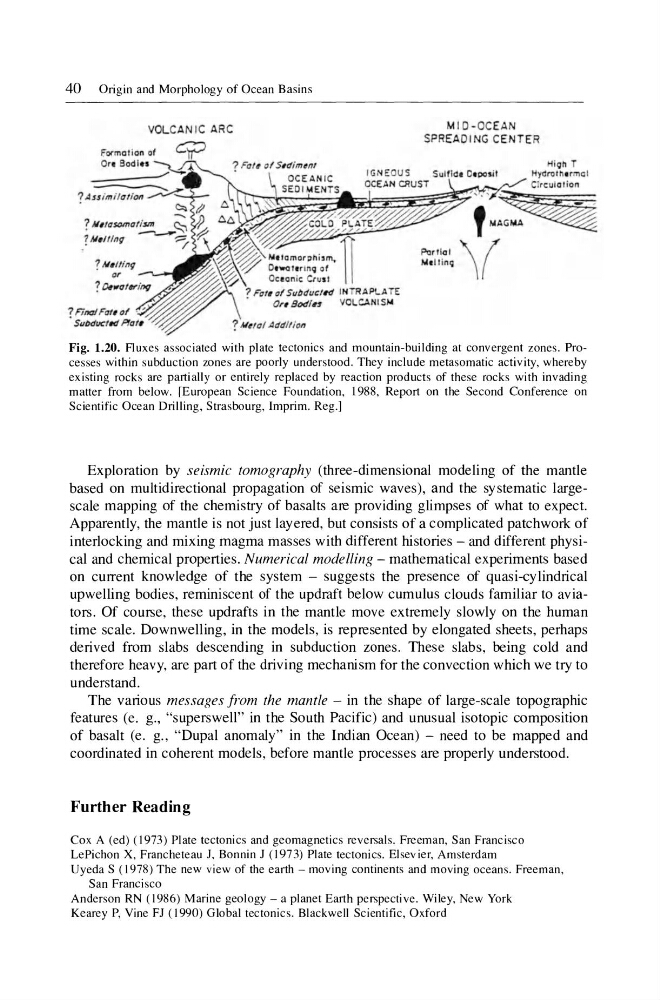
Fig. 1.20. Fluxes associated with plate tectonics and mountain-building at convergent zones. Processes within subduction zones are poorly understood. They include metasomatic activity, whereby
existing rocks are partially or entirely replaced by reaction products of these rocks with invading
matter from below. [European Science Foundation, 1988, Report on the Second Conference on
Scientific Ocean Drilling, Strasbourg, Imprim. Reg.]
Exploration by seismic tomography (three-dimensional modeling of the mantle
based on multidirectional propagation of seismic waves), and the systematic largescale mapping of the chemistry of basalts are providing glimpses of what to expect.
Apparently, the mantle is not just layered, but consists of a complicated patchwork of
interlocking and mixing magma masses with different histories - and different physical and chemical properties. Numerical modelling - mathematical experiments based
on current knowledge of the system - suggests the presence of quasi-cy Iindrical
upwelling bodies, reminiscent of the updraft below cumulus clouds familiar to aviators. Of course, these updrafts in the mantle move extremely slowly on the human
time scale. Downwelling, in the models, is represented by elongated sheets, perhaps
derived from slabs descending in subduction zones. These slabs, being cold and
therefore heavy, are part of the driving mechanism for the convection which we try to
understand.
The various messages from the mantle - in the shape of large-scale topographic
features (e. g., "superswell" in the South Pacific) and unusual isotopic composition
of basalt (e. g., "Dupal anomaly" in the Indian Ocean) - need to be mapped and
coordinated in coherent models, before mantle processes are properly understood.
Further Reading
Cox A (ed) (1973) Plate tectonics and geomagnetics reversals. Freeman, San Francisco
LePichon X, Francheteau J, Bonnin J (1973) Plate tectonics. Elsev ier, Amsterdam
Uyeda S (1978) The new view of the earth - moving continents and moving oceans. Freeman ,
San Francisco
Anderson RN (1986) Marine geology - a planet Earth perspective. Wiley, New York
Kearey P, Vine FJ (1990) Global tectonics. Blackwell Scientific, Oxford
VOLCAN IC ARC
format ion of
C?
MI D·OCEAN
SPREADING CENTER
Hi Qh T
OttBOdl e. ~
SulfI d e Oe""si'
Hydn>lherma l
;'
,~ C ircu l a t i o n
~~~~".~
(
Fig. 1.20. Fluxes associated with plate tectonics and mountain-building at convergent zones. Processes within subduction zones are poorly understood. They include metasomatic activity, whereby
existing rocks are partially or entirely replaced by reaction products of these rocks with invading
matter from below. [European Science Foundation, 1988, Report on the Second Conference on
Scientific Ocean Drilling, Strasbourg, Imprim. Reg.]
Exploration by seismic tomography (three-dimensional modeling of the mantle
based on multidirectional propagation of seismic waves), and the systematic largescale mapping of the chemistry of basalts are providing glimpses of what to expect.
Apparently, the mantle is not just layered, but consists of a complicated patchwork of
interlocking and mixing magma masses with different histories - and different physical and chemical properties. Numerical modelling - mathematical experiments based
on current knowledge of the system - suggests the presence of quasi-cy Iindrical
upwelling bodies, reminiscent of the updraft below cumulus clouds familiar to aviators. Of course, these updrafts in the mantle move extremely slowly on the human
time scale. Downwelling, in the models, is represented by elongated sheets, perhaps
derived from slabs descending in subduction zones. These slabs, being cold and
therefore heavy, are part of the driving mechanism for the convection which we try to
understand.
The various messages from the mantle - in the shape of large-scale topographic
features (e. g., "superswell" in the South Pacific) and unusual isotopic composition
of basalt (e. g., "Dupal anomaly" in the Indian Ocean) - need to be mapped and
coordinated in coherent models, before mantle processes are properly understood.
Further Reading
Cox A (ed) (1973) Plate tectonics and geomagnetics reversals. Freeman, San Francisco
LePichon X, Francheteau J, Bonnin J (1973) Plate tectonics. Elsev ier, Amsterdam
Uyeda S (1978) The new view of the earth - moving continents and moving oceans. Freeman ,
San Francisco
Anderson RN (1986) Marine geology - a planet Earth perspective. Wiley, New York
Kearey P, Vine FJ (1990) Global tectonics. Blackwell Scientific, Oxford